


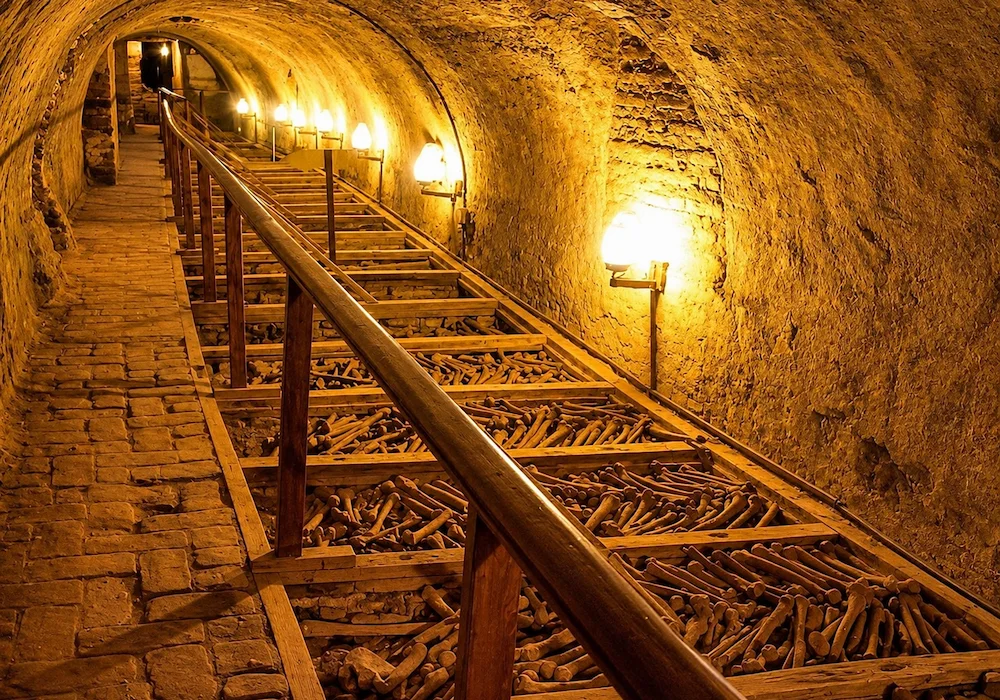
Beneath the gilded altarpieces, baroque naves, and quiet cloisters of the Basilica and Convent of San Francisco of Assisi lies South America's most astonishing subterranean burial ground: the Catacombs of Lima. Built during the mid-17th century as communal burial crypts for colonial parishioners and Catholic guilds, these stone, brick, and calicanto limestone galleries hold the skeletal remains of over 25,000 individuals interred before 1808. Rediscovered in the early 20th century, the catacombs stand today as one of Peru's most compelling cultural and anthropological attractions, fascinating travelers worldwide with their massive 10-meter-deep ossuary wells, earthquake-damping architectural engineering, and enduring legends of secret escape tunnels linking the convent to the Viceregal Palace and the Holy Inquisition.
01 Historical Origins: The City of the Dead Beneath Colonial Lima
For more than two centuries of Spanish viceregal rule, the capital of the Viceroyalty of Peru possessed no open-air public cemeteries. Between the founding of Lima in 1535 and the first hygiene reforms of the early 19th century, colonial society was deeply convinced that the physical proximity of the deceased body to sacred altars and saints' relics ensured a faster and more pious voyage through purgatory into eternal glory. For this profound theological reason, Catholic churches and convents operated as genuine subterranean necropolises.
Under the direction of the Franciscan Order, which settled in Lima in 1546 along the fertile banks of the Rímac River, an extensive network of communal underground galleries, crypts, and vaults was constructed beneath the main basilica and adjacent chapels of San Francisco of Assisi, the Chapel of Solitude, and the Chapel of the Miracle. Over generations, Lima residents across every social class—from wealthy encomenderos and titled Spanish aristocrats to indigenous guilds and Afro-Peruvian religious brotherhoods (cofradías)—purchased the right to eternal rest beneath the temple floor.
Religious Guilds (Cofradías)
Each colonial guild (silversmiths, shoemakers, free Afro-Peruvians) maintained an assigned burial vault in the convent subsoil to hold communal funerals for its members.
Crypts for Wealthy Benefactors
Affluent colonial families funded altarpieces, paintings, and church additions in exchange for perpetual family burial niches placed directly in front of the high altar.
The Sanitary Ban of 1808
Overcrowding and airborne disease concerns prompted Viceroy Fernando de Abascal to outlaw intra-mural church burials in 1808, opening Lima's Presbítero Maestro Cemetery.
Historical estimates indicate that between 1560 and 1808, over 25,000 individuals were interred across these galleries. Following their official closure, the entryways were covered with quicklime and compacted soil, remaining hidden until ecclesiastical and archaeological teams reopened the chambers in 1947 for anthropological documentation and public viewing.
02 Crypt Architecture: Brick Vaults, Calicanto Mortar & Seismic Resilience
Descending down the stone staircases that lead from the convent's main cloister reveals a masterpiece of colonial engineering. Unlike Roman or Parisian catacombs, which were hollowed out of abandoned underground limestone quarries, the San Francisco Catacombs of Lima are a planned architectural brick-and-mortar masonry construction.
The thick supporting walls and arches are built from kiln-fired clay bricks bonded with calicanto, an ancient mortar blend of slaked lime, volcanic river sand, and smooth pebbles. Colonial records note that sea bird egg whites from coastal guano islands were frequently added to the mixture to enhance elasticity and weatherproofing. This massive underground vault system served a vital double purpose: bearing the tremendous structural load of the basilica's twin bell towers, while effectively dissipating seismic shockwaves.
The Seismic Shock Absorber that Preserved San Francisco
The catastrophic earthquakes of 1687 and 1746 flattened almost all of viceregal Lima, demolishing churches, palaces, and homes. However, San Francisco Basilica remained remarkably intact because its vast underground barrel-vaulted crypts functioned as an elastic structural damper, absorbing ground vibrations and enabling the church walls above to flex rather than snap.
Throughout the passages, visitors observe ribbed groin vaults and tubular ceiling vents that rise to the surface courtyards, providing constant air circulation and dampness control—a remarkably modern ventilation strategy for 17th-century Latin America.
03 Communal Pits & Ossuaries: The Symbolic Organization of Skeletal Remains
The most visually striking aspect of the catacombs tour is the sight of the deep ossuary wells. Originally, deceased persons were wrapped in plain linen shrouds, dusted with quicklime layers to accelerate organic decomposition and prevent odors, and laid horizontally in stacked tiers inside communal chambers.
As decades elapsed and flesh dissolved leaving only clean bones, Franciscan brothers performed secondary exhumations: long bones and skulls were gathered and transferred to deep central pits, clearing wall niches for subsequent interments.
The Famous 10-Meter Ossuary Well
At the central crossing of two main subterranean galleries sits a massive cylindrical pit plunging ten meters down into the earth. During scientific restoration in 1953, human remains were sorted by bone type: femurs and tibias were laid in radiating geometric spokes, while skulls formed concentric outer rings, creating a poignant baroque Memento Mori reminding travelers of mortality and human equality.
Despite the dramatic visual atmosphere, the tour proceeds with reverence and dignity. Knowledgeable guides emphasize the spiritual purpose of these sacred grounds, where class distinctions faded in death and where lamplight illuminates an extraordinary chapter of viceregal physical anthropology.
04 Urban Legends: Secret Underground Tunnels to the Palace & Inquisition
Few places in Downtown Lima have inspired as many mysterious folk legends and eerie ghost stories as the San Francisco crypts. For decades, popular lore insisted that the catacombs were merely the entrance to an extensive secret tunnel network linking the viceroyalty's power centers.
The Popular Legend
Urban myths claimed secret military passageways linked San Francisco directly to the Government Palace, the Court of the Inquisition, the Cathedral of Lima, and even the Real Felipe Fortress in Callao.
Archaeological Reality
Modern excavations by archaeologists from the Ministry of Culture and Prolima proved these were not long-distance military conduits, but sections of pre-Hispanic irrigation canals (such as the Huatica canal), colonial stormwater culverts, and private Franciscan service corridors.
Stories of wandering spectral friars and phantom voices add an intriguing layer to Lima's nighttime folklore, though the true appeal of the site remains its extraordinary architectural and historical authenticity.
05 Comparison Guide: Lima Catacombs vs. Other Historic Burial Sites
To contextualize the historical significance of San Francisco's crypts, this comparative table contrasts Lima's main historic burial sites with an international benchmark:
| Historic Site | Period of Use | Estimated Burials | Key Architectural Feature | Visitor Experience |
|---|---|---|---|---|
|
Landmark San Francisco Catacombs |
1560 – 1808 | 25,000+ individuals | 10m deep circular ossuary & seismic calicanto vaults | Daily guided tour included with museum ticket |
| Lima Cathedral Crypts | 1540 – 1808 | Archbishops & high nobility | Francisco Pizarro's tomb & mosaic crypt | Part of Cathedral & Religious Art Museum |
| Presbítero Maestro Cemetery | 1808 – Present | 300,000+ individuals | Heroes' Crypt & Carrara marble mausoleums | Daytime & nighttime cultural tours |
| Paris Catacombs (France) | 1786 – 1860 | 6,000,000+ individuals | Kilometric subterranean limestone quarry galleries | Self-guided tour with timed entry audio guide |
06 Visitor Regulations, 2026 Admission Prices & Opening Hours
To ensure a smooth, respectful, and well-planned visit to San Francisco Convent and its underground crypts, review these practical details updated for 2026:
2026 Admission Fees & Hours
- Operating Hours: Monday through Sunday, 9:00 AM to 8:00 PM (last entry at 7:30 PM).
- Adult Admission: S/ 20.00 (includes guided entry to cloisters, ancient library, choir, and catacombs).
- University Students: S/ 10.00 (with valid student identification card).
- Schoolchildren: S/ 5.00.
- Tour Duration: Approximately 45 to 60 minutes led by resident museum guides.
Photography Rules
To preserve sacred dignity and historical artifacts, photography and flash videos are strictly prohibited within the catacombs and ancient library.
Flat Walking Shoes
Historic brick passages and worn stone steps can be slightly uneven. Flat, comfortable sneakers with rubber soles are highly recommended.
Accessibility Notice
Because of narrow 17th-century stone stairwells, underground crypt access cannot accommodate wheelchairs or strollers.
07 Experience the Catacombs with Lima Tour Peru's Colonial City Tour
To fully appreciate how the Catacombs weave into the larger historical tapestry of the "City of the Kings," the optimal way to visit is as part of an expertly curated colonial downtown circuit.
With Lima Tour Peru, an official inbound operator accredited by MINCETUR and PROMPERU of the RAP Travel Peru group, our Colonial & Modern Lima City Tour delivers a stress-free experience: climate-controlled private pickup from Miraflores or San Isidro, pre-arranged priority admission without ticket lines, and certified bilingual art-history guides.
Colonial Lima City Tour & San Francisco Catacombs
Comprehensive guided tour covering Main Square, Cathedral, San Francisco Catacombs, and modern Miraflores with private transport.
Half Day · Daily DeparturesCustom Private Lima Cultural Excursion
Tailor your historical exploration of downtown palaces and underground crypts with an exclusive private vehicle and flexible scheduling.
Custom QuoteFor private bookings or tailored cultural itineraries across Lima, connect directly with our travel specialists through our Contact Us page or via WhatsApp.
Recommended reads: San Francisco Convent Museum · Lima Cathedral & Pizarro's Tomb · Plaza Mayor of Lima.
08 Frequently Asked Questions
How many people were buried in the San Francisco Catacombs?
Historical records estimate between 25,000 and 30,000 people were buried across these underground crypts from the mid-17th century until 1808, when Viceroy Fernando de Abascal inaugurated the Presbítero Maestro General Cemetery and prohibited church interments.
Why are the bones arranged in circular and geometric patterns?
During archaeological restoration and cataloging in the 1950s, anthropologists organized and classified long bones (femurs, tibias) and skulls in concentric circles within deep wells to optimize preservation, airflow, and a respectful educational display.
Is it claustrophobic or hazardous to go down into the catacombs?
The corridors are relatively spacious, well-ventilated through original colonial shafts, and equipped with subtle lighting and safe handrails. However, individuals with severe claustrophobia should be aware that it is an enclosed subterranean vault environment with arched ceilings of 2.2 to 2.5 meters.
Are the catacombs truly connected to the Government Palace?
This is one of Lima's most cherished urban myths. While there were subterranean water canals, drainage culverts, and service passages between convent buildings, archaeological evidence has found no walkable secret military tunnels directly connecting to the Government Palace.
Can you enter the catacombs independently without a guide?
No, admission to the crypts and the Convent Museum requires an authorized guided visit to preserve historical heritage and ensure visitor safety. On Lima Tour Peru's Colonial City Tour, a private expert guide leads your complete exploration with pre-arranged skip-the-line entry.