

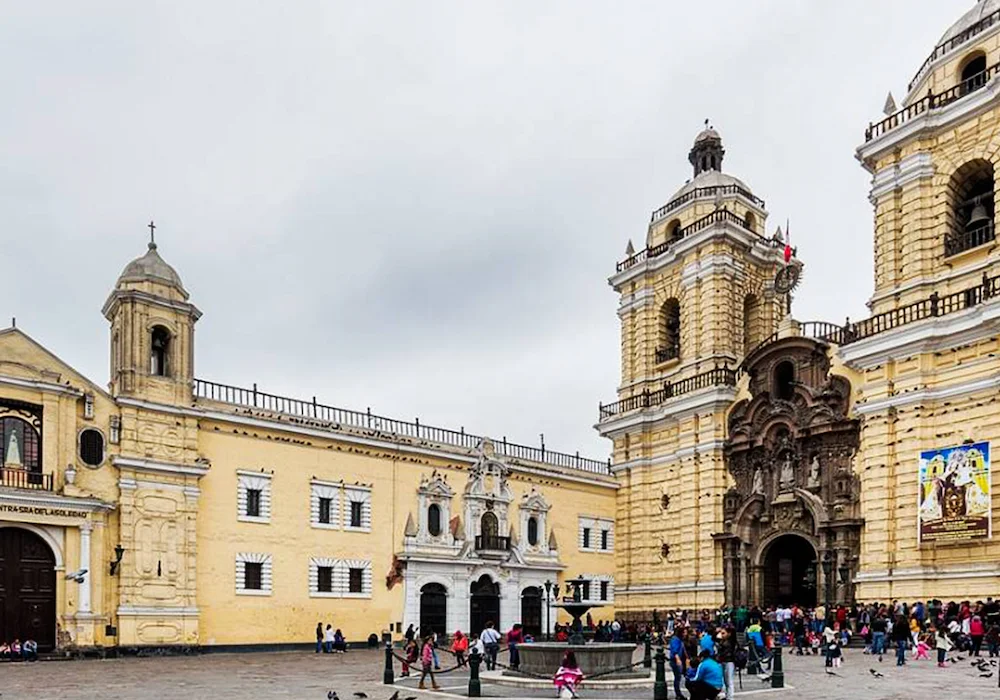
Designated a UNESCO World Heritage Site in 1991, the Monumental Complex of San Francisco of Assisi in Lima stands as the undisputed pinnacle of viceregal religious architecture in Peru and one of the grandest Franciscan monasteries in the Americas. Founded in 1546 along the historic banks of the Rímac River, this vast ecclesiastical enclave is celebrated for its ornate Churrigueresque baroque carved stone facade, an extraordinary Mudejar dome intricately assembled from Nicaraguan cedar, peaceful cloisters lined with genuine 1620 Sevillian glazed tiles, and one of the world's most valuable monastic libraries, safeguarding over 25,000 rare incunabula, Flemish atlases, and hand-illuminated choral manuscripts preserved through four turbulent centuries of earthquakes and revolutions.
01 History & Foundation: The Crown Jewel of Lima Viceregal Baroque
Just two blocks east of Lima's Plaza Mayor (Main Square) stands the most revered and architecturally harmonious religious complex of colonial South America: the Monumental Complex and Basilica of San Francisco of Assisi (locally known as San Francisco el Grande). Inscribed on the UNESCO World Heritage List in 1991 as an anchor of Historic Downtown Lima, this sanctuary served not only as the spiritual headquarters for the Franciscan Order across the Southern Cone, but also as one of the most affluent and culturally influential ecclesiastical foundations of the Spanish Empire.
The Franciscan arrival dates back to 1546 when pioneering friars received prime land bordering the Rímac River. However, the magnificent baroque monument we admire today emerged from a monumental reconstruction following the devastating earthquake of 1655. Directed by the visionary commissary general Father Luis de Cervela and masterminded by Portuguese architect Constantino de Vasconcellos along with master builder Manuel de Escobar, the basilica was solemnly inaugurated in October 1672, establishing the gold standard of viceregal baroque architecture in Peru.
Consecrated in 1672
Engineered on massive calicanto stone foundations, the basilica survived largely unscathed through the catastrophic earthquakes of 1687 and 1746 that flattened downtown Lima.
UNESCO Heritage Site
Its singular architectural layout blends European high baroque ornament with Moorish Mudejar carpentry and local Andean quincha (reed and plaster) vaulting.
Colonial Intellectual Hub
The monastery housed celebrated humanists, chroniclers, and linguists who authored the earliest grammars and dictionaries of native Quechua and Aymara tongues.
02 Monumental Architecture: Stone Portal & the Mudejar Cedar Dome
The facade of San Francisco Basilica is one of the most celebrated sculpted stone compositions in Latin America. Carved from gray quarry stone extracted from the nearby San Cristóbal hill and coastal river valleys, it showcases a dramatic three-tiered retablo-facade articulated with rusticated Corinthian columns, niches holding statues of the Immaculate Conception and Franciscan saints, and an ornate carved wooden central balcony.
Flanking this stone centerpiece are twin 33-meter-tall bell towers, dressed in historic viceregal golden-yellow plaster, crowned with octagonal belfries and soaring pyramidal spires that grace the capital's skyline.
The Breathtaking Mudejar Carved Cedar Dome
Ascending the grand stone staircase to the upper choir and monastic library, visitors are greeted by an awe-inspiring Moorish-style Mudejar artesonado dome, completed in 1625 by master craftsman Friar Diego Gómez. Hand-carved entirely from imported Nicaraguan cedar beams joined through intricate interlocking geometric strapwork without a single iron nail, this structural wonder—reminiscent of the Alhambra palaces in Granada—flexed harmoniously through four centuries of powerful earth tremors.
In the upper choir, the magnificent cedar choir stalls feature 130 seats exquisitely carved with bas-reliefs of saints, prophets, and martyrs, centered around a gargantuan revolving four-sided wooden lectern that once held colossal hand-illuminated parchment choral books.
03 The Ancient Monastic Library: 25,000 Rare Volumes & Incunabula
Widely regarded as one of the world's most evocative historical libraries, the San Francisco Monastic Library immediately immerses travelers in a mystical scholarly atmosphere reminiscent of Umberto Eco's medieval mystery The Name of the Rose.
Its two soaring stories of floor-to-ceiling carved cedar bookcases, accessed via wooden balconies and rolling ladders, preserve an irreplaceable collection of approximately 25,000 volumes printed between the 15th and 18th centuries. Within this sanctuary of colonial knowledge rest treatises on scholastic theology, canon law, botany, pharmacology, navigation, astronomy, and sacred choral polyphony.
Priceless Volumes Preserved in the Library
- 15th-Century Incunabula: Extremely rare movable-type books printed before the year 1500 from the early printing presses of Venice, Nuremberg, and Basel.
- Antwerp Polyglot Bible (1572): A masterpiece commissioned by King Philip II of Spain and produced by printer Christophe Plantin, printed in Hebrew, Aramaic, Greek, Latin, and Syriac.
- First Quechua-Spanish Dictionary (1560): The foundational grammatical work authored by Dominican friar Domingo de Santo Tomás.
- Hand-Tinted Atlases by Mercator & Ortelius: World maps charting the early European trade routes across the Americas and the Pacific.
The library maintains controlled temperature and gentle diffused light to safeguard rag paper, gold-leaf lettering, and original sheepskin and calfskin bindings, meaning interior photography is strictly prohibited.
04 The Main Cloister: 1620 Sevillian Glazed Tiles & Zurbarán Art
The contemplative pulse of Franciscan monastic life centers on the peaceful Main Cloister, a two-story quadrangular arcade of rounded arches supported by calicanto pillars. In the center of the courtyard, an octagonal bronze fountain cast in 1673 gurgles softly, offering an oasis of calm right in the middle of historic downtown Lima.
The perimeter wainscoting along the four cloister walkways is decorated with the finest collection of 17th-century Sevillian glazed tiles (azulejos) in the Americas. Custom-manufactured in the pottery district of Triana (Seville) between 1620 and 1643, these more than 4,000 polychrome ceramic tiles exhibit floral arabesques, mythical beasts, bird figures, and coat-of-arms heraldry representing colonial benefactors.
The Life of Saint Francis Painted Canvas Cycle
Mounted above the tile work is an acclaimed cycle of large-scale oil canvases depicting the life and miracles of Saint Francis of Assisi. Completed around 1670 by artists influenced by master Francisco de Zurbarán and Rubens, the paintings are celebrated for dramatic tenebrist lighting, coarse burlap robe textures, and poignant facial expressions.
05 Comparison Guide: Key Architectural Spaces & Artistic Treasures
To orient your visit and help you appreciate the complex's most valuable artistic highlights, here is a structured overview of San Francisco Convent's landmark spaces:
| Architectural Space | Period / Year | Artistic Style | Defining Landmark Feature | Heritage Significance |
|---|---|---|---|---|
| Stone Facade & Twin Towers | 1672 | Churrigueresque Baroque | Carved gray stone portal & octagonal bell spires | The visual icon of Historic Downtown Lima |
| Grand Staircase Mudejar Dome | 1625 | Hispano-Moorish Mudejar | Mortise-and-tenon cedar carpentry without nails | Unique in South America for its preservation |
|
Landmark Monastic Library |
16th – 18th Century | Viceregal Baroque | 25,000 rare books, incunabula & Antwerp Bible | One of the most valuable historic libraries on Earth |
| Main Cloister | 1620 – 1643 | Mannerist & Sevillian | 4,000+ Triana glazed tiles & Francis life canvases | Largest colonial ceramic tile ensemble in the Americas |
| Monastic Refectory | Circa 1650 | Flemish Baroque | Last Supper canvas featuring roasted guinea pig | Prime example of cultural syncretism in colonial art |
| Underground Catacombs | 1560 – 1808 | Calicanto Vault Engineering | Deep ossuary pits & over 25,000 burials | Peru's most famous subterranean historic burial vault |
06 The Refectory & the Iconic Andean "Last Supper" with Guinea Pig
The ancient dining hall (refectory) of the Franciscan friars preserves one of the most culturally fascinating paintings in all of viceregal South America: the massive Last Supper attributed to the workshop of Flemish Jesuit master Diego de la Puente (active in Lima during the mid-17th century).
Unlike European Renaissance depictions by Leonardo or Tintoretto, this five-meter-long canvas introduces an audacious local adaptation of the biblical Passover meal. Spread upon the white tablecloth, directly in front of Christ and his twelve disciples, rests a platter bearing a crisp roasted guinea pig (cuy), a ceremonial delicacy of ancient Andean civilization.
The Guinea Pig as Sacrificial Lamb
The traditional biblical lamb was replaced with the Andean guinea pig so newly baptized indigenous converts could easily connect Christ's sacrifice with native ritual offerings.
Native Andean Crops
The table also showcases yellow ají chili peppers, native potatoes, and tropical coastal fruits nestled alongside unleavened bread and Spanish colonial wine carafes.
The Portrait of Judas
At the table's edge, Judas Iscariote clutches the bag containing thirty silver coins, breaking the fourth wall to stare directly at the viewer with an unsettling, malevolent gaze.
The refectory also displays portrait series of the twelve apostles and Christian martyrs painted by disciples of legendary master Bartolomé Esteban Murillo.
07 Practical Info, 2026 Ticket Fees & Lima Tour Peru City Tour
San Francisco Monumental Complex is situated at the corner of Jirón Lampa and Jirón Ancash, in the atmospheric Plazuela San Francisco of Downtown Lima. Here is essential visitor information updated for 2026:
2026 Hours & Admission Pricing
- Opening Hours: Monday through Sunday (including national holidays) from 9:00 AM to 8:00 PM.
- General Adult Ticket: S/ 20.00 (includes full guided circuit: cloisters, library, chapter hall, and catacombs).
- Student Ticket: S/ 10.00 (with valid higher education ID card).
- Schoolchildren: S/ 5.00.
- Masses in the Basilica: Monday through Saturday at 7:00 AM, 8:00 AM, and 7:00 PM; multiple morning masses on Sundays.
To enjoy an enriching, stress-free cultural outing without worrying about Lima's traffic or ticketing queues, book the Colonial & Modern Lima City Tour with Lima Tour Peru. We provide private climate-controlled hotel pickups, priority entrance tickets, and certified professional guides passionate about Peru's viceregal heritage.
Colonial Lima City Tour & San Francisco
Visit the Main Square, Lima Cathedral, San Francisco Ancient Library, and Catacombs with private hotel transport.
Half Day · Daily DeparturesTailored Viceregal Heritage Excursion
Design a customized private itinerary exploring downtown baroque convents, aristocratic palaces, and art galleries.
Custom QuoteFor private bookings or tailored cultural itineraries across Lima, connect directly with our travel specialists through our Contact Us page or via WhatsApp.
Related articles: Lima Catacombs Guide · Archbishop's Palace of Lima · Best Museums in Lima Guide.
08 Frequently Asked Questions
When was the current San Francisco complex constructed?
Although the Franciscan Order arrived in 1546, most of the monumental structures standing today were rebuilt following the 1655 earthquake under the direction of Father Luis de Cervela and Portuguese architect Constantino de Vasconcellos, culminating in a grand consecration in 1672.
Why is the San Francisco Convent library so world-famous?
It safeguards over 25,000 priceless historical volumes, including 15th-century incunabula (books printed before 1500), the renowned Antwerp Polyglot Bible (1572), world atlases by Mercator and Ortelius, and early colonial theological manuscripts written in Quechua and Aymara.
Why does the Last Supper painting show a guinea pig served on the table?
The monumental canvas painted by the Flemish master Diego de la Puente incorporates a roasted guinea pig (cuy), native chili peppers, and Andean potatoes—an intentional iconographical syncretism used by colonial missionaries to make the biblical scene culturally relatable to indigenous Peruvians.
Are photos allowed inside the museum and ancient library?
Photography is permitted in the open-air central cloister courtyard and exterior public square. However, photography is strictly prohibited inside the ancient library, art galleries, and underground catacombs to preserve fragile historic pigments and maintain reverence.
What is the difference between visiting just the catacombs and the full museum?
The admission ticket to San Francisco Convent is an all-inclusive single pass: authorized guides lead visitors through the tile-lined cloisters, the Mudejar dome, chapter hall, choir stalls, historic library, and finally down into the underground catacomb chambers.