


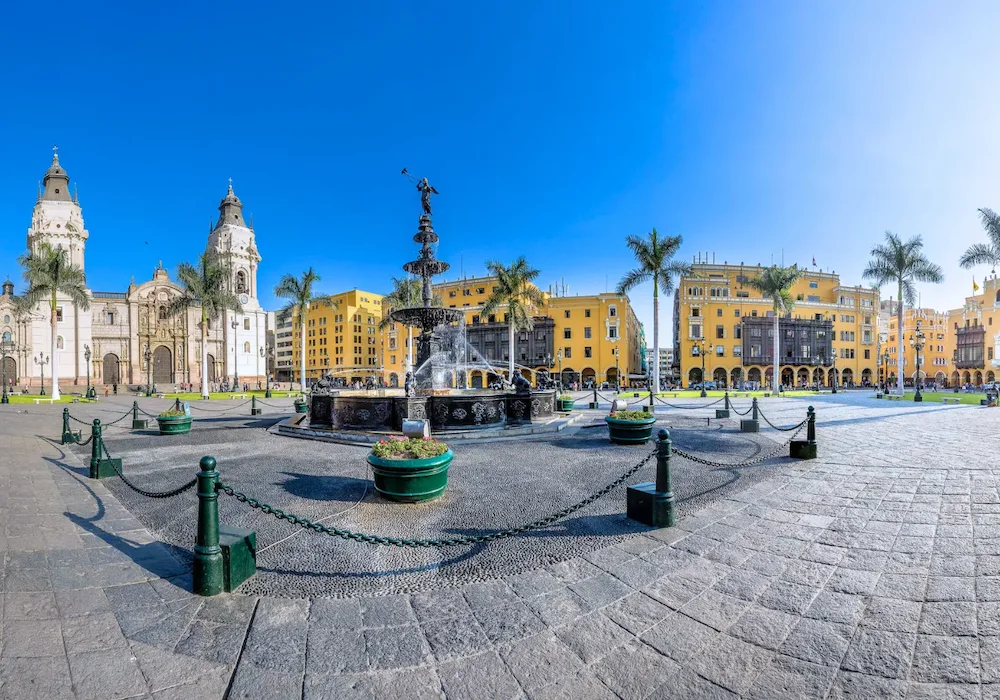
Few civic squares in the Americas concentrate as much living history, dramatic grandeur, and sovereign authority as the Plaza Mayor of Lima (also known as Plaza de Armas). Established on January 18, 1535, by Francisco Pizarro upon the ancestral domain of Indigenous chieftain Taulichusco, this square served for nearly three centuries as the undisputed administrative, spiritual, and commercial heart of the Spanish Empire's wealthiest American viceroyalty. Witness to General José de San Martín's proclamation of Peruvian Independence in 1821, Inquisition autos-da-fé, and vibrant viceregal fiestas, it is now an impeccably pedestrianized UNESCO World Heritage landmark. In this comprehensive guide, we unveil its ancestral roots, the architectural secrets of its four governing palaces, precise times for the Government Palace Changing of the Guard, and expert visitor advice.
01 From Taulichusco to Francisco Pizarro: The 1535 Foundation
Long before Spanish conquistadors reached the Pacific coast, the fertile Rímac River Valley nurtured a flourishing network of indigenous civilizations interconnected by multi-millennial irrigation canals. Upon the exact ground where the Plaza Mayor of Lima stands today stood the residence of chieftain Taulichusco, ruler of the Lower Rímac under the Inca Empire. His adobe administrative compound oversaw agricultural networks feeding central coastal lordships.
On January 18, 1535, Francisco Pizarro chose this strategic site to establish the «City of the Kings» (Ciudad de los Reyes). The location offered abundant fresh water from the river, fertile agricultural bottomlands, a mild coastal climate, and a prudent distance of two leagues (approximately 12 km) from the natural seaport of Callao, shielding the settlement from immediate pirate raids while securing direct maritime communications with Panama and Spain.
The Grid Plan and the Four Strategic Plots
Using surveyor cord and stakes, Pizarro delineated a square plaza measuring 140 meters per side (nearly two hectares in total area), subdividing the surrounding blocks into four equal quarters. The northern perimeter was reserved for the Governor's Residence (today's Government Palace), the east for the cathedral church (now the Lima Cathedral and Archbishop's Palace), the west for the municipal council, and the south for commercial porticos and residences of senior conquistadors.
Across three centuries of Spanish viceregal rule, the Plaza Mayor served as far more than an ornamental esplanade: it operated as an open-air market, temporary bullring for royal coronation celebrations, and solemn tribunal for autos-da-fé orchestrated by the Holy Office of the Inquisition. Across its four corners on July 28, 1821, General José de San Martín officially proclaimed Peruvian Independence to an exultant crowd.
02 The 1651 Bronze Fountain: The Square's Oldest Standing Landmark
At the exact epicenter of the esplanade stands the oldest intact architectural monument on the entire Plaza Mayor: its celebrated 1651 cast bronze fountain. Before its erection, a rustic stone basin installed in 1578 by Viceroy Francisco de Toledo supplied fresh water to Lima's citizenry via subterranean aqueducts fed by the Rímac River.
To bestow upon the viceregal capital a fountain commensurate with its imperial status, Viceroy García Sarmiento de Sotomayor, Count of Salvatierra, commissioned master foundryman Antonio de Rivas to forge a monumental bronze masterpiece. The fountain was inaugurated amid festive civic celebrations on September 8, 1651:
Three Cascading Basins
Constructed with three tiers of octagonal basins adorned with leonine spouts and cherub watercasters that channel continuous water into a finely finished colonial reservoir.
The Angel of Fame
At the pinnacle stands the winged figure of Fame blowing a trumpet with her right hand and grasping in her left the standard bearing the imperial coat of arms of Lima and Castile.
Surviving Three Centuries of Tremors
Having weathered destructive earthquakes in 1687, 1746, and 1940, the fountain remains the only 17th-century structure still standing continuously in its original foundational position.
Surrounding the fountain, manicured floral gardens, royal palms, and wrought-iron republican lamp posts provide a peaceful setting to pause and admire the surrounding colonial skyline.
03 The Four Seats of Power: Government Palace, Cathedral, Archdiocese & City Hall
Taking a 360-degree panorama of the Main Square reveals the physical manifestation of the governing forces that shaped Peruvian civilization across five centuries. Each facade guards treasures of extraordinary heritage:
Government Palace (North Side)
Known as the House of Pizarro, this is the official seat of the Executive Branch and presidential residence. Its French neobaroque facade dates to 1938, housing the Golden Hall and the Honor Courtyard.
Lima Metropolitan Cathedral (East Side)
Primate cathedral of Peru featuring Renaissance stone portals and neoclassical towers. It guards the funeral chapel and tomb of Francisco Pizarro, 17th-century carved choir stalls, and subterranean crypts.
Archbishop's Palace (East Side)
Neocolonial palace completed in 1924, renowned for its ornate enclosed balconies hand-carved in cedar, imperial mahogany staircase, and exquisite sacred art museum.
Municipal Palace / City Hall (West Side)
Seat of metropolitan government, designed in French neoclassical style with ground-floor arcades. It houses the Municipal Library and the original 1821 Peruvian Declaration of Independence.
Completing the perimeter are the colonial Scribes' and Haberdashers' Porticoes (south and west sides), featuring cheerful yellow arched galleries home to traditional coffee houses and jewelry shops.
04 The Changing of the Guard: Schedule, Protocol & Military Pageantry
The daily highlight that gathers enthusiastic crowds around the Main Square is the Changing of the Guard at the Government Palace. This ceremonial military spectacle stands among the most vibrant and photographic civic traditions in South America.
The ceremony unfolds within the palace's expansive Honor Courtyard immediately behind ornate iron railings, just paces from onlookers on the pedestrian esplanade:
Held daily, Monday through Sunday. The spectacle begins promptly between 11:45 AM and 12:00 PM, lasting approximately 20 to 25 minutes. Arriving by 11:30 AM ensures unobstructed front-row viewing along the perimeter railing.
Guard mounting is executed by the «Marshal Domingo Nieto» Cavalry Regiment (dressed in gala red-and-blue Napoleonic-era dragoon uniforms) or the historic «Junin Hussars» with polished dress sabers.
Accompanied by the Farándola marching band, the soldiers execute synchronized drills while playing rousing military marches alongside iconic Peruvian folk songs like «El Cóndor Pasa» and coastal marineras.
05 The Square by Day & by Night: Architectural Illumination & Ambiance
The ambiance of the Main Square shifts captivatingly with the time of day. Under daylight, the plaza bustles with civic vitality: school groups on heritage tours, traditional photographers, international travelers, and local pedestrians strolling along Jirón de la Unión under Lima's mild coastal skies.
As twilight arrives, however, the plaza takes on an enchanting fairy-tale quality thanks to the architectural warm-LED illumination installed across the perimeter. The cedar balconies of the Archbishop's Palace, the baroque towers of the Cathedral, and the yellow arches of the porticoes glow in golden tones that reflect in the central fountain's waters.
Lima by Night: Golden Hour Magic
Strolling across the illuminated square after 06:30 PM offers tranquility and mild temperatures. Many travelers pair an evening plaza walk with dinner in restored colonial mansions nearby or continue to the dazzling Magic Water Circuit.
06 Practical Tips: Safety, Best Timing & Pedestrian Access
To ensure your journey around Lima's Main Square is smooth, completely safe, and memorable, keep these insider recommendations in mind:
The entire Main Square perimeter is strictly closed to vehicular traffic. The safest pedestrian approaches are Jirón de la Unión (connecting from Plaza San Martín) and Jirón Carabaya, both thoroughly patrolled and signposted.
Due to the presence of Government Palace and City Hall, the square is one of Peru's most secure public spaces, monitored by dedicated Tourist Police officers, national police, and city surveillance cameras.
Arrive around 10:00 AM to explore the Cathedral and Archbishop's Palace, step into the square by 11:30 AM for the Changing of the Guard, and enjoy traditional Creole lunch under colonial portico cafes.
Touring involves walking over antique stone tiles and cobblestones. Wear flat walking shoes, a broad-brimmed hat, and sunscreen even during overcast coastal mornings.
07 Premier Main Square Tours & Booking with Lima Tour Peru
Visiting the Plaza Mayor alongside a certified bilingual guide unlocks hidden architectural symbolism, forgotten colonial legends, and hassle-free transfers avoiding Lima's complex city traffic:
Colonial & Modern Lima City Tour
Complete 4-hour half-day tour: Main Square, palace facades, San Francisco Monastery Catacombs, panoramic Huaca Pucllana view, and Love Park in Miraflores.
From US$ 35 per personColonial City Tour + Buffet Lunch
Extended cultural exploration through the Main Square and Historic Downtown, followed by an oceanfront Peruvian gourmet buffet at Mangos Miraflores.
From US$ 70 per personBoth shared and private experiences feature climate-controlled tourist vehicles with pickup at hotels in Miraflores, San Isidro, and Barranco, professional licensed drivers, and certified bilingual guides. Inquire today via our Contact Us page.
Explore more from our guide series: Archbishop's Palace of Lima: Balconies & Sacred Art · Lima Cathedral & Pizarro's Crypt · Historic Center of Lima Travel Guide.
08 Frequently Asked Questions about Lima's Main Square
What civic spectacles and colonial events took place historically on the Main Square?
Until the late 19th century, the square featured neither trees nor manicured gardens: it functioned as the city's open-air food market, an arena for royal bullfights honoring Spanish monarch coronations, equestrian jousting tournaments, and the somber public venue for Inquisition autos-da-fé ceremonies.
Where was the colonial pillory (picota) located and what legal authority did it represent?
The pillory (picota) was erected by Francisco Pizarro in the very center of the square as the supreme physical emblem of Spanish royal penal jurisdiction. Royal decrees were nailed upon it and convicted criminals were publicly displayed. It was permanently removed in July 1821 by order of General José de San Martín prior to declaring national independence.
How and when can travelers witness the ceremonial Sunday flag-raising ceremony?
Every Sunday morning between 08:30 AM and 09:00 AM, ceremonial detachments of the Peruvian Armed Forces, National Police, and municipal officials conduct the solemn raising of the National Flag of Peru alongside the Flag of the City of Kings. The ceremony features honorary salutes, military marching, and the National Anthem performed by the civic municipal band.
Why are the civic buildings surrounding Lima Main Square painted in a uniform yellow-ochre palette?
The color scheme reflects a strict municipal conservation ordinance enacted by PROLIMA and endorsed by UNESCO. The «Lima ochre yellow» wash with crisp white moldings evokes 18th-century traditional lime washes, restoring the harmonious chromatic balance and visual sobriety that defined Pizarro's historical grid during its architectural golden age.
Which dining balconies and rooftop terraces provide the best panoramic viewpoints over the square?
The elevated dining terraces of the Club de la Unión (western flank) and historic balconies along Pasaje Nicolás de Ribera and Pasaje Olaya house cafes and restaurants offering privileged 180-degree viewpoints over the 1651 fountain and illuminated governing palaces, ideal for sunset and evening architectural photography.