


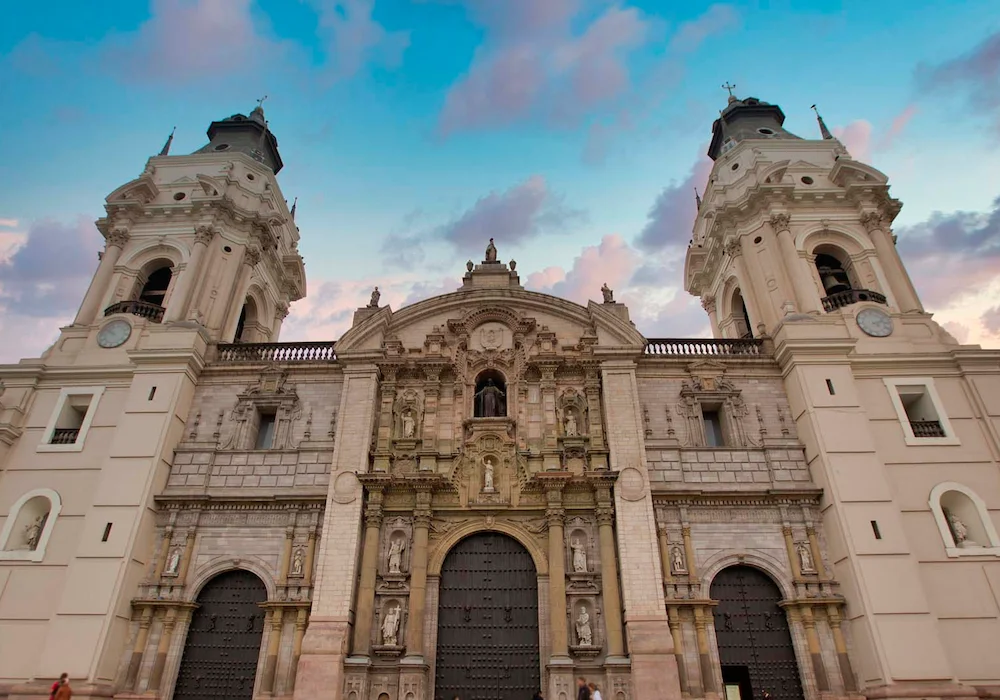
Commanding the eastern perimeter of Lima's Main Square with majestic dignity, the Lima Cathedral (officially the Metropolitan Basilica Cathedral of Saint John the Apostle and Evangelist) stands as Peru's preeminent viceregal landmark and the historical religious core of the City of Kings. Founded on January 18, 1535 by Spanish conquistador Francisco Pizarro himself, this architectural treasure has survived and evolved through catastrophic earthquakes into a breathtaking living museum. Within its nave lie the scientifically verified remains of Pizarro, one of Latin America's most magnificent Baroque choir stalls carved in cedar, fourteen ornate side chapels, and an invaluable Museum of Religious Art. This definitive travel guide delivers verified opening hours, ticket rates, historical context, and insider tips for an unforgettable visit.
01 History & Foundation: Francisco Pizarro's 1535 Cornerstone
The origins of the Lima Cathedral are deeply entwined with the birth of Peru's viceregal capital. On January 18, 1535, during the solemn founding ceremony of the City of the Kings (Ciudad de los Reyes), Spanish conquistador Francisco Pizarro personally designated the prime plot of land on the eastern flank of the Main Square to establish the mother church, dedicated to Our Lady of the Assumption. Colonial chronicles record that Pizarro himself laid the foundational stone and carried the very first mangrove timber log on his shoulders to erect the original rustic adobe structure.
Just six years later, on May 14, 1541, Pope Paul III issued the papal bull «Illius fulciti praesidio», elevating the church to cathedral status and creating the Diocese of Lima. In 1546, it was officially elevated to a Metropolitan Archdiocese, with Friar Jerónimo de Loayza consecrated as its first archbishop, establishing Lima as the preeminent ecclesiastical capital of Spanish dominion across South America.
Historical Foundation
Founded on January 18, 1535 by Francisco Pizarro. Elevated to Cathedral in 1541 by Pope Paul III and to Metropolitan See in 1546.
Seismic Engineering
After the 1746 earthquake, its Gothic vaults were rebuilt in flexible quincha and cedar, standing resilient against earthquakes for over 250 years.
UNESCO World Heritage
Inscribed as a UNESCO World Cultural Heritage site in 1991 as the spiritual and architectural core of the City of Kings.
As mining and transoceanic commerce enriched the Viceroyalty of Peru, the modest original chapel proved inadequate. In 1584, celebrated Spanish architect Francisco Becerra —who also designed the cathedrals of Cusco and Puebla— conceived a grand Renaissance basilica inspired by the cathedrals of Seville and Jaén in Spain, featuring three lofty main naves flanked by two rows of side chapels.
However, the Lima Cathedral's physical destiny was continually reshaped by the seismic tremors of Peru's central coast. Earthquakes in 1609, 1687, and most catastrophically the massive earthquake and tsunami of October 28, 1746 brought down vaults, towers, and walls. The subsequent reconstruction directed by Viceroy José Antonio Manso de Velasco (Count of Superunda) produced an ingenious colonial anti-seismic architectural solution: the towering Gothic rib vaults were rebuilt not from brittle stone, but from lightweight cedar timber and quincha (interwoven cane and mud plaster), masterfully painted to replicate carved stone. Thanks to this lightweight flexibility, the structure has survived every major tremor for over 250 years.
The cathedral's distinctive neoclassical twin bell towers, rising 48 meters (157 feet) into the skyline, were designed at the close of the 18th century by Spanish priest and architect Presbítero Matías Maestro and inaugurated between 1797 and 1798.
02 The Crypt of Francisco Pizarro & The Mystery of His Tomb
Entering the cathedral through the right-hand aisle, the first side chapel dedicated to Saint John the Baptist shelters the final resting place of Lima's founder, Francisco Pizarro González (1478-1541). The chapel walls are lavishly adorned with Venetian glass mosaics installed in the early 20th century, displaying Pizarro's personal coat of arms, the royal seal granted to Lima by Emperor Charles V in 1537, and a dramatic visual tribute to the legendary Thirteen of Gallo Island (Los Trece de la Fama).
Beyond its aesthetic grandeur, the tomb harbors one of the most intriguing forensic archaeological discoveries in South American history:
The 1977 Accidental Crypt Discovery
For nearly a century, an intact mummified body kept inside a glass casket was exhibited as Pizarro. However, in 1977 during routine crypt maintenance, workmen breached a hidden wall cavity and unearthed an engraved lead casket bearing the words: «Here is the head of the Marquis Don Francisco Pizarro who discovered and conquered the kingdoms of Peru...».
Definitive International Forensic Analysis
Between 1984 and 1985, a scientific team led by Peruvian archaeologist Dr. Hugo Ludeña and renowned American forensic anthropologist William R. Maples determined that the displayed mummy belonged to an uninjured colonial magistrate. In stark contrast, the skeleton from the lead casket bore multiple sword fractures and blade cuts across the jaw, cervical vertebrae, and arms, matching the documented assassination by the Almagrista faction on June 26, 1541.
Today, the scientifically verified remains of Francisco Pizarro rest peacefully within an imposing marble and bronze sarcophagus inside this chapel, offering an extraordinary moment of historical contemplation for travelers.
03 Pedro de Noguera's Choir Stalls & Landmark Side Chapels
Positioned prominently in the center of the main nave, facing the sanctuary, stands one of the supreme achievements of viceregal Baroque woodworking in the Western Hemisphere: the Lima Cathedral Choir Stalls. Meticulously hand-carved between 1624 and 1626 by master Sevillian sculptor Pedro de Noguera, alongside Martín Alonso de Mesa and Luis Ortiz de Vargas, this magnificent ensemble was fashioned entirely from dense Amazonian cedar.
The choir seating follows three exquisite masterworks of devotional woodworking:
Upper Stalls (53 Seats of Dignity)
Designated for the archbishop, cathedral chapter dignitaries, and senior canons. Each high-relief backrest portrays a full-length depiction of the twelve apostles, the four evangelists, church fathers, and female martyr saints framed by fluted pilasters, cherubs, and intricate floral garlands.
Lower Stalls (35 Choral Seats)
Reserved for junior chaplains, adorned with delicate Renaissance arabesques, graceful volutes, and geometric woodwork in dense cedar.
The Monumental Rotating Facistol
A massive rotating four-sided lectern carved from mahogany and cedar, upon which oversized Gregorian chant choir books illuminated on vellum parchment were displayed during choral prayer.
Flanking the lateral aisles are fourteen distinct chapels containing centuries of sacred art, devotion, and craftsmanship:
Chapel of Saint Toribio de Mogrovejo
Dedicated to Lima's second archbishop, champion of indigenous rights and patron saint of Latin American bishops. An exquisite repoussé silver urn cradles his sacred relics.
Chapel of Our Lady of Hope
Famous for the revered statue of Our Lady of Hope (Virgen de la O), venerated by expectant mothers and adorned with robes embroidered in gold bullion thread and seed pearls.
Chapel of the Christ at the Pillar
Features a striking, lifelike 17th-century Sevillian school sculpture of Christ bound to the pillar, showcasing the dramatic polychrome realism characteristic of Spanish Baroque art.
Neoclassical High Altar Baldachin
A towering Corinthian canopy designed by Matías Maestro in the early 19th century, featuring gold-leaf finishes and sculpted evangelists that replaced the earlier Baroque altarpiece.
04 The Museum of Religious Art & Cathedral Crypt Chambers
Beyond its functioning sanctuary, the cathedral houses the Museum of Religious Art of the Lima Cathedral, preserving one of the richest collections of colonial ecclesiastical treasures in South America. The self-contained museum tour leads through historically pristine chambers:
In the Chapter House (Sala Capitular), where cathedral authorities historically convened to govern ecclesiastical affairs, hangs an uninterrupted portrait gallery of all Lima's archbishops from the 16th century through modern days. Adjacent, the Great Sacristy boasts colossal cedar vestry bureaus holding gold-and-silver-threaded vestments, monumental canvas oils attributed to the Cusqueña and Limeña painting schools, and priceless silver monstrances encrusted with genuine pearls, emeralds, and rubies.
First-time visitors frequently confuse the two subterranean sites. While the renowned Catacombs of San Francisco Monastery functioned as the city's public mass cemetery until 1808 (holding over 25,000 common citizen burials in geometric bone arrangements), the subterranean crypts of the Lima Cathedral were exclusive burial vaults reserved for archbishops, viceroys, cathedral canons, and prominent noble fraternities. Both sites offer complementary insights and are seamlessly explored together on our Colonial & Modern Lima City Tour.
Descending into the cathedral crypt chambers allows travelers to inspect original 16th-century stone foundations, preserved burial vaults of historic prelates, and an atmosphere steeped in centuries of viceregal heritage.
05 Official Opening Hours, Ticket Rates & 2026 Practical Tips
To ensure smooth logistics for your visit to the Lima Cathedral, here are the verified operating guidelines for 2026:
Opening Hours
Monday to Friday: 09:00 AM to 05:00 PM.
Saturdays: 10:00 AM to 01:00 PM.
Sundays: 01:00 PM to 05:00 PM (morning Catholic mass).
Admission Fees
Cathedral + Museum Ticket: S/ 15.00 PEN (approx. US$ 4.00).
Combined Ticket: S/ 30.00 PEN (includes Archbishop's Palace next door).
Visitor Guidelines
Photography: Allowed without flash or tripods.
Dress Code: Modest attire with shoulders and knees covered as it is an active church.
On major national or Catholic feast days (such as the Independence Day Te Deum ceremony on July 28, Holy Week, or Corpus Christi), tourist visiting hours may be restricted or adjusted on short notice due to liturgical events. We recommend booking through our guided city tour with pre-arranged admissions.
As an active archbishop's seat and cathedral basilica, modest clothing is required (shoulders and knees covered). Avoid sleeveless tank tops, beach shorts, or hats inside the sanctuary.
Arrive at the Main Square around 11:30 AM to enjoy the presidential guard-changing spectacle across the square at the Government Palace at 12:00 PM, followed by an unhurried afternoon visit inside the Cathedral.
The intricate theological iconography of the choir stalls, the forensic history of Pizarro's crypt, and the stories behind the chapels come vividly alive when interpreted by an accredited bilingual guide.
The immediate perimeter of the Main Square has constant tourist police surveillance; nonetheless, keep personal belongings secure on side streets and always use authorized tourist transport.
06 How to Experience the Lima Cathedral with Lima Tour Peru
As an official inbound tour operator licensed by MINCETUR and PROMPERU under the RAP Travel Peru group (RUC 20490005022), we craft personalized excursions connecting Lima's architectural treasures with comfort and historical precision:
Colonial & Modern Lima City Tour
The definitive city circuit: Plaza Mayor, Lima Cathedral, San Francisco Catacombs, and upscale coastal Miraflores cliffs.
From US$ 35 per personColonial City Tour + Gourmet Lunch
Pair your historic downtown walk with a top-tier Peruvian culinary lunch at Casa Tambo, Mangos Larcomar, or Café Museo Larco.
From US$ 65 per personMagic Water Circuit Night Tour
The ideal evening finish: 13 illuminated fountains and Guinness Record laser choreography celebrating Peru's rich traditions.
From US$ 28 per personPachacamac Sanctuary & Barranco
Link viceregal Lima with the ancient coastal seaside oracle and the romantic Bridge of Sighs in bohemian Barranco.
From US$ 45 per personAll private excursions feature modern vehicles, licensed drivers, door-to-door hotel transfers in Miraflores, San Isidro, and Barranco, and 24/7 dedicated assistance. Get in touch with our travel team via Contact Us.
Recommended reading from our guide series: Historic Center of Lima Travel Guide · Magic Water Circuit Complete Guide · Bridge of Sighs in Barranco: History & Legend.
07 Frequently Asked Questions about the Lima Cathedral
Where is the Lima Cathedral located and how do I get there?
It is located on the eastern side of Lima's Main Square (Plaza Mayor / Plaza de Armas), at the corner of Jr. Carabaya and Jr. Huallaga in the Historic Center. The safest and most convenient option for travelers staying in Miraflores or San Isidro is booking an official private city tour with hotel pickup, or taking a verified ride-hailing taxi (30 to 45 minutes depending on traffic).
Are Francisco Pizarro's authentic remains really inside the Lima Cathedral?
Yes. While an unidentified mummified body was mistakenly displayed for decades, maintenance workers in 1977 discovered an inscribed lead box in the crypt containing a skull and bones. In 1984-1985, definitive forensic examinations by Peruvian archaeologist Dr. Hugo Ludeña and US forensic anthropologist William Maples proved that the skeleton bore multiple sword thrusts and knife wounds exactly matching historic accounts of Pizarro's violent assassination on June 26, 1541.
How much is admission to the Lima Cathedral and what does it include?
General tourist admission to the Cathedral and its Religious Art Museum is approximately S/ 15.00 PEN per adult (approx. US$ 4.00). A combined ticket including the Archbishop's Palace Museum next door costs S/ 30.00 PEN (approx. US$ 8.00). The ticket grants full access to the main naves, Pizarro's Tomb, the choir stalls, the Chapter House, the Sacristy, and the subterranean burial vaults.
What are the official tourist visiting hours for the Cathedral?
Standard visiting hours are Monday through Friday from 9:00 AM to 5:00 PM, Saturdays from 10:00 AM to 1:00 PM, and Sundays from 1:00 PM to 5:00 PM. Sunday mornings are reserved exclusively for Catholic religious mass services. Hours are subject to adjustment during official state ceremonies (such as Independence Day Te Deum on July 28) and major religious holidays like Holy Week.
Is photography allowed inside the Cathedral and its museum?
Yes, non-commercial personal photography and video recording are permitted throughout the naves, crypt, and museum rooms, provided flash and tripods are not used, protecting antique oil paintings and gilded altarpieces. Visitors are expected to observe quiet reverence and maintain modest attire (shoulders and knees covered) as it remains an active place of Catholic worship.