

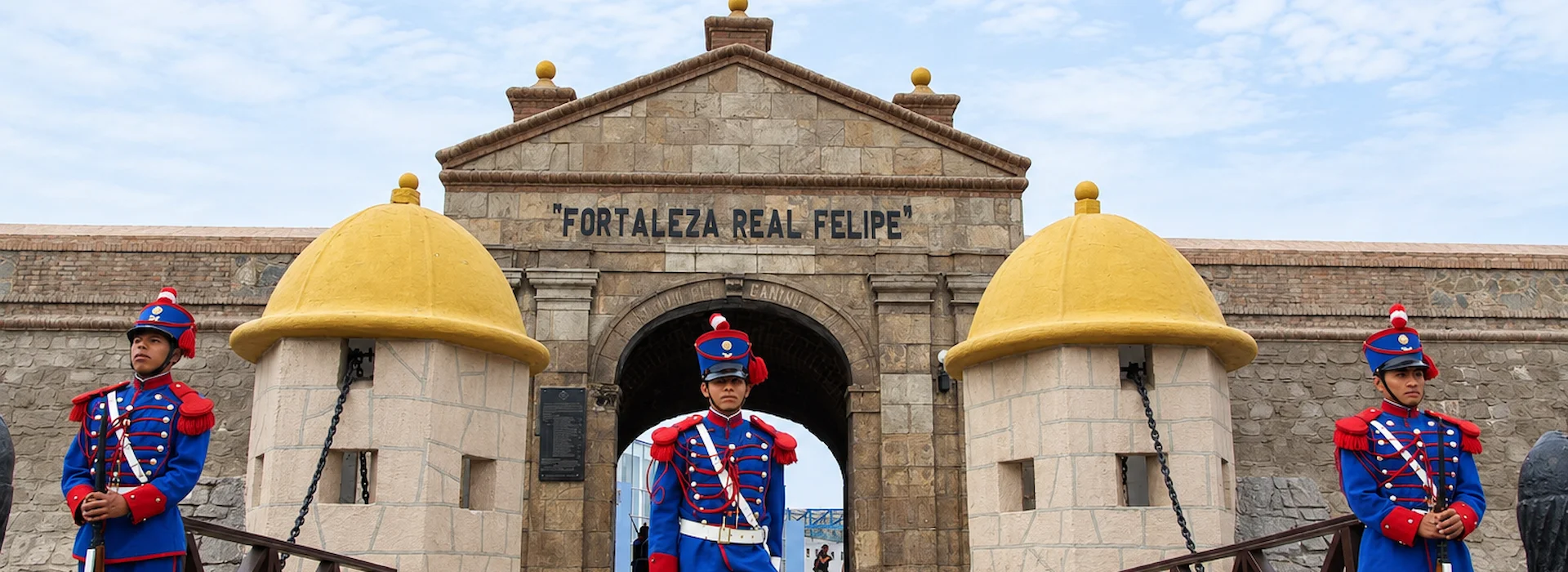
Commanding the shores of the Pacific Ocean as an impregnable bastion of quarried stone and mortar, the Real Felipe Fortress (Fortaleza del Real Felipe) stands as the largest and most formidable military defensive complex erected by the Spanish Empire anywhere in South America. Commissioned by Viceroy José Antonio Manso de Velasco (Count of Superunda) following the apocalyptic earthquake and tsunami of October 28, 1746 that entirely obliterated the colonial port of Callao, this colossal pentagonal fortress built in the Vauban tradition required nearly three decades of construction. Within its imposing stone towers, suffocating subterranean labyrinthine dungeons, and artillery bastions, monumental chapters of history unfolded: it served as the final Spanish royalist stronghold in South America during the epic siege of 1824–1826 and the heroic stage of the Battle of Callao (Dos de Mayo) in 1866. This definitive guide explores its documented heritage, hidden legends, visiting hours, and private guided excursions.
01 Origins & Construction: Imperial Shield Against Corsairs After the 1746 Tsunami
Throughout the 16th and 17th centuries, Callao stood as the most coveted maritime prize for English, Dutch, and French privateers raiding Pacific trade routes. Renowned corsairs including Sir Francis Drake (1579), Thomas Cavendish (1587), and Dutch admiral Jacques l'Hermite (1624) repeatedly bombarded and blockaded Lima's coastline, exposing the vulnerabilities of the port's early adobe and stone enclosures.
The turning point came on the fateful evening of October 28, 1746, when a catastrophic earthquake (magnitude estimated between 8.6 and 9.0) triggered a colossal tsunami with waves exceeding 10 meters (33 feet) that completely submerged Callao, killing more than 5,000 residents and obliterating its defense network. In response to this utter devastation, energetic Viceroy José Antonio Manso de Velasco resolved to build not mere walls, but the most impregnable military fortress in the Spanish overseas empire.
27 Years of Construction
Begun on January 21, 1747 and finalized in 1774 under the reigns of Ferdinand VI and Charles III, demanding an extraordinary investment of imperial treasury reserves.
Cut Stone & Calicanto
Constructed with massive quarried and dressed stone brought by barge from San Lorenzo Island and calicanto mortar reinforced with seabird guano egg whites.
Vauban Geometric Design
A pentagonal bastioned complex covering 70,000 square meters, surrounded by dry water-fillable moats, drawbridges, and interlocking artillery lines.
For his extraordinary leadership in rebuilding Lima and Callao, King Ferdinand VI elevated Manso de Velasco with the title Count of Superunda (meaning "Over the Waves"), naming the formidable citadel in tribute to his royal predecessor, King Philip V: the Royal Fortress of Real Felipe.
02 Vauban Military Architecture: The King's Tower & The Queen's Tower
Conceived by French academician and mathematician Louis Godin alongside Spanish military engineers José Amich and Juan Francisco Rossa, the complex was designed following the geometric bastioned doctrines of French Marshal Sébastien Le Prestre de Vauban. Its irregular pentagonal layout ensured that each of its five massive bastions (named The King, The Queen, The Prince, The Princess, and San Carlos) could provide lethal crossfire covering the dead angles of neighboring curtain walls.
Among its key defensive elements stand its two commanding circular stone towers:
The King's Tower (Torreón del Rey)
Located on the inland bastion. It operates as an autonomous citadel within the fortress, possessing its own moat, drawbridge, labyrinthine spiral ramp designed to disorient attackers, three elevated artillery tiers, and an observation turret offering 360-degree views over the harbor.
The Queen's Tower (Torreón de la Reina)
Facing northwest toward the open bay. It housed shore batteries aimed at naval targets, deep blast-proof gunpowder magazines, supply storage casemates, and subterranean disciplinary chambers.
The Governor's House (Casa del Gobernador)
A stately two-story colonial residence featuring classical porticos and an interior courtyard where the military commandant resided, currently exhibiting period uniforms, weaponry, and archives.
The Knight of the Twelve Cannons
An elevated artillery redoubt positioned inside the central esplanade, engineered to rotate and fire twelve heavy bronze cannon pieces simultaneously toward any compromised wall section.
03 The Empire's Last Stand: Rodil's Epic Siege & The Battle of Callao (1866)
Ironically, while Real Felipe never had to repel a pirate amphibious landing, it witnessed two of the most critical military engagements in South American history:
The Siege of Rodil (1824–1826)
Following the decisive patriot victory at the Battle of Ayacucho in December 1824, Spanish Brigadier José Ramón Rodil barricaded himself inside Real Felipe, refusing to surrender. For 14 harrowing months under joint patriot siege by land and sea, starvation and disease devastated the garrison. Of more than 6,000 royalist soldiers and aristocrats sheltered within, the vast majority perished before Rodil capitulated on January 23, 1826, lowering the final Spanish imperial flag in continental South America.
The Battle of Callao / Dos de Mayo (1866)
Four decades later, Spain attempted to reassert imperial hegemony over the Pacific coast. On May 2, 1866, Callao's shore batteries and Real Felipe's heavy artillery decisively repelled Spain's Pacific Fleet under Admiral Casto Méndez Núñez, cementing the definitive independence of Peru, Chile, Bolivia, and Ecuador, an engagement where Peruvian War Minister José Gálvez sacrificed his life.
Walking through these historic stone courtyards and standing before genuine bronze cannons cast in Seville and Lima brings these monumental historical moments powerfully to life.
04 Underground Enigmas: Suffocating Dungeons, Hidden Passages & Ghost Myths
Centuries of military conflict, imprisonment, and human endurance have woven a deep aura of mystery and folklore around Real Felipe:
Beneath the King's Tower lie the casamatas and punishment dungeons, among the harshest confinement chambers of the colonial world. In these narrow, airless stone cells, prisoners were kept in total darkness, unable to sit down, with seawater seeping around their ankles during high tides. Confinement here was often a death sentence within weeks.
Because thousands of souls perished within the ramparts during the 1824–1826 siege and subsequent political imprisonments, local folklore abounds with accounts of apparitions: the spectral figure of The White Lady gliding along the King's Tower ramp, crying children, and rattling chains in the subterranean casemates. The Peruvian Army regularly hosts special evening ghost-lore tours that sell out weeks in advance.
Persistent popular myths also describe secret underwater tunnels allegedly connecting Real Felipe with Government Palace in Lima or San Lorenzo Island. While archaeological research confirmed these were sophisticated aqueducts, freshwater cisterns, and counter-mine defense galleries, the aura of intrigue remains undiminished.
05 Official Opening Hours & Army Museum Ticket Rates
To ensure smooth logistics for your visit to Real Felipe Fortress, here are the verified operating guidelines for 2026:
Opening Hours
Tuesday to Sunday: 09:00 AM to 04:00 PM.
Mondays: Closed for base maintenance and military garrison protocols.
Admission Fees
Adults: S/ 15.00 to S/ 20.00 PEN (approx. US$ 4.50 to $5.50).
Students & Children: S/ 5.00 to S/ 10.00 PEN with valid ID.
Guided Visit Requirement
Admission is strictly conducted in guided groups escorted by military or certified guides to preserve historical assets and adhere to naval base security.
06 Practical Tips for Your Visit: Footwear, Timing & Guidelines
To make your exploration across the stone ramparts and towers comfortable, safe, and memorable, keep these practical tips from our local guides in mind:
The circuit involves climbing steep historic stone ramps, narrow spiral staircases, and uneven cobblestones. Sturdy athletic footwear is essential.
A comprehensive tour covering the towers, Governor's House, artillery bastions, and military museums takes approximately 2 to 2.5 hours at a relaxed pace.
Much of the fortress tour is open-air atop high stone battlements. Bring sunscreen, sunglasses, a hat, and a light windbreaker jacket for seaside gusts.
The fortress main gate is just a 5-minute stroll from Plaza Matriz in Monumental Callao and Chucuito's oceanfront restaurants, forming an ideal day trip.
07 How to Experience Real Felipe Fortress with Lima Tour Peru
As an official inbound tour operator licensed by MINCETUR and PROMPERU under the RAP Travel Peru group (RUC 20490005022), we offer exclusive guided tours designed for comfort and depth:
Monumental Callao & Real Felipe
Guided exploration of the military fortress, King's Tower, the urban murals of Monumental Callao, and charming seaside Chucuito.
From US$ 70 per personPalomino Islands Wildlife Cruise
Set sail from Callao harbor to swim with wild sea lions and spot Humboldt penguins in their natural Pacific island sanctuary.
From US$ 105 per personColonial & Modern Lima City Tour
Link viceregal military history with Lima's UNESCO Main Square, the Metropolitan Cathedral, and San Francisco Catacombs.
From US$ 35 per personPachacamac Sanctuary & Barranco
Explore the coastal oracle of Pachacamac and the bohemian charm of Barranco's romantic Bridge of Sighs overlooking the sea.
From US$ 45 per personAll private excursions feature modern climate-controlled vehicles, licensed drivers, door-to-door hotel transfers in Miraflores, San Isidro, and Barranco, and 24/7 dedicated assistance. Request a customized quote via our Contact Us page.
Recommended reading from our guide series: Callao Tours: Real Felipe, Chucuito & Hidden Routes · Historic Center of Lima Travel Guide · Lima Cathedral & Pizarro's Crypt · Cerro San Cristóbal Viewpoint Guide.
07 Frequently Asked Questions about Real Felipe Fortress
Why was the Real Felipe Fortress built and who ordered its construction?
It was commissioned by Viceroy José Antonio Manso de Velasco (Count of Superunda) in 1747, after the catastrophic earthquake and tsunami of October 28, 1746 leveled Callao's previous fortifications. Its primary purpose was to shield the viceregal capital and transoceanic silver shipments from continuous threats by British and Dutch privateers (such as Francis Drake and Thomas Cavendish in earlier centuries), named in tribute to King Philip V of Spain.
How long did construction take and what materials were used?
Construction spanned 27 years, from January 21, 1747 to 1774, directed by military engineers including Louis Godin, José Amich, and Juan Francisco Rossa. It was constructed of calicanto (a resilient colonial mortar of lime, sand, and seabird guano egg whites) reinforced with heavy quarried stone transported from nearby San Lorenzo Island and kiln-fired brick.
What happened during Rodil's famous siege at the fortress?
Following the decisive Battle of Ayacucho in 1824, Spanish Brigadier José Ramón Rodil barricaded himself inside Real Felipe, refusing to acknowledge Peruvian independence. For nearly 14 months (December 1824 to January 1826), patriotic republican forces besieged the fortress by land and sea. Of the more than 6,000 royalist loyalists and aristocrats sheltered within, the vast majority perished from scurvy, dysentery, and starvation before Rodil surrendered with a few hundred survivors, ending Spanish imperial dominion on the continent.
What are the official opening hours and ticket prices for 2026?
The Army Historical Museum inside Real Felipe generally welcomes visitors Tuesday through Sunday from 9:00 AM to 4:00 PM (closed Mondays for military maintenance). General adult admission is approximately S/ 15.00 to S/ 20.00 PEN (approx. US$ 4.50 to $5.50), with discounted rates for students and children. Tours inside are conducted in guided groups under the direction of certified guides for security and historical interpretation.
Are there really secret labyrinths and punishment dungeons in the King's Tower?
Yes. The King's Tower features an ingenious labyrinthine spiral ramp system designed to confuse and trap invaders who breached the drawbridge. Deep in its base lie notorious punishment cells (casamatas): extremely narrow, pitch-black chambers where colonial prisoners were confined standing upright without room to sit, receiving only trace air from high ventilation slits.