


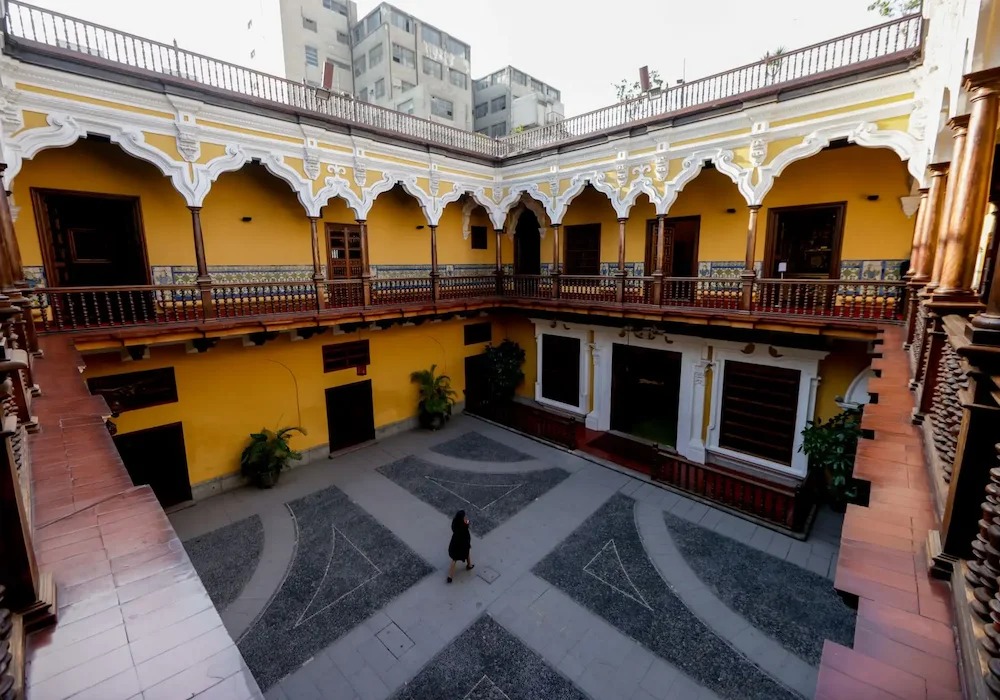
Located at Jirón Ucayali 363, just three short blocks from Lima's Plaza Mayor, stands what art historians consider the most exquisite viceregal mansion in South America: Torre Tagle Palace (Palacio de Torre Tagle). Completed in 1735 as the ancestral home of Don José Bernardo de Tagle Bracho—the first Marquis of Torre Tagle and Royal Treasurer of the Spanish Armada—this monumental residence stands as the crowning achievement of Limeño Andalusian baroque with Moorish (Mudéjar) and Creole undertones. Declared a Peruvian National Monument in 1929 and serving as the official seat of the Ministry of Foreign Affairs (Cancillería) since 1918, the palace captivates travelers with its carved Panamanian stone portal, shaded inner courtyards paved with 1737 Sevillian polychrome tiles, and above all, its two iconic carved cedar box-balconies—internationally celebrated as the finest examples of colonial joinery on earth. This definitive guide unveils its noble history, architectural treasures, diplomatic protocol, and visit highlights.
01 The Marquisate of Torre Tagle & Origins of the Noble Estate
During the golden twilight of the early 18th century, Lima reigned as the wealthiest metropolis of the Spanish Americas. In this climate of aristocratic prestige, Don José Bernardo de Tagle Bracho—Knight of the Order of Calatrava, Treasurer General of the Spanish Royal Armada, and first Marquis of Torre Tagle—commissioned a family estate that would showcase the power and pedigree of his lineage.
Construction commenced around 1715 and was officially completed in 1735, as commemorated by an engraved inscription in the main courtyard. The Marquis contracted the viceroyalty's most accomplished stonecutters and master joiners, importing elite materials from across the Spanish Empire: Panamanian ashlar stonework, fine Central American hardwoods, and thousands of polychrome glazed tiles fired in the famous kilns of Triana in Seville.
Remarkably, the palace's seismic-resistant foundation weathered the catastrophic earthquake of 1746 that decimated 90% of colonial Lima, cementing its standing as South America's most magnificent surviving domestic baroque masterpiece.
02 Andalusian Baroque Architecture: Asymmetry, Stone Portal & Crest
The outer facade of Torre Tagle Palace is a triumph of 18th-century Limeño baroque design. Rejecting rigid neoclassical symmetry, the facade displays a deliberate, calculated asymmetry conceived to enhance visual drama along the narrow, cobblestoned perspective of Jirón Ucayali.
Monumental Panamanian Stone Portal
Hand-carved from dense Panama stone transported by sea across the Pacific. Its baroque composition features channeled pilasters, curved moldings, and a broken pediment sheltering the central balcony.
Aristocratic Family Coat of Arms
Meticulously sculpted in high relief above the entrance lintel, displaying the quartered heraldry of the Tagle Bracho and Pérez de la Riva houses, crowned by a noble marquis coronet and plumed helmet.
Ochre Walls & Grotesque Modillions
The contrast between warm red-ochre upper stucco and grey foundation stone accentuates noble gravity, embellished by carved timber corbels featuring classical masks and floral scrolls.
03 The Carved Box-Balconies: Masterpieces of Viceregal Joinery
If one architectural element defines the romantic identity of viceregal Lima, it is the pair of carved cedar box-balconies gracing the piano nobile of Torre Tagle Palace. International architectural historians universally revere them as the most opulent wooden balconies created in the colonial Americas.
Constructed entirely from Nicaraguan cedar and Central American mahogany, these overhanging viewing galleries merge diverse cultural aesthetics into one harmonious ensemble:
The Wonder of Torre Tagle's Balconies
Moorish Mudéjar screen lattice: Intricately pierced timber lattices enabled cloistered aristocratic women to look out upon street processions without exposing themselves to public gaze.
Elaborate baroque relief carving: Every surface features rosettes, drop finials, bead moldings, and mortise-and-tenon joints fitted without a single visible iron nail.
Asymmetric proportions: The wider left balcony features seven lattice bays aligning with the ceremonial salon, while the right balcony features five bays corresponding to the family oratory.
04 Noble Courtyards, 1737 Sevillian Tiles & The Golden Carriage
Stepping through the river-cobblestone entrance passage (zaguán), visitors enter a tranquil sanctuary of viceregal grandeur: the main courtyard (Patio de Honor). Framed by trefoil wooden arches resting on spiraled columns and stone socles, the space recalls grand Renaissance palacios of Seville and Córdoba.
The walls of the courtyard and entrance arcade are lined with authentic 1737 Sevillian glazed tiles (azulejos), exhibiting vibrant cobalt blues, sunshine yellows, and deep ochres depicting hunting scenes, mythological cherubs, and baroque heraldry.
The 18th-Century Marquis Carriage
Sheltered within the entrance arcade rests an extraordinary 18th-century gilded viceregal carriage upholstered in crimson velvet with embossed bronze lanterns. It is one of only a handful of intact aristocratic horse carriages surviving across the South American continent.
05 Official Seat of Foreign Affairs: Diplomacy & Republican Heritage
In the early 20th century, the Peruvian government acquired the historic residence to protect it from neglect. In 1918, President José Pardo y Barreda decreed Torre Tagle Palace as the official headquarters of the Ministry of Foreign Affairs of Peru (Cancillería).
Over more than a century of diplomatic service, the palace has hosted pivotal treaties, summit conferences, and visiting world leaders. Its historic staterooms—such as the Ambassadors' Hall and the Treaty Chamber—preserve French Boulle marquetry furniture, full-length Venetian mirrors, and exquisite Cusco School religious paintings.
06 Visitor Protocols, Location on Jr. Ucayali & Photography Tips
Because Torre Tagle Palace operates as an active government ministry and diplomatic chancery, tourist access follows specific visiting guidelines:
| Visiting Option | Schedule & Conditions | Admission Fee | Highlights Included |
|---|---|---|---|
| Exterior Street Viewing | Open 24/7 (pedestrian Jr. Ucayali) | Free / Public Access | Panama stone portal, heraldic crest & cedar balconies |
| Illuminated Night Viewing | Daily from 6:30 p.m. to 10:30 p.m. | Free / Public Access | Warm LED architectural lighting illuminating woodcarvings |
| Special Heritage Open House | Civic holidays by Cancillería / PROLIMA | Free (advance online registration) | Inner courtyard, Sevillian tiles & golden carriage |
|
Recommended Guided Lima Tour Peru City Tour |
Daily morning & afternoon departures | Included in official tour | Expert historical narration, context & guided photo stop |
Best Photography Light
Mid-morning between 10:00 a.m. and 1:00 p.m. casts bright sun directly upon the facade, illuminating every detail of the lattice woodcraft.
Pedestrian Ucayali Boulevard
Jirón Ucayali is entirely pedestrianized, offering a leisurely 3-minute stroll connecting the Plaza Mayor with San Pedro Church.
Security & Tourist Police
Due to its foreign ministry function, the street features continuous diplomatic police patrols, making it one of Lima's safest blocks.
07 How to Experience Torre Tagle Palace with Lima Tour Peru
To truly appreciate the architectural nuances of Torre Tagle Palace, visit alongside an expert certified guide who can explain the genealogical history and artistic treasures of viceregal Lima:
Colonial & Modern Lima City Tour
Explore the UNESCO Historic Center, Torre Tagle Palace exterior, San Francisco Catacombs, and Miraflores with a certified bilingual guide.
From US$ 35 per personColonial City Tour + Gourmet Lunch
Pair architectural marvels with an oceanfront multi-course traditional Peruvian buffet in Miraflores.
From US$ 70 per personAll private excursions feature professional drivers, climate-controlled vehicles, and 24/7 dedicated assistance. Contact our travel specialists via our Contact Us page.
Recommended reading: Casa O'Higgins Historic Mansion in Downtown Lima · Archbishop's Palace of Lima · Lima Main Square Complete Guide.
08 Frequently Asked Questions about Torre Tagle Palace
Why is the exterior facade of Torre Tagle Palace deliberately asymmetrical?
Unlike Renaissance academicism requiring rigid symmetry, Limeño Creole baroque emphasized domestic functionality and dramatic light dynamics. The carved stone portal and left balcony are significantly wider because they anchored the grand ceremonial receiving salon and carriage entryway, whereas the right wing housed private family chambers and the domestic chapel, creating a charming visual rhythm.
What sacred relics and art treasures are preserved inside the palace's private chapel?
On the second floor sits the private family oratory of the Tagle lineage, an intact 18th-century jewel featuring a gilt-wood baroque altarpiece leafed in 22k gold, original oil paintings from the Cusco School in carved polychrome frames, and an official papal bull issued by Pope Benedict XIII granting domestic plenary indulgences.
What treatment preserved the cedar and mahogany woodwork for nearly 300 years in humid Lima?
Master colonial carpenters utilized Nicaraguan cedar and Central American mahogany deeply cured with natural vegetable oils and insect-repellent resins that resist termite and wood-borer infestation. Furthermore, the Moorish lattice screens allow continuous airflow from Pacific sea breezes, preventing trapped condensation within joinery joints.
What prominent historical role did Torre Tagle Palace play during Peruvian Independence?
The 2nd Marquis of Torre Tagle, Don José Bernardo de Tagle y Portocarrero, joined General José de San Martín's liberation army, declaring Trujillo's independence in 1820. He subsequently served as President of Peru between 1823 and 1824, making the family mansion the command center for historic military and diplomatic treaties.
Under what circumstances or dates can tourists tour the interior staterooms of the palace?
As the functioning headquarters of the Ministry of Foreign Affairs and the Chancellor's private office, daily interior tourist access is restricted for security. However, the Foreign Ministry and PROLIMA host special open-house guided tours on commemorative occasions (International Day for Monuments, Night of Museums, and Lima Heritage Week) with advance identity registration.