

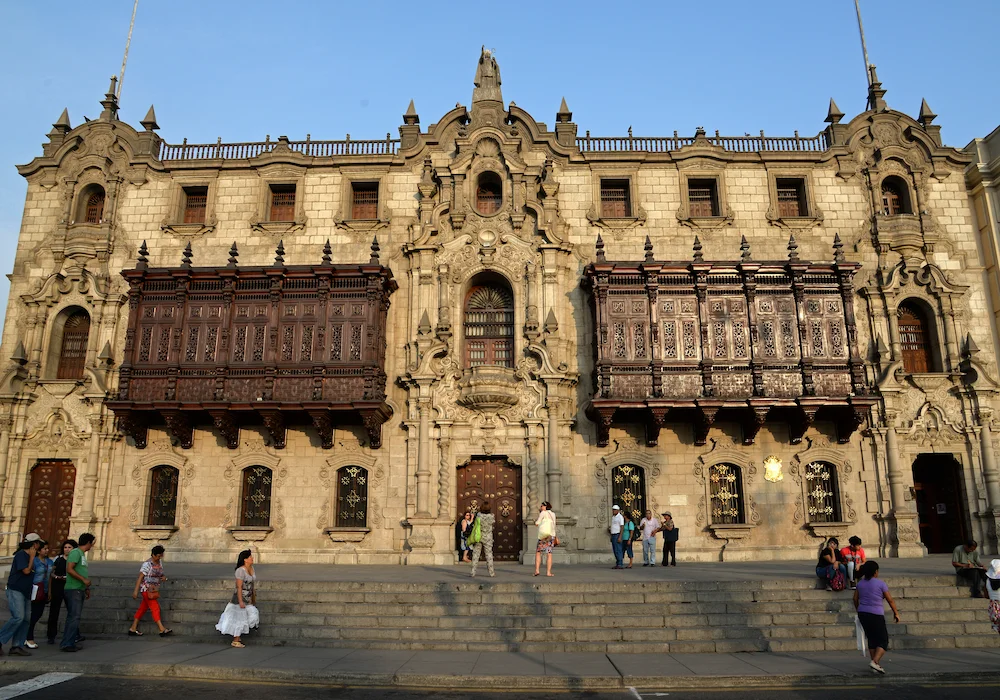
Flanking the eastern perimeter of Lima's Main Square, immediately adjacent to the Metropolitan Cathedral, the Archbishop's Palace of Lima stands as one of the most exquisite summits of Peruvian architecture. While the parcel was consecrated during the city's 1535 founding as the bishop's residence, the monumental current edifice —inaugurated in 1924 under the brilliant direction of architects Claude Sahut and Ricardo de Jaxa Malachowski— synthesizes the very best of Lima Baroque, Mudejar craft, and neocolonial splendor. Its world-renowned enclosed balconies hand-carved from cedar, noble mahogany imperial staircase, and priceless sacred art museum make it an indispensable cultural highlight on any Historic Center itinerary.
01 History & Foundation: From the 1535 Bishopric to the Neocolonial Landmark
When Spanish conquistador Francisco Pizarro laid out Lima's foundational grid on January 18, 1535 —the famed Pizarro's Grid (Damero de Pizarro)— he deliberately designated the prime parcel adjacent to the main cathedral as the official episcopal residence. The early colonial bishop's house hosted Friar Jerónimo de Loayza, Lima's first archbishop and key organizer of the influential Lima Councils, and subsequently Saint Toribio of Mogrovejo, patron saint of the Latin American episcopate.
Across centuries of viceregal rule, the residence endured structural reconstructions spurred by catastrophic coastal seismic tremors, particularly the devastating earthquakes of 1687 and 1746. By the early 20th century, the historic residence, while featuring noble brick courtyards, had suffered severe architectural deterioration that called for a magnificent reconstruction worthy of South America's primate ecclesiastical see.
The 1924 Neocolonial Masterpiece
The old structure was demolished to initiate an ambitious national project. Designed by French architect Claude Antoine Sahut Laurent and concluded by acclaimed Polish-Peruvian architect Ricardo de Jaxa Malachowski, the current Archbishop's Palace was solemnly consecrated on December 8, 1924, commemorating the centennial of the decisive Battle of Ayacucho which sealed Peruvian and South American independence.
This masterpiece marked the zenith of Peru's neocolonial architectural movement: an early 20th-century cultural renaissance seeking to celebrate the viceregal baroque aesthetic of Lima through modern reinforced concrete engineering dressed in hand-chiseled stone masonry.
02 Enclosed Balconies and the Cedar Neocolonial Facade
The facade of the Archbishop's Palace is an exceptional achievement of harmonious civic design, aligning seamlessly with the twin baroque bell towers of the neighboring Lima Cathedral. Sculpted from fine ashlar stone extracted from historical quarries outside Lima, it features an ornate Plateresque portal topped by a stone figure of Saint Barbara and the deeply carved archiepiscopal coat of arms.
Nonetheless, the crowning visual glory that captivates international visitors is its pair of monumental enclosed wooden balconies (balcones de cajón), hand-carved from Nicaraguan cedar and tropical mahogany. These suspended balconies represent the highest expression of Lima's 18th-century baroque architecture:
Solid Cedar Craftsmanship
Painstakingly carved by master woodworkers in Lima, drawing inspiration from the illustrious Torre Tagle Palace balconies but elevated to monumental civic proportions.
Mudejar Latticework Heritage
Featuring openwork lattice screens rooted in Andalusian Moorish craft, allowing residents to catch coastal sea breezes and watch the plaza without being seen from street level.
Sculpted Wooden Corbels
Each balcony overhang rests on heavy wooden consoles intricately carved with classical grotesques, floral volutes, and baroque scrolls that achieve visual weightlessness.
Unlike historical residences where balconies are strictly viewed from the street, tourist admission to the Archbishop's Palace allows visitors to stand directly within these wooden chambers, enjoying sweeping views over Lima's Main Square from the archbishops' own vantage point.
03 Interior Tour: Grand Mahogany Staircase, Courtyards & Synod Hall
Stepping through the studded wooden entrance portal, guests are welcomed into a noble Renaissance-inspired cloistered courtyard framed by round arches, Corinthian pilasters, and black-and-white marble flagstones.
The architectural centerpiece of the palace is the Grand Imperial Staircase, celebrated as one of the finest wood installations in South America. Crafted from solid mahogany with hand-turned balusters and bronze candelabras, the imperial flight splits and rises towards an expansive central skylight fitted with an Art Nouveau French stained glass window depicting the celestial apotheosis of Saint Toribio of Mogrovejo.
The second-floor state apartments house the archdiocese's formal chambers:
- The Synod Hall: A grand ceremonial chamber draped in crimson velvet where provincial councils and papal delegations were received, framed by hand-carved choir stalls.
- The Private Archiepiscopal Chapel: An intimate sanctuary boasting an authentic 18th-century gilded baroque altarpiece and sacred oil canvases.
- The Archbishop's Formal Study: Elegantly appointed with Louis XV desks, mother-of-pearl inlay cabinets (bargueños), and historical archiepiscopal wax seals.
04 Museum Treasures: Sacred Paintings, Colonial Sculpture & Relics
Today, the Archbishop's Palace houses Lima's foremost Museum of Sacred Art, curating a precious collection of ecclesiastical art gathered from colonial monasteries, hermitages, and chapels across the Rímac Valley:
Cusco & Lima School Viceregal Painting
Masterful 17th- and 18th-century oil canvases influenced by Italian master Bernardo Bitti and Indigenous masters, featuring legendary arquebusier angel series and Marian devotions.
Liturgical Gold & Silver Metalwork
Processional monstrances, repoussé silver chalices from Upper Peru, gem-encrusted ciboriums, and jeweled pectoral crosses reflecting viceregal Lima's maritime wealth.
Polychrome Wood Sculptures
Stunning statuary featuring lifelike flesh tones (encarnado) by Sevillian and Quito school artisans, dressed in garments embroidered with silver and gold metallic threads.
Among the most venerated artifacts are personal relics of Saint Rose of Lima and memorabilia linked to Saint Martin de Porres, international patron saints who walked these exact streets during the early 1600s.
05 Visiting Hours, 2026 Admission Fees & Combined Cathedral Ticket
Visiting the Archbishop's Palace is straightforward and forms the natural companion visit to the adjacent Cathedral. Below are current official admission rates and ticketing guidelines:
Cathedral + Palace Pass (Recommended)
Combined admission: S/ 30 to S/ 35 (~US$ 8 – US$ 9 per adult). Grants complete access to both neighboring monuments, museum rooms, and Pizarro's Crypt.
Single Palace Admission
General rate: S/ 20 per adult. Discounted student tickets are available at the physical ticket window upon presenting valid ID.
Opening Hours
Monday to Saturday: 09:00 AM – 05:00 PM.
Sundays: Closed for tourist visits due to archdiocesan Catholic services.
Tickets can be bought on-site at the Cathedral atrium ticket office or at the side entrance on Jirón Carabaya. For travelers seeking private transfers, certified guides, and curated commentary, facade exploration is included on our Colonial & Modern Lima City Tour.
06 Practical Tips: Photography, Guided Commentary & What to Combine
To ensure an enriching, smooth visit through this neocolonial landmark in downtown Lima, keep these expert tips in mind:
Plan for 45 minutes to 1 hour to comfortably tour both floors, photograph the imperial staircase, and enjoy the enclosed balcony viewpoints.
Flash-free personal photography is permitted throughout courtyards, hallways, and balconies. Avoid camera flash in darker sacred art rooms to protect antique oil pigments.
As the active administrative headquarters of the Roman Catholic Archdiocese of Lima, respectful casual attire with shoulders covered is requested.
Tour the palace around 10:30 AM to step onto the Main Square by 11:30 AM, perfectly positioned for the 11:45 AM Changing of the Guard ceremony across the square.
Pair the palace seamlessly with the Lima Cathedral, Lima Main Square, and the San Francisco Monastery Catacombs.
07 Premier Historic Center Tours & Booking with Lima Tour Peru
Experiencing Lima's Historic Downtown with a certified bilingual guide unlocks stories, hidden architectural symbols, and colonial legends that independent visitors often miss. Lima Tour Peru operates daily guided experiences with climate-controlled door-to-door hotel transfers:
Colonial & Modern Lima City Tour
Classic half-day journey: Main Square, Archbishop's Palace and Cathedral facades, San Francisco Monastery Catacombs, panoramic Huaca Pucllana, and Love Park.
From US$ 35 per personColonial City Tour + Gourmet Lunch
Extended 5-hour cultural journey pairing comprehensive historic sightseeing with a distinguished Peruvian lunch buffet at Mangos Miraflores or Larco Cafe.
From US$ 70 per personPrivate departures feature licensed drivers, modern air-conditioned vans with pickup in Miraflores, San Isidro, and Barranco, certified bilingual guides, and personalized travel coordination. Get in touch via our Contact Us page.
Related articles in our guide series: Lima Main Square: Landmarks & Guard Ceremony · Lima Cathedral & Pizarro's Crypt · Historic Center of Lima Travel Guide.
08 Frequently Asked Questions about the Archbishop's Palace of Lima
What architectural vestiges of the original 16th-century episcopal residence remain preserved?
During the monumental 1920s reconstruction, original 16th-century virreinal stone-and-lime foundations, ancient underground water conduits, and the carved stone lintel from Archbishop Jerónimo de Loayza's primitive residence were conserved and stabilized. These archaeological remnants can be viewed in the lower level adjacent to archival repositories.
Does the Archbishop of Lima still use this palace for active official duties?
While the Archbishop resides in a pastoral residence, the Archbishop's Palace remains the canonical protocol and administrative headquarters of the Archdiocese of Lima. The historic Synod Hall continues to host receptions for papal nuncios, clerical synods, ceremonial appointments, and the signing of official archdiocesan decrees.
What is the historical value of the Archdiocesan Archives and can researchers access them?
The Archdiocesan Archives of Lima represent one of the oldest and most important historical documentary repositories in South America. They preserve parish baptismal and matrimonial records dating back to 1538—including the original sacramental certificates of Saint Rose of Lima and Saint Martin de Porres—accessible to accredited academic researchers and genealogists by appointment.
How are the hand-carved cedar enclosed balconies maintained against Lima's coastal humidity?
To safeguard the untreated Nicaraguan cedar against Lima's persistent coastal humidity (frequently exceeding 85%), master conservation woodworkers from the Escuela Taller de Lima apply quarterly treatments of natural beeswax and protective mineral oils that nourish the timber grains without altering the historical patina or using synthetic varnishes.
What liturgical vestments and viceregal ecclesiastical regalia are displayed in the Vestments Hall?
The Vestments Hall showcases elaborate chasubles hand-embroidered with gold and silver bullion threads from master workshops in Lyon and Seville, pontifical miters studded with colonial gemstones, pastoral staffs crafted from silver bullion, and crimson damask copes worn during historic virreinal Corpus Christi processions.