

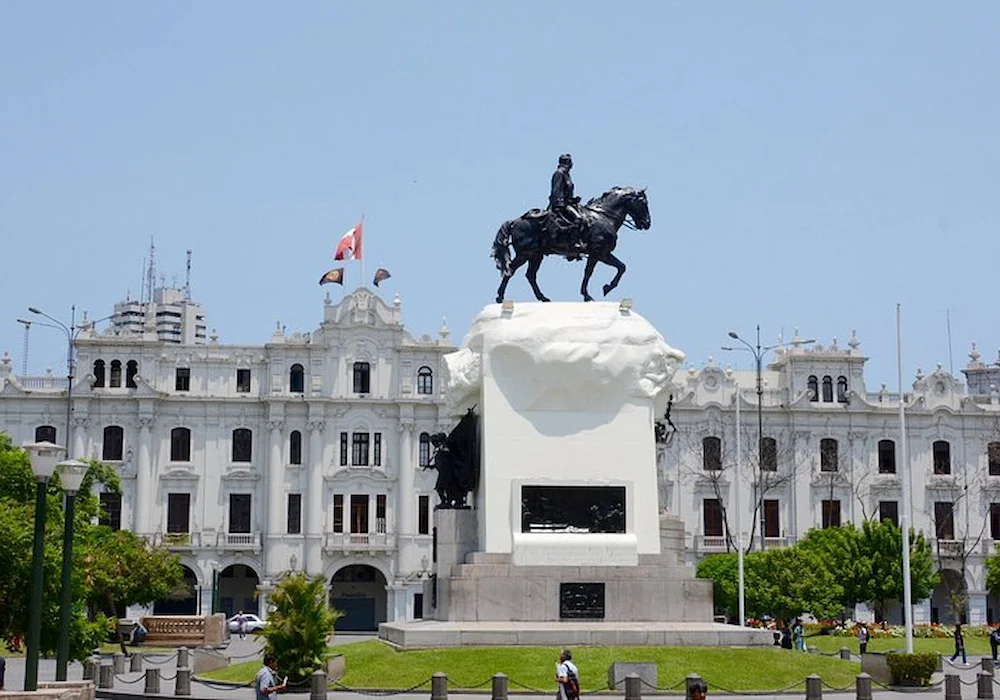
Inaugurated on July 27, 1921, as the premier urban centerpiece commemorating the centennial of Peru's Independence under President Augusto B. Leguía, Plaza San Martín stands as the civic, monumental, and republican heartbeat of Lima. Conceived under strict academic proportions featuring uniform white-granite arcades and crowned by the majestic bronze equestrian monument to General José de San Martín —sculpted by celebrated Spanish master Mariano Benlliure—, this square is the quintessential starting point for any walking exploration of the Historic Center. Flanked by architectural icons such as the Gran Hotel Bolívar, the Club Nacional, and the Colón Theater, it guards the southern entrance of pedestrianized Jirón de la Unión, gracefully connecting republican grandeur with colonial Lima.
01 History of the Plaza: The 1921 Independence Centennial Monument
At the turn of the 20th century, Lima underwent ambitious urban modernization driven by celebrations for the first centennial of Peru's National Independence (1821–1921). President Augusto B. Leguía envisioned a grand public square honoring the Liberator General José de San Martín that would serve as the modern civic forum of a blossoming republic expanding beyond colonial ramparts.
The designated parcel replaced the colonial Micheo square and ancient railway terminal of San Juan de Dios. The square was officially inaugurated on July 27, 1921, amidst foreign diplomatic dignitaries from across the Americas and Europe. The urban layout and grand uniform arcades were entrusted to Spanish architect and sculptor Manuel Piqueras Cotolí, who designed a harmonious neoclassical plaza featuring geometric gardens, bronze lampposts, ornamental fountains, and continuous porticos.
UNESCO World Heritage Landmark
Recognized for its extraordinary urban cohesion and pristine Beaux-Arts and neoclassical facades, Plaza San Martín was inscribed as a core component of the Historic Center of Lima on the UNESCO World Heritage List in 1988 and 1991.
02 Benlliure's Equestrian Monument & the Legend of the Flame
At the center of the square rises the imposing monument to General San Martín, selected via an international competition and crafted in bronze and granite by renowned Spanish master sculptor Mariano Benlliure.
The dramatic bronze statue depicts San Martín astride his steed in field uniform, calm yet resolute, gazing toward the future of the liberated nation. The stepped polished granite plinth features intricate bronze bas-reliefs capturing decisive moments of the independence campaign: crossing the snowbound Andes, proclaiming independence in Lima, and decisive battles.
Benlliure's Bronze Masterpiece
Cast in Spain in 1921, the statue displays remarkable anatomical realism and military poise, reflecting statesmanship and republican valor over a towering pedestal.
The Whimsical Llama Curiosity
On the plinth's front face, the allegorical bronze sculpture of the Motherland wears a tiny Andean llama on her helmet. The Spanish sculptor took the instruction to adorn her with "llamas" (votive flames) literally, gifting Lima one of its beloved artistic curiosities.
03 Republican Landmarks: Hotel Bolívar, Club Nacional & Arcades
Strict municipal building regulations passed in the 1920s mandated that all edifices facing the square conform to uniform height limits and luminous white-granite facades, creating one of Latin America's most cohesive architectural panoramas:
Gran Hotel Bolívar (1924)
Designed by Peruvian architect Rafael Marquina for the centennial of the Battle of Ayacucho. Renowned for its imported stained-glass dome, golden ballrooms, and signature Pisco Sour Catedral.
Club Nacional (1929)
A French academic masterpiece designed by Ricardo de Jaxa Malachowski and Enrique Bianchi, boasting carved limestone balconies, grand columns, and aristocratic wood-paneled halls.
Colón Theater & Arcades
The 1914 Colón Theater features Art Nouveau detailing, flanked by the majestic Portales de Zela and San Martín with their continuous ground-floor pedestrian arcades.
04 Comparison Guide of Landmarks Surrounding Plaza San Martín
Quick-reference guide to the architectural treasures framing Plaza San Martín:
| Monument / Palace | Year & Architect | Architectural Style | Primary Highlight |
|---|---|---|---|
|
Unmissable San Martín Equestrian Monument |
1921 (Mariano Benlliure) | Monumental Bronze Sculpture | Bronze Liberator, independence reliefs & Motherland with llama helmet |
| Gran Hotel Bolívar | 1924 (Rafael Marquina) | Beaux-Arts & Neoclassical | Stained-glass rotunda, historical suites & Pisco Sour Catedral |
| Club Nacional | 1929 (Malachowski & Bianchi) | French Academic Classicism | Carved limestone loggias, portico & noble library |
| Portales de San Martín & Zela | 1920s (Piqueras Cotolí) | Uniform Neoclassical Arcades | Covered pedestrian walkways linking directly to Jirón de la Unión |
05 The Historic Walk: Along Jirón de la Unión to the Main Square
Plaza San Martín guards the southern threshold of Jirón de la Unión, Lima's most storied pedestrian avenue. During the 19th and early 20th centuries, walking along this street —known in Peruvian lore as «jironear»— was the supreme daily social ritual of Lima's intellectual elite and bohemians, centered around legendary cafes like the Palais Concert.
Strolling from Plaza San Martín to the Main Square takes a comfortable 15 to 20 minutes (800 meters / half a mile) and reveals essential heritage stops:
La Merced Basilica
Dating to the 16th century, featuring a breathtaking Churrigueresque Baroque facade sculpted in Peruvian stone honoring Our Lady of Mercy.
Casa O'Higgins & Colonial Mansions
Historic residences preserving tranquil Andalusian courtyards, cobblestone entryways, and intricate wooden lattice balconies.
Main Square & Government Palace
The grand culmination of the walk: Lima's 1535 founding core featuring the Cathedral, Archbishop's Palace, and midday Changing of the Guard.
06 Visitor Advice: Classic Pisco Sour, Photography & Ideal Hours
Make the very most of your visit to Plaza San Martín with these expert insider tips:
The Pisco Sour Ritual at Hotel Bolívar
Step into the hotel's wood-paneled bar to sip a traditional Pisco Sour Catedral accompanied by crispy lomo saltado tequeños underneath the historic stained glass rotunda.
Golden Hour Photography
Between 4:00 p.m. and 6:00 p.m., golden afternoon light illuminates the white stone palaces. At dusk around 6:30 p.m., floodlights cast warm illumination over the arcades.
Safety & Pedestrian Transit
Plaza San Martín and Jirón de la Unión benefit from permanent patrols by the specialized Tourism Police. Stick to illuminated pedestrian corridors, keep valuables discreet, and enjoy the lively urban ambiance.
07 Guided Historic Center Tours with Lima Tour Peru
At Lima Tour Perú (licensed tour operator of RAP Travel Peru group, certified by MINCETUR and PROMPERÚ), our private guided circuits begin at Plaza San Martín and weave through Lima's finest historical treasures:
Colonial & Modern Lima City Tour
Half-day guided excursion starting at Plaza San Martín, walking down Jirón de la Unión to the Cathedral, Catacombs, and Miraflores cliffs.
From US$ 35 per personCity Tour + Traditional Pisco Experience
Combine in-depth architectural walks with a curated Peruvian Pisco tasting session in historic colonial courtyards.
From US$ 50 per personTo book private excursions or craft a personalized Lima itinerary, reach out to our team through our Contact Us page.
Recommended reading: Historic Center of Lima Complete Guide · Plaza Mayor of Lima: Visitor Guide · Casa O'Higgins on Jirón de la Unión.
08 Frequently Asked Questions about Plaza San Martín
What is the famous historical curiosity regarding the Motherland sculpture on the monument?
At the base of the monument below the equestrian statue of San Martín stands the allegorical bronze sculpture of the Motherland. Legend has it that the civic commission instructed Spanish sculptor Mariano Benlliure to crown her with a wreath of "llamas" (flames of fire). The artist interpreted the instruction literally, sculpting a miniature Andean camelid (a llama) perched atop her helmet, an amusing artistic curiosity visitors delight in locating.
Why is Plaza San Martín considered the ideal starting point to explore Downtown Lima?
Due to its strategic transport connections and urban flow: it anchors the southern edge of the historic core, easily reached from Miraflores and San Isidro via the Metropolitano bus rapid transit (Colmena or Jirón de la Unión stations) or taxi. From the square, travelers enjoy a completely pedestrianized downhill walk along Jirón de la Unión to the Main Square, passing colonial churches, historic mansions, and landmark cafes.
What traditional cocktails and culinary specialties are famous at the Gran Hotel Bolívar?
Inaugurated in 1924, the Gran Hotel Bolívar is world-famous for its signature "Pisco Sour Catedral": a generous 5-to-6-ounce cocktail creation savored by illustrious historical guests including Ernest Hemingway, Orson Welles, Ava Gardner, and Charles de Gaulle in its classic wood-paneled lobby bar.
What safety guidelines and recommendations should visitors keep in mind when visiting the square?
Plaza San Martín is actively monitored by Lima Tourism Police and municipal surveillance cameras. Recommended visiting hours are between 9:00 a.m. and 6:00 p.m. Travelers should maintain customary situational awareness, keep valuables secure when photographing, and remain along main pedestrianized corridors such as Jirón de la Unión.
How long does the walk from Plaza San Martín to the Main Square take?
The distance is roughly 800 meters (half a mile) in a straight line along Jirón de la Unión. A leisurely stroll takes 15 to 25 minutes, allowing ample time to admire La Merced Church, Casa O'Higgins, and historic commercial facades along the way.