


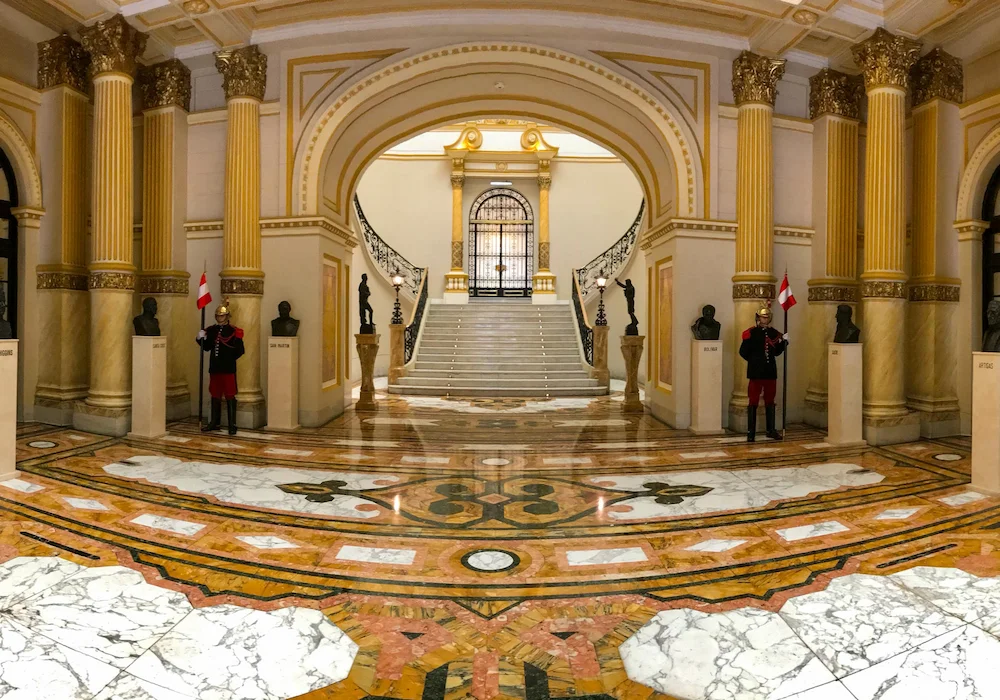
Dominating the northern flank of Lima's Plaza Mayor overlooking the Rímac River stands the Government Palace of Peru (Palacio de Gobierno)—historically renowned as Pizarro's House (Casa de Pizarro)—the executive headquarters of the President of Peru. The grounds preserve an unbroken chain of regional authority spanning nearly a millennium: prior to Spanish conquest, this sacred site served as the administrative compound of Taulichusco, the last indigenous ruler of the lower Rímac Valley; in 1535 Spanish conquistador Francisco Pizarro erected his fortified adobe residence; and across colonial centuries it housed 40 Spanish viceroys. Masterfully reconstructed in the 1930s with lavish French-inspired neo-baroque architecture designed by Claude Sahut and Ricardo de Jaxa Malachowski, the palace dazzles visitors with its glittering Versailles-style Golden Hall leafed in 22k gold, a four-century-old historic fig tree, and the pageantry of the daily noon Changing of the Guard performed by the presidential horse guard regiment. This guide covers its history, ceremonial staterooms, viewing tips, and tour integration.
01 From Taulichusco & Pizarro's Estate to Republican Presidential Seat
Very few sites in the Western Hemisphere can claim such an unbroken continuum of executive authority as the grounds of Peru's Government Palace (Palacio de Gobierno). Long before Spanish conquistadors founded the City of Kings, this natural riverbank knoll overlooking the Rímac River served as the seat of local ruler Taulichusco the Elder, the curaca who governed the lower Rímac Valley under Inca Imperial rule.
On January 18, 1535, upon establishing Lima, Spanish expedition leader Francisco Pizarro claimed this prime parcel for his personal governor's palace. The original Casa de Pizarro was a fortified adobe compound featuring timber-beam ceilings, courtyards, stables, and orchards irrigated by an ancient pre-Inca canal. In this very compound, on June 26, 1541, Pizarro was assassinated by rival Diego de Almagro's faction.
Pre-Columbian Period: Lordship of Taulichusco
Headquarters of indigenous civic administration regulating the agricultural irrigation network of the Lima valley prior to European contact.
Viceregal Era: Home to 40 Spanish Viceroys
From 1543 until 1821, forty royal viceroys governed the Spanish South American empire from these halls, expanding courtroom chambers and the historic Viceroys' Gallery.
Republican Era: General San Martín to Modern Day
In July 1821, Liberator General José de San Martín established the Protectorate government here, permanently enshrining it as the official residence of the President of Peru.
02 20th-Century Rebirth: French-Inspired Neo-Baroque Architecture
The imposing, grand architectural presence visible today is not a colonial relic, but rather a 20th-century triumph. On July 3, 1921, just weeks before celebrations marking the centennial of Peruvian independence, a catastrophic fire gutted the older viceregal timber and mud-brick staterooms.
President Augusto B. Leguía commissioned acclaimed French architect Claude Antoine Sahut Laurent to design a grand presidential palace reflecting French Beaux-Arts neo-baroque elegance, drawing inspiration from Versailles and Parisian municipal palaces.
Following Leguía's administration, the monumental complex was brought to fruition under President Óscar R. Benavides by legendary Polish architect Ricardo de Jaxa Malachowski, who refined the grand facade facing Plaza Mayor and crafted the staterooms, officially inaugurated in 1938.
03 Ceremonial State Rooms: The Golden Hall, Túpac Amaru & Basadre
Within Government Palace lies a sequence of magnificent staterooms reserved for state banquets, credential ceremonies, and swearing-in of presidential cabinets:
The Resplendent Golden Hall: Homage to Versailles
Modeled after the Hall of Mirrors at the Palace of Versailles, the Golden Hall (Salón Dorado) is Peru's grandest reception hall. Soaring vaulted ceilings and ornate moldings are lavished with 22-karat gold leaf, illuminated by colossal Baccarat crystal chandeliers, French beveled mirrors, and Louis XIV crimson velvet furnishings.
Túpac Amaru Grand Salon
Formerly named the Pizarro Hall, it features a carved timber cupola, four sculpted allegories of the arts, and a celebrated monument honoring indigenous leader Túpac Amaru II.
Jorge Basadre Hall
A dignified Spanish Renaissance-style hall honoring Peru's preeminent republican historian, adorned with colonial oil paintings and cast bronze candelabras.
Cáceres Room & Cabinet Chamber
Ceremonial rooms housing the sword of Marshal Andrés Avelino Cáceres and the oval mahogany conference table where the President's Council of Ministers convenes.
04 The Courtyard of Honor, Sevillian Patio & 400-Year-Old Fig Tree
Several manicured courtyards connect the administrative wings of the palace. The largest and most famous is the Courtyard of Honor (Patio de Honor), separated from the Plaza Mayor by towering wrought-iron gates crowned by bronze carriage lanterns.
Adjoining the presidential residence lies the tranquil Sevillian Courtyard, adorned with semicircular arches and vivid blue-and-yellow glazed tile murals presented as a diplomatic gift by the city of Seville in the 1920s.
Pizarro's 400-Year-Old Historic Fig Tree
Within an inner presidential garden flourishes an ancient fig tree (Ficus carica) that Limeño folklore and chronicler Ricardo Palma attest was planted by Francisco Pizarro himself in 1535. Nearly five centuries old, its gnarled trunk still produces fresh green leaves as a botanical monument to Lima's founding.
05 The Changing of the Guard: Presidential Cavalry & Military Band
One of Lima's premier cultural traditions is the daily Changing of the Guard ceremony, staged with solemn precision inside the palace Courtyard of Honor.
The spectacle is executed by the elite "Mariscal Domingo Nieto" Cavalry Regiment, the official Life Guard of the President of Peru. The troopers don historic 19th-century French dragoon dress uniforms: navy blue tunics with scarlet piping, golden epaulettes, white breeches, and gleaming brass helmets topped by cascading red horsehair plumes.
Daily Noon Schedule
The ceremony begins promptly at 11:45 a.m. and finishes around 12:15 p.m. seven days a week. We recommend arriving at Plaza Mayor by 11:20 a.m. for front-row railing views.
Live Military Band
The mounted fanfare band performs historic Peruvian marches, French ceremonial anthems, traditional Limeño waltzes, and the internationally celebrated Andean melody El Cóndor Pasa.
Precision Drill Maneuvers
Relief squads execute high-stepping Prussian parade march drills with fixed bayonets and flashing sabers in synchronized choreography.
06 Security Protocols, Plaza Viewpoints & Guided Stateroom Access
As the active seat of government, Government Palace observes strict protocols designed to ensure visitor security and comfort:
| Viewing Experience | Location & Schedule | Admission / Requirements | What You Will See |
|---|---|---|---|
|
Unmissable Changing of the Guard (Plaza View) |
Plaza Mayor railing at 11:45 a.m. daily | Free / Public Access | Full military ceremony, fanfare band & dragoon guards |
| Daytime Facade Photography | Plaza Mayor open 24/7 (pedestrian zone) | Free / Public Access | Neo-baroque palace facade, wrought-iron gates & guards |
| Illuminated Evening View | Plaza Mayor from 6:30 p.m. to 11:00 p.m. | Free / Public Access | Golden floodlit illumination over French limestone facades |
| Official Guided Stateroom Tour | Palace Interior (scheduled protocol dates) | Free (advance institutional registration) | Golden Hall, Túpac Amaru Salon & historic courtyards |
Security note: The Tourism Police and Presidential Security continuously safeguard the area. Visitors may take photographs freely from the Plaza Mayor with handheld cameras, but drone flights are strictly prohibited by federal civil aviation regulations.
07 How to Experience the Changing of the Guard with Lima Tour Peru
To enjoy prime front-row views of the Changing of the Guard while discovering the historic layers of Lima's Main Square, join our curated small-group or private excursions synchronized for the noon ceremony:
Colonial & Modern Lima City Tour
Witness the Changing of the Guard, explore the Lima Cathedral, San Francisco Catacombs, and modern Miraflores with a certified guide.
From US$ 35 per personColonial City Tour + Gourmet Lunch
Pair the pageantry of Government Palace with an oceanfront multi-course traditional Peruvian buffet in Miraflores.
From US$ 70 per personAll private excursions feature professional drivers, climate-controlled vehicles, and 24/7 dedicated assistance. Contact our travel specialists via our Contact Us page.
Recommended reading: Lima Main Square Complete Guide · Archbishop's Palace of Lima · Lima Cathedral & Pizarro's Crypt.
08 Frequently Asked Questions about Government Palace of Peru
Do any physical remnants survive from Francisco Pizarro's original 16th-century colonial residence?
No above-ground walls remain from the original 1535 rammed-earth and adobe structure due to the catastrophic earthquakes of 1687 and 1746, and a devastating fire in 1921. However, archaeological excavations beneath the palace floors have uncovered pre-Hispanic foundations belonging to chieftain Taulichusco's estate, early viceregal footing stones, and above ground, the legendary 400-year-old fig tree traditionally held to have been planted by Pizarro himself.
What exact time does the Changing of the Guard begin and where is the best vantage point on the Plaza Mayor?
The ceremony begins promptly at 11:45 a.m. and concludes around 12:15 p.m. Monday through Sunday. The premier vantage point for unobstructed views and photography is directly along the northern pedestrian apron of Lima's Plaza Mayor, facing the ornate wrought-iron railings of the Patio of Honor. Arriving 20 to 30 minutes early ensures front-row positioning before spectator crowds gather.
Which regiment serves as the presidential honor guard: Nieto's Dragoons or the Hussars of Junín?
The official presidential bodyguard is the "Mariscal Domingo Nieto" Cavalry Regiment, established in 1904. Its troopers wear distinctive French dragoon-style dress uniforms featuring polished brass helmets, horsehair plumes, and blue jackets with red piping. During select national holidays and state visits, historical contingents from the "Glorious Hussars of Junín No. 1" Regiment also participate in ceremonial duties.
Why does the current architecture of Government Palace reflect French neo-baroque rather than Spanish colonial?
Following a catastrophic fire on July 3, 1921 that gutted the old viceregal staterooms, President Augusto B. Leguía commissioned French architect Claude Sahut to rebuild the palace in grand Parisian Beaux-Arts and Versailles-inspired baroque styles. Later in 1938, President Óscar R. Benavides retained acclaimed Polish architect Ricardo de Jaxa Malachowski to complete the monumental residence, culminating in its majestic French-influenced neo-baroque facade.
Are professional tripods or drone flights permitted around the perimeter of Government Palace?
The airspace above Lima's Plaza Mayor and Government Palace is designated a strict military no-fly zone by civil aviation authorities (DGAC) and the Peruvian Air Force; drone operations are strictly prohibited under penal law. Casual tourist photography with handheld cameras and smartphones is fully permitted and encouraged from the public plaza, though professional setups with tripods require advance press credentials or municipal heritage permits.