


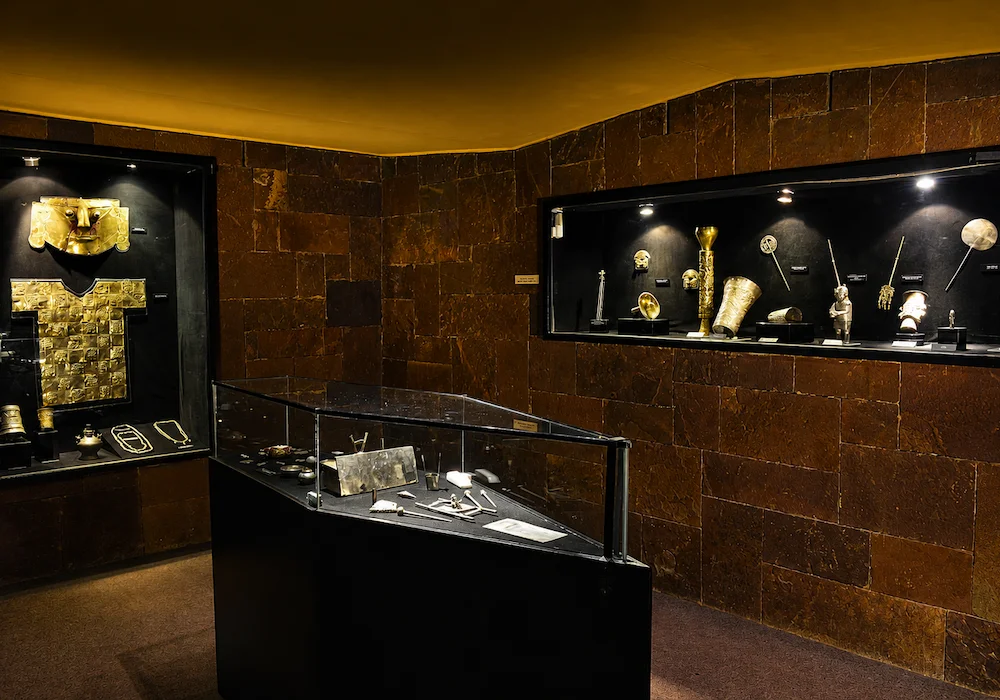
Nestled in the residential district of Santiago de Surco, the Miguel Mujica Gallo Foundation preserves one of the most famous and distinctive private collections of pre-Columbian metallurgy and historical militaria in South America: the Gold Museum of Peru and Arms of the World. Assembled during the mid-20th century by Peruvian diplomat and connoisseur Miguel Mujica Gallo, this armored multi-level underground vault houses thousands of masterworks hammered in gold, silver, and tumbaga alloys by ancient artisans from the Vicus, Mochica, Lambayeque (Sican), Chimu, Nazca, and Inca cultures, complemented on upper floors by an extraordinary private armory featuring over 20,000 historic weapons spanning centuries and civilizations.
01 Origin of the Collection: The Passion of Miguel Mujica Gallo
The Gold Museum of Peru and Arms of the World is the life's work of prominent Peruvian businessman, diplomat, and connoisseur Miguel Mujica Gallo (1910–2001). Over several decades of international travels and expeditions across Peru's northern desert coast during the 1940s and 1950s, Mujica Gallo assembled an extraordinary array of pre-Columbian antiquities and historic militaria to establish a permanent cultural foundation for the nation.
Inaugurated at its permanent home in the Monterrico neighborhood of Santiago de Surco, the institution is administered by the Miguel Mujica Gallo Foundation. The structure was engineered as an impenetrable fortress with thick reinforced concrete walls and a massive underground vault secured by bank-grade armored doors, designed expressly to protect invaluable metallurgical masterpieces.
The Sacred Radiance of the Sun in Ancient Peru
To ancient Andean civilizations, gold was never a medium of financial commerce as in Europe. Rather, it was venerated as the tangible sweat of the Sun God (Inti)—a celestial substance imbued with sacred energy worn by divine monarchs, high priests, and mummified royal ancestors to ensure their eternal immortality in the cosmos.
02 Pre-Columbian Gold Masterpieces: Funerary Masks, Tumis & Regalia
Descending into the climate-controlled underground vault, travelers enter a dimly lit chamber where illuminated display vitrines spotlight the gleaming metallurgy of Peru's foremost pre-Hispanic cultures:
Sicán & Chimú Funerary Masks
Monumental repoussé gold faceplates featuring winged turquoise eyes and amber teardrops that enveloped the heads of mummified desert lords.
Ceremonial Knives (Tumis)
Iconic crescent-bladed sacrificial knives crowned by the mythical figure of the deity Naylamp, intricately inlaid with chrysocola, turquoise, and spondylus.
Pectorals, Crowns & Nose Ornaments
Elaborately hammered sheets of pure gold with feline and serpent motifs that transformed the human body into a radiant solar divinity.
The collection also showcases ceremonial gold beakers (keros and aquillas) depicting combat and sacrifice rituals, articulated royal gold gloves, and exquisite mantle pins (tupus) crafted via lost-wax casting and delicate cold-hammering techniques.
03 Arms of the World Collection: Swords, Samurai Armor & Historic Rifles
Occupying the spacious upper levels of the complex, the Arms of the World Museum represents one of the largest private militaria collections globally, encompassing over 20,000 cataloged artifacts:
European Medieval & Renaissance Armory
Full suits of 15th- and 16th-century knight's plate armor, Toledo steel chainmail, ceremonial halberds, and rapiers forged by master armorsmiths in Solingen and Toledo.
Asian Weaponry & Feudal Samurai Armor
Authentic Japanese katanas and wakizashis from the Kamakura and Edo periods, full samurai battle suits (yoroi), Persian scimitars, and Damascus daggers inlaid with jade.
Weaponry of Celebrated Historical Figures
Highlights include ceremonial gold-hilted sabers gifted to Spanish monarchs, personal flintlock dueling pistols linked to Napoleon Bonaparte, and ivory-inlaid firearms crafted for Russian imperial dignitaries.
04 Comparison Guide of Primary Exhibits & Iconic Treasures
Overview of the primary wings and galleries across the dual museum complex:
| Gallery / Wing | Building Location | Cultures & Eras | Signature Masterpieces |
|---|---|---|---|
|
Most Celebrated Gold Museum Vault |
Armored Basement Levels -1 & -2 | Pre-Columbian (Vicus, Sican, Chimu, Inca) | Turquoise-eyed funerary masks, ceremonial tumis, gold crowns & pectorals |
| Western Historic Armory | First & Second Upper Floors | 13th to 19th Centuries (Europe & Americas) | Knight's plate armor, Toledo steel rapiers & Napoleonic firearms |
| Oriental & Asian Weaponry | Main Floor Thematic Wing | Feudal Japan & Islamic Near East | Feudal samurai armor (yoroi), antique katanas & Persian scimitars |
| Pre-Columbian Textiles & Mummies | Adjacent Vault Galleries | Paracas, Chancay & Wari | Intricate funerary mantles, mummy bundles & ceremonial ceramics |
05 Opening Hours, 2026 Admission Fees & Planning Your Visit
Practical visitor logistics for planning your excursion to the Gold Museum:
Opening Hours
Open Monday through Sunday from 10:30 a.m. to 6:00 p.m. (last ticket sold at 5:00 p.m.). Mid-day and early afternoon hours generally offer the quietest gallery atmosphere.
2026 Admission Fees
Standard adult admission is approximately S/ 33 for both international and Peruvian visitors, and S/ 16 for children under 11. One ticket includes access to both the Gold and Arms collections.
Recommended Transportation
Public mass transit does not connect directly to the Monterrico neighborhood. Visitors are strongly advised to arrange roundtrip transport via app-based taxis or book a private guided tour with hotel pickup and drop-off from Miraflores or San Isidro.
06 Museography & Historical Authenticity Assessments
In the early 2000s, the Gold Museum of Peru underwent comprehensive metallurgical and radiographic technical assessments conducted by cultural protection authorities and Peruvian archaeologists. The findings indicated that while certain artifacts acquired in past decades were modern reproductions or reconstructed utilizing contemporary alloys, the overwhelming majority of the repository —particularly the Vicus, Chimu, and Inca royal funerary attires and the world-renowned historic armory— represents authentic, irreplaceable cultural heritage.
Today, the institution displays updated didactic signage, allowing lovers of pre-Columbian art and international travelers to appreciate the astounding metallurgical ingenuity of ancient Andean civilizations in an engaging, transparent educational setting.
07 Private Guided Museum Experiences with Lima Tour Peru
At Lima Tour Perú, we curate private, door-to-door cultural excursions featuring certified bilingual historian guides and modern climate-controlled vehicles:
Gold Museum of Peru Private Tour
Door-to-door transfer from your hotel in Miraflores or San Isidro, coordinated admissions, and an in-depth private guided exploration.
Custom QuoteColonial & Modern Lima City Tour
Explore the Main Square, Lima Cathedral, San Francisco Catacombs, and clifftop parks with an official licensed guide.
From US$ 35 per personTo reserve custom private excursions or speak with our travel planners, contact us via our Contact Us page.
Recommended reading: Larco Museum in Pueblo Libre · Archaeological Sites & Huacas in Lima · Huaca Pucllana Pyramid Guide.
08 Frequently Asked Questions about the Gold Museum of Peru
Where is the Gold Museum of Peru located and how can visitors reach it from Miraflores or San Isidro?
The museum is situated at Jr. Alonso de Molina 1100 in the Monterrico neighborhood of Santiago de Surco. From tourist hubs like Miraflores, San Isidro, or Barranco, the journey by private vehicle or authorized taxi takes approximately 25 to 40 minutes depending on daytime traffic via Av. Primavera or the Pan-American highway.
Which pre-Columbian civilizations are represented inside the gold vault?
The underground vault features ceremonial attire and funerary regalia from Peru's greatest coastal and Andean metallurgical civilizations: Vicus, Mochica, Lambayeque (Sican), Chimu, Nazca, Paracas, Chancay, and Inca, featuring crowns, pectoral collars, large ear spools, and repoussé beakers.
Does the entrance ticket grant access to both the gold and arms collections?
Yes. The standard general admission ticket includes full entry to both permanent exhibitions: the armored underground vault of the Gold Museum of Peru and the extensive upper-level exhibition halls of the Arms of the World Museum.
Is photography permitted inside the exhibition galleries?
Non-flash photography for personal and educational use is generally allowed. In the underground gold vault, specific security guidelines apply to prevent reflections and preserve viewing comfort around high-security display vitrines. Checking with gallery attendants upon entry is advised.
How much time is recommended for a thorough visit of both museums?
Visitors should budget between 1.5 and 2 hours in total: approximately 45 to 60 minutes for the underground pre-Columbian metallurgy vault and a similar duration to explore the extensive thematic military history galleries.