


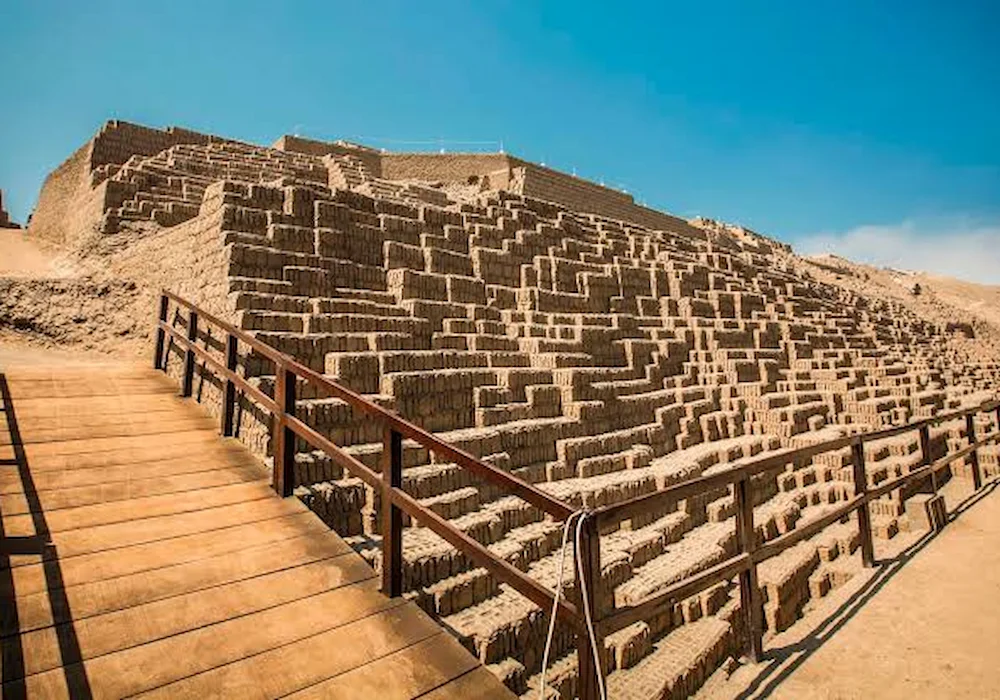
Nestled in the upscale residential and commercial core of Miraflores, framed by contemporary avenues and high-rise residences, Huaca Pucllana stands as an astonishing monument to Lima's multi-millennial ancestral heritage. Erected around 500 AD by the Lima Culture and later revered as an elite cemetery and administrative center by the Wari and Ychsma civilizations, this colossal 25-meter-high stepped pyramid weathered seismic shifts and the passage of fifteen centuries thanks to an ingenious earthquake-resistant «bookcase» adobe brick engineering. Today, Pucllana provides international travelers an archaeological experience unparalleled in South America: touring sunlit ancient ceremonial plazas by day or marveling at floodlit adobe ramparts by night while savoring contemporary Peruvian cuisine at its celebrated on-site restaurant. This definitive guide details its history, 2026 official ticket hours, tips, and official private tours.
01 Millenary Origins: The Lima Culture & Sacred Pucllana Complex
Long before Spanish conqueror Francisco Pizarro plotted the viceregal grid of the Historic Center of Lima in 1535, Peru's central Pacific coastline sustained a sophisticated network of pre-Columbian hydraulic civilizations. Between 200 and 700 AD, during the Early Intermediate Period, the Lima Culture flourished across the fertile river valleys fed by the Rímac, Chillón, and Lurín rivers. Within modern-day Miraflores, this society of farmers, sea navigators, and priests constructed their supreme ceremonial and administrative acropolis: Huaca Pucllana (originating from the native coastal Quechua word pugllana, meaning «a sacred place for ceremonial games and sacred rituals»).
The ceremonial complex originally encompassed over 20 hectares (50 acres), integrating the Great Stepped Pyramid with expansive ceremonial plazas, grain storage silos, and elite residential enclosures for the theocratic ruling class. The site's spatial alignment was carefully calculated: major ramps and courtyards aligned with seasonal solstices and the underground canals feeding coastal crops, turning the pyramid into an immense agricultural observatory honoring the sea and regional water deities.
Lima Culture Era (200–700 AD)
Monumental construction of the Great Stepped Pyramid as the political, administrative, and religious hub governing the lower Rímac river valley.
Wari Reoccupation (800–1000 AD)
The southern highland Wari Empire conquered coastal Lima and transformed the upper pyramid terraces into a sacred necropolis for high-ranking lords and priestesses.
Ychsma Period (1000–1470 AD)
Late pre-Inca coastal lordships utilized the site for ancestral veneration offerings before the Inca Empire incorporated the territory into Tawantinsuyu.
By the late 20th century, informal urban development had reduced the archaeological zone to 6 hectares (15 acres). In 1981, a visionary team of Peruvian archaeologists directed by Dr. Isabel Flores Espinosa initiated an ongoing multidisciplinary research, excavation, and conservation program backed by the Municipality of Miraflores and the Ministry of Culture. Today, Huaca Pucllana stands as South America's most celebrated model of urban archaeological preservation and public tourism.
02 Seismic Engineering in Clay: The Genial «Bookcase» Adobe Technique
Coastal Lima lies directly along the Pacific Ring of Fire, one of the planet's most seismically active zones. Faced with powerful subduction earthquakes that would have shattered rigid solid masonry, ancient Lima master architects engineered an ingenious earthquake-resistant construction method: the renowned «bookcase technique» (técnica del librero).
Rather than laying sun-dried adobe bricks horizontally in rigid cemented rows, workers shaped millions of compact clay bricks by hand, known as adobitos (often bearing the visible fingerprints of the ancient craftsmen who shaped them). These bricks were set vertically on their edges in parallel freestanding panels, leaving narrow expansion gaps between vertical rows mortared with soft coastal mud and crushed seashell paste.
Elastic Seismic Energy Dissipation
Much like books lined up vertically on a library shelf that can wobble and lean independently during a tremor without collapsing the entire bookcase, the individual brick panels flex and absorb seismic shockwaves freely.
Battered Trapezoidal Inclined Walls
Monumental walls were constructed with wide trapezoidal foundations tapering gradually toward the top. This battered incline lowered the center of mass, preventing structural tipping under severe lateral ground movement.
Communal Tribute & Collective Crafting
Different agricultural communities (ayllus) manufactured and contributed batches of clay bricks using soil from their local irrigation channels. Archaeologists can trace varying clay tones and sizes across the walls reflecting collective communal labor.
Thanks to this brilliant architectural innovation, the 25-meter-high, seven-tiered truncated pyramid spanning over 500 meters in length has survived fifteen centuries of major earthquakes, remaining structurally sound to this day.
03 Daytime Exploration vs. Evening Magic: Illumination & Haute Cuisine
One of Huaca Pucllana's defining appeals is its dual personality: an informative archaeological adventure by day, and a dramatically illuminated mystical spectacle by night.
Daytime Tours: Structural Depth & Botanical Grounds
Perfect for photography, architecture enthusiasts, and families. Daylight accentuates the earthen textures of the seven stepped terraces and sacrificial offering pits, granting access to the native flora garden (purple corn, lúcuma, pacae trees) alongside resident Andean camelids and Peruvian hairless dogs.
Night Tours: Atmospheric Floodlights & Urban Contrast
After sunset, a sophisticated warm LED lighting scheme illuminates the soaring adobe terraces, casting captivating shadows along ancient staircases against Lima's evening sky. The tranquil atmosphere provides a mesmerizing contrast with the bustling metropolitan lights of Miraflores.
Situated directly on the archaeological perimeter, the acclaimed on-site restaurant showcases refined contemporary Peruvian gastronomy. Dining on the open-air terrace with a front-row view of the floodlit 1,500-year-old pyramid rising into the night is universally praised by culinary critics as one of South America's most unforgettable dining experiences. Advanced table reservations are essential.
04 On-Site Museum, Wari Ancestral Offerings & Native Wildlife
Every guided tour through Pucllana includes admission to the modern Site Museum, a climate-controlled gallery displaying masterworks unearthed across four decades of ongoing excavations:
Highlight exhibits include intact funeral bundles (fardos) belonging to the Wari elite, notably the «Lord of the Unkus», discovered complete with woven ceremonial tunics, sculpted wooden funerary masks inlaid with mother-of-pearl, and anthropomorphic clay vessels. Also displayed are intricate Lima Culture ceramics decorated with stylized sharks and interlocking serpents, alongside burial evidence of young female ritual sacrifices dedicated during the pyramid's closure ceremonies.
Peruvian Hairless Dog (Viringo)
Huaca Pucllana cares for a protected pack of native Peruvian hairless dogs, an ancient pre-Columbian breed designated as National Cultural Heritage. Revered for their warm skin and hypoallergenic nature, they served as medicinal companions in ancient coastal homes.
Ancient Native Botanical Garden
Living agricultural plots cultivated with indigenous plants domesticated thousands of years ago: giant white choclo corn, pallar lima beans, native chillies, achiote seasoning, lúcuma fruits, and naturally colored brown and beige native cotton.
Andean Camelids & Guinea Pigs
A traditional corral hosts live llamas and alpacas alongside Andean guinea pigs (cuyes), demonstrating the vital highland trading connections maintained by the coastal Lima peoples.
05 Official 2026 Opening Hours, Admission Fees & Online Booking
To ensure effortless logistics for your excursion to Huaca Pucllana, here are the verified operating conditions and entry fees for 2026:
Opening Hours
Wednesday to Monday: Daytime shift 09:00 AM to 04:15 PM.
Evening shift: Wednesday to Sunday 07:00 PM to 09:30 PM.
Tuesdays: Closed all day for archaeological conservation.
Official Admission Rates
Daytime general ticket: S/ 15.00 PEN (approx. US$ 4.00).
Evening illuminated ticket: S/ 17.00 PEN.
Students & children: S/ 7.50 to S/ 8.50 PEN with valid student ID.
Mandatory Booking & Guided Tours
Admission is strictly regulated via mandatory online reservation through the official ticketing portal or via authorized private operators. All visitors are escorted by official site guides to preserve delicate earthen ruins.
06 Practical Tips for Your Visit: Footwear, Photography & Miraflores Strolls
To ensure a safe, comfortable, and memorable archaeological visit, keep these practical recommendations from our local guides in mind:
The visiting trail climbs historic compacted earth and loose gravel ramps. Avoid high heels or slick sandals; cushioned athletic shoes provide secure traction on stepped ramps.
Around 03:00 PM the afternoon golden sun casts dramatic side shadows across the bookcase adobe textures. For night tours, ensure your camera has optical stabilization or a night exposure mode.
The ancient clay bricks are fragile and easily damaged by skin oils and friction. Always remain on marked timber walkways and avoid leaning against delicate ceremonial walls.
07 How to Experience Huaca Pucllana & Miraflores with Lima Tour Peru
As an official inbound tour operator licensed by MINCETUR and PROMPERU under the RAP Travel Peru group (RUC 20490005022), we connect Pucllana's ancient heritage with Lima's greatest highlights through tailored private excursions:
Colonial & Modern Lima City Tour
Scenic panoramic visit of Huaca Pucllana, walking stroll along Miraflores' Love Park, and comprehensive exploration of the UNESCO Historic Center and Catacombs.
From US$ 35 per personPachacamac Sanctuary & Barranco
Connect the story of Lima Culture with the coastal ocean oracle of Pachacamac in Lurín Valley and the bohemian charm of Barranco's Bridge of Sighs.
From US$ 45 per personPrivate Larco Museum Tour
The premier archaeological counterpart: an 18th-century viceregal mansion housing South America's finest pre-Columbian gold, silver, and erotic pottery.
From US$ 50 per personPeruvian Food Tour & Dining
Savor traditional fruit and ceviche market tastings, craft pisco sour cocktails, and an exclusive evening dinner facing the floodlit pyramid.
From US$ 85 per personAll private experiences feature climate-controlled vehicles, licensed drivers, door-to-door hotel transfers in Miraflores, San Isidro, and Barranco, certified bilingual guides, and 24/7 dedicated assistance. Request a customized quote via our Contact Us page.
Recommended reading: Archaeological Sites in Lima: Guide · Miraflores Travel Guide · Historic Center of Lima · Real Felipe Fortress in Callao.
07 Frequently Asked Questions about Huaca Pucllana
Why is Huaca Pucllana famous and which civilization built it?
Huaca Pucllana is famous as Miraflores' foremost pre-Columbian ceremonial and administrative center. Erected around 500 AD by the Lima Culture using millions of handmade adobe bricks arranged vertically in the ingenious «bookcase technique», its earthquake-resistant architecture has endured for over 1,500 years. Later, it served as an elite burial ground for the Wari Empire and a sacred site for the Ychsma culture.
Is it better to visit Huaca Pucllana by day or at night?
Both visits offer distinct, complementary experiences: daytime tours allow travelers to appreciate intricate adobe brick masonry, tour the native botanical garden, and observe indigenous Peruvian hairless dogs and Andean camelids. Nighttime tours feature atmospheric LED floodlights washing over ancient stepped terraces, creating a magical visual contrast with modern Miraflores.
Is advance booking required to visit Huaca Pucllana?
Yes. Under Ministry of Culture preservation regulations and visitor capacity limits, admission is strictly conducted in guided groups with mandatory advance reservation via the official ticketing portal or through an authorized tour operator with hotel pickup. Tickets are not sold without an assigned time slot.
How does the Huaca Pucllana Restaurant work, and is an admission ticket required to dine?
The Huaca Pucllana Restaurant operates independently within the archaeological boundary. Guests do not need to purchase a monument ticket to dine; however, exploring the pyramid ramparts and site museum requires official admission. Due to its international culinary acclaim, booking tables at least two weeks in advance is strongly recommended.
What days is Huaca Pucllana open and what are the visiting hours?
It opens Wednesday through Monday (closed on Tuesdays for archaeological conservation maintenance). Daytime hours run from 09:00 AM to 04:15 PM, while illuminated evening tours operate Wednesday through Sunday from 07:00 PM to 09:30 PM.