


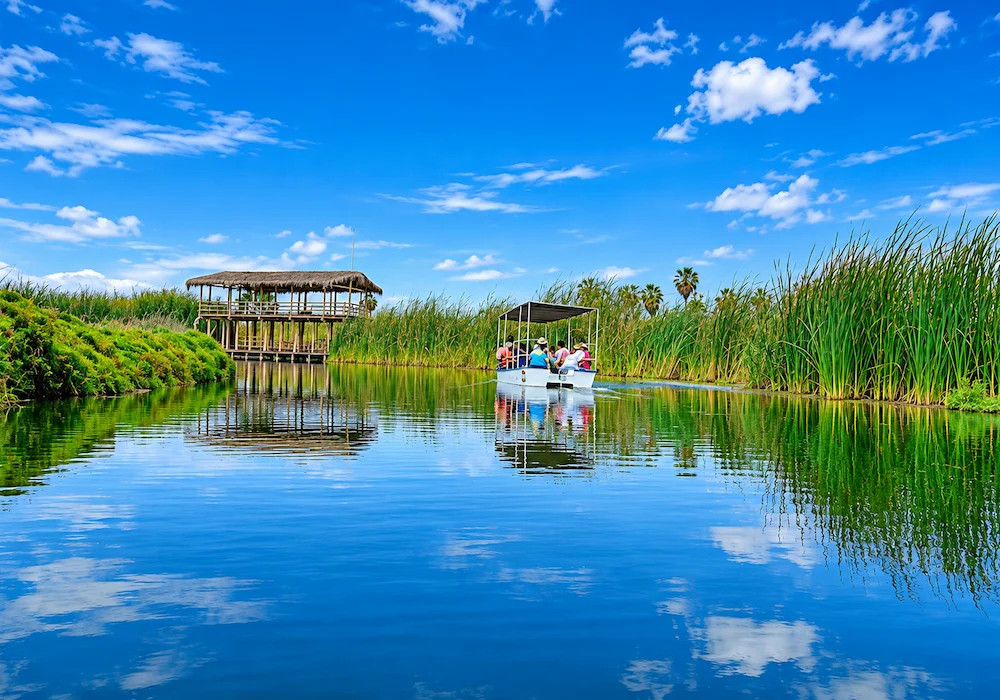
Located just 35 minutes south of the tourist hubs of Miraflores and Barranco in the coastal district of Chorrillos lies one of the most remarkable ecological sanctuaries of the Peruvian desert coast: the Pantanos de Villa Wildlife Refuge. Internationally designated as a Ramsar Wetland Site in 1997, this subtropical coastal oasis encompasses over 263 hectares (650 acres) of brackish lagoons, lush reedbeds, and freshwater marshes that provide vital stopover habitat and permanent shelter for more than 210 bird species, both resident and transcontinental migrants. Walking its elevated boardwalk trails, gliding on peaceful traditional rowboats, and observing waterfowl from scenic blinds delivers an unforgettable wilderness immersion within Lima's urban perimeter.
01 Origin & Ecosystem: Lima's Premier Protected Coastal Wetland
Amidst the urban expansion of Lima —the world's second-largest desert metropolis after Cairo— the Pantanos de Villa Wildlife Refuge stands as a hydrogeological and biological sanctuary. Located in the coastal district of Chorrillos, this wetland is nourished by subterranean groundwater aquifers flowing from the Andean foothills and the Rimac river basin, which surface here before filtering into the Pacific Ocean.
Covering an area of 263.27 hectares (650 acres) of brackish lagoons, littoral marshes, and dense totora reedbeds, the refuge is an ecological beacon. On January 20, 1997, it received international recognition as a Ramsar Wetland Site of International Importance. Today it is managed collaboratively by Peru's National Protected Natural Areas Service (SERNANP) and the Municipal Authority of Pantanos de Villa (PROHVILLA).
Key Ecosystem Role
Pantanos de Villa acts as an ecological bio-filter for coastal aquifers, sequesters atmospheric carbon, stabilizes coastal microclimates, and serves as an indispensable refueling stopover on the Pacific Flyway for millions of transcontinental migratory birds.
02 Avian Biodiversity: Over 210 Species on the Pacific Shoreline
The principal highlight of Pantanos de Villa is its exceptional ornithological richness. Naturalists and birders have recorded over 210 bird species, spanning permanent residents, seasonal Andean migrants, and long-distance transcontinental travelers crossing hemispheres.
Resident Waterfowl
Species nesting year-round across the lagoons: the white-tufted grebe (Rollandia rolland), plumbeous rail, common gallinule, black-crowned night heron, and white-cheeked pintail.
Egrets & Wading Birds
Graceful waders stalking through shallow channels: the great egret (Ardea alba), little blue heron, snowy egret, and seasonal visits of the puna ibis descending from high Andean plateaus.
Transcontinental Migrants
Between November and March, vast flocks of Franklin's gulls, spotted sandpipers, elegant terns, and peregrine falcons stop over after epic journeys from North America and the Arctic tundra.
03 Visitor Circuits: Boardwalk Trails, Watchtowers & Boat Excursions
The refuge boasts low-impact visitor infrastructure carefully developed to offer close-up wildlife observation without disturbing fragile bird nesting colonies:
Traditional Circuit (Main Lagoon)
The primary and most accessible loop. Features elevated wooden boardwalks over the marshes, three covered panoramic watchtowers, and the central dock for traditional rowboat excursions guided by local boatmen.
Genesis & Marvilla Trails
Ecological trails tailored for gentle hiking and nature photography. Traverse inland saltwater meadows, natural springs, and the coastal shorelines where resting shorebirds gather.
Traditional Rowboat Excursions
Navigating the calm waters of the Main Lagoon takes approximately 30 to 40 minutes. Because rowboats utilize no combustion engines, they glide silently within arm's reach of totora reed nests, delivering outstanding wildlife photo opportunities unavailable from land.
04 Comparison Guide of Wetland Trails & Viewing Experiences
Compare the visitor options at Pantanos de Villa to choose the route that best suits your travel schedule and birding preferences:
| Trail / Experience | Average Duration | Difficulty & Access | Main Highlight |
|---|---|---|---|
|
Top Recommended Traditional Trail + Rowboat on Main Lagoon |
1 hr 30 min to 2 hours | Easy / Boardwalk & Boat | Silent navigation, waterfowl nesting colonies & observation blinds |
| Main Lagoon Walking Boardwalk | 45 to 60 minutes | Easy / Flat wooden trail | Covered watchtowers and panoramic wetland vistas |
| Genesis Spring Loop | 40 minutes | Easy / Packed earth path | Natural groundwater springs, totora reeds, and flora |
| Marvilla Shoreline Circuit | 50 minutes | Easy / Sandy footpath | Franklin's gulls, coastal sandpipers, and ocean breezes |
05 Visiting Hours, 2026 Ticket Prices & Best Seasons for Birding
Timing your visit properly guarantees spectacular sightings of foraging, courting, and resting waterfowl:
Opening Hours
Open Monday through Sunday from 8:30 a.m. to 4:30 p.m. (last admission to trails at 3:30 p.m.). The early morning hours (8:30 to 10:30 a.m.) and late afternoon (3:00 to 4:30 p.m.) offer the highest bird activity and softest photography light.
2026 Admission Fees
Refuge entrance fees managed by SERNANP/PROHVILLA are approximately S/ 15 to S/ 20 for international adults and S/ 10 for Peruvian residents. The optional rowboat excursion costs approximately S/ 12 to S/ 15 per person.
Pro Field Recommendations
Carry binoculars or a camera equipped with a telephoto lens (300mm+ recommended). Wear neutral-toned clothing (khaki, beige, or olive green) to avoid startling shy waders. Bring reef-safe or biodegradable sunscreen, drink water, and keep noise to a minimum on the wooden walkways.
06 How to Get There from Miraflores & Combined Day Itineraries
Pantanos de Villa is situated on Av. Hernando de Lavalle s/n, alongside the Old South Pan-American Highway in Chorrillos. The safest and most convenient way to reach the reserve from Miraflores, San Isidro, or Barranco is via private vehicle or app-based ride services (a 30 to 45-minute drive depending on traffic).
The Ultimate Southern Lima Circuit: Due to its coastal location, Pantanos de Villa pairs flawlessly into a half-day or full-day itinerary that merges archaeology, coastal wilderness, and bohemian arts:
1. Pachacamac Sanctuary
Explore the millennia-old adobe pyramids of the pre-Inca coastal oracle, the Sun Temple, and the Virgins of the Sun Sanctuary in Lurin Valley.
2. Pantanos de Villa
Unwind amidst serene wetland boardwalks and rowboat tours discovering coastal biodiversity just outside the bustling city.
3. Bohemian Barranco
Cap off the afternoon crossing the Bridge of Sighs, browsing street art murals, and savoring ocean-view cocktails at sunset.
07 Private Southern Lima Experiences with Lima Tour Peru
At Lima Tour Perú, an official certified tour operator under the RAP Travel Peru group (MINCETUR and PROMPERÚ licensed), we craft seamless private itineraries connecting Lima's historical and ecological highlights:
Pachacamac & Barranco Private Tour
Door-to-door excursion with climate-controlled transport, licensed private guide, and seamless coordination across southern Lima.
From US$ 45 per personCustom Nature & Birdwatching Day Trips
Tailor-made private journeys with specialized naturalist guides, binoculars, and coastal gastronomy experiences.
Custom QuoteFor personalized group bookings or custom itineraries, connect directly with our travel specialists via our Contact Us page.
Recommended reading: Bridge of Sighs in Barranco · Archaeological Sites in Lima · Callao Tours & Real Felipe Guide.
08 Frequently Asked Questions about Pantanos de Villa
What is the best season of the year for birdwatching migratory species at Pantanos de Villa?
The peak birdwatching season runs from November through April (austral spring and summer). During these months, tens of thousands of boreal migratory birds arrive from North America and the Arctic to overwinter, along with austral species dispersing from Patagonia and the high Andes.
Is advance booking required to take the boat excursion on the Main Lagoon?
Traditional rowboats managed by certified local boatmen operate on a first-come, first-served basis at the Main Lagoon checkpoint. However, on weekends, holidays, or for organized private groups, arriving early (before 10:30 a.m.) or coordinating with an authorized tour operator is highly recommended to guarantee access without wait times.
What essential equipment is recommended for an optimal birding excursion?
Visitors should carry field binoculars (8x42 or 10x42), a telephoto camera lens (300mm or longer), comfortable walking shoes, a broad-brimmed sun hat, sunscreen, and eco-friendly biodegradable insect repellent to avoid contaminating sensitive aquatic habitats.
Are the trails and facilities safe and accessible for families with children and seniors?
Yes. The Wildlife Refuge features flat, well-marked wooden boardwalks with safety railings, covered observation blinds, and permanent park rangers from SERNANP and PROHVILLA. The traditional circuit is gentle and fully suitable for visitors of all ages.
How can a visit to Pantanos de Villa be combined with nearby tourist attractions?
Due to its strategic position along Lima's southern coastal corridor, the ideal itinerary pairs an early morning tour of Pachacamac Archaeological Sanctuary with a seaside seafood lunch in Chorrillos or Lurin Valley, an afternoon nature walk in Pantanos de Villa, and sunset cocktails at Barranco's Bridge of Sighs.