

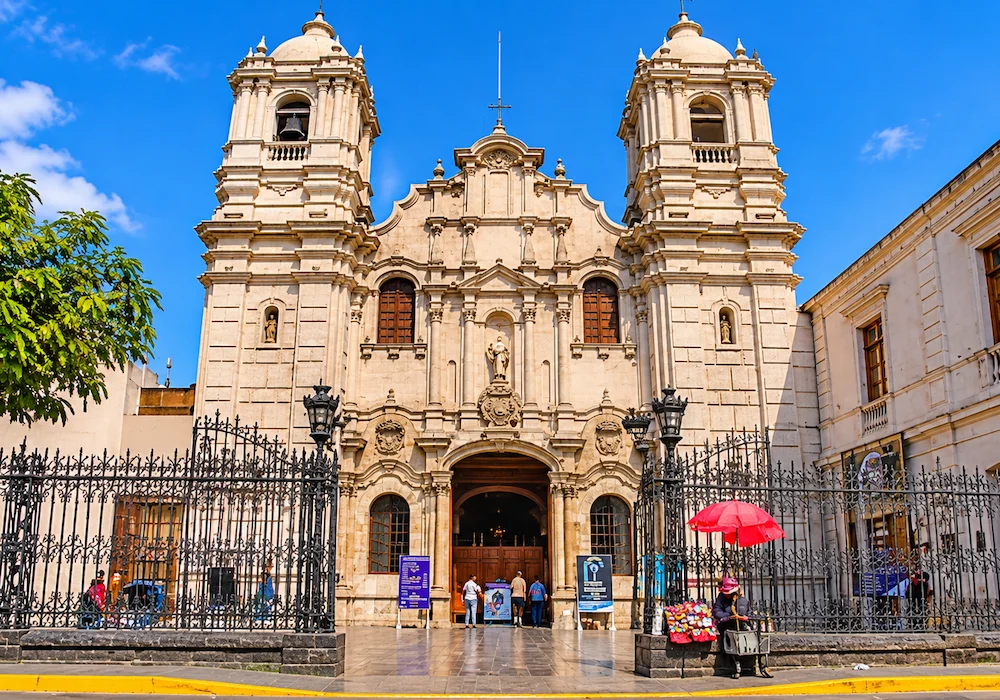
At the crossroads of Jirón Huancavelica and Avenida Tacna in downtown Lima stands one of the most revered Catholic sanctuaries in the Americas: the Sanctuary and Monastery of Las Nazarenas. This sacred site is the cradle of the largest Catholic procession in the world: devotion to the Lord of Miracles (Señor de los Milagros, also hailed as the Black Christ or Christ of Pachacamilla). Painted around 1651 on a humble adobe wall by an enslaved Angolan man, the sacred fresco miraculously survived completely unscathed the catastrophic earthquakes of 1655, 1687, and 1746 that flattened colonial Lima. Today, Las Nazarenas draws millions of purple-clad pilgrims, houses an exquisite viceregal museum, and shelters the cloistered Discalced Carmelite Nazarene nuns. This definitive guide unveils its history, visiting and mass hours, October traditions, and guided cultural tours.
01 Sacred Origins: Benito of Angola & The 1651 Pachacamilla Mural
In the mid-17th century, the district of Pachacamilla—situated just beyond Lima's formal Spanish grid where Avenida Tacna meets Jirón Huancavelica today—was home to modest quarters inhabited by enslaved and freed Afro-descendants from West and Central Africa, organized into mutual-aid confraternities according to their ancestral nations.
Around the year 1651, an enslaved Angolan man remembered in oral tradition as Benito of Angola (or Pedro Dalcón in other historical chronicles), guided by profound spiritual devotion, painted with natural earth pigments onto a crude adobe wall the image of Christ crucified. The fresco portrayed Christ in tranquil agony, crowned by the Holy Spirit in the form of a dove and God the Father above, later joined by the figures of the Virgin Mary and Saint John the Apostle mourning at the foot of the cross.
Afro-Peruvian Spiritual Legacy
Rendered on unfired adobe and lime in an impoverished settlement, the mural offered deep spiritual consolation to enslaved workers amidst harsh labor.
Failed Attempt to Erase the Fresco (1671)
When church authorities ordered the unauthorized mural painted over, painters sent up ladders suffered inexplicable tremors and swoons, prompting the viceroy to sanction devotion.
First Official Mass (September 14, 1671)
In response to unstoppable public devotion, the first solemn mass was celebrated before Viceroy Count of Lemos, formally inaugurating institutional worship.
That humble mud wall, painted without classical European training by loving hands, was destined to become the supreme emblem of spiritual identity in Peru.
02 The Earthquakes of 1655, 1687 & 1746: The Miracle of the Unbroken Wall
Lima rests directly upon the circum-Pacific seismic belt. Throughout viceregal times, catastrophic earthquakes leveled the capital, yet before each disaster the adobe mural of Pachacamilla defied all natural laws:
The Great Earthquake of November 13, 1655
A devastating tremor brought down stone mansions and cathedral bell towers across Lima and Callao. In Pachacamilla, every surrounding shack collapsed into dust; only the fragile mud wall bearing the Christ fresco stood entirely intact without a hairline fracture.
The Cataclysm of October 20, 1687
An extreme tremor pulverized the capital once again. The sacred wall survived undamaged, prompting Spanish benefactor Sebastián de Antuñano to commission an exact oil-on-canvas replica to process through Lima's streets for the first time.
The 1746 Earthquake and Callao Tsunami
The mightiest recorded earthquake in Lima's history leveled 90% of urban structures. While ornate masonry vaults collapsed across the center, the adobe wall of the Lord of Miracles stood solitary and unbroken amid the ruins.
Contrary to popular misconception, the image enthroned above Las Nazarenas' high altar is not an oil painting on canvas or wood: it is the original 1651 mud-and-straw wall. The entire 18th-century rococo sanctuary was constructed around this sacred masonry, encasing it within solid embossed silver frames and armored protective glass.
03 Viceregal Rococo Splendor: Viceroy Amat's Church & Carmelite Cloister
The present church is a crown jewel of 18th-century viceregal art. Following the 1746 earthquake, pious Catalan Viceroy Manuel de Amat y Junyent personally championed and funded the construction of the monumental sanctuary, consecrated in grandeur on January 20, 1771.
Executed in the refined Lima rococo style with transitional neoclassical restraint, the sanctuary showcases rusticated pilaster facades, a soaring hemispherical dome crowned by an octagonal lantern, and resplendent gilded altarpieces carved by Lima's premier master joiners.
Adjoining the sanctuary is the Monastery of Discalced Carmelite Nazarene Nuns, established in 1730 under Teresian reform. Within this strictly cloistered enclosure, contemplative nuns dedicate their days to perpetual prayer for humanity, hand-craft the purple habits worn by devotees, and stand guard over the sacred wall forming the back of their choir.
04 The Purple Month: The World's Largest Catholic Procession & Canvas
Every October, Lima completely transforms: balconies are draped in regal purple tapestries, storefronts display gold crests, and thick clouds of incense drift through the colonial air. This is the Mes Morado (Purple Month), when the Lord of Miracles departs the sanctuary to navigate historic avenues in what the Holy See recognizes as the largest ongoing Catholic procession in the world.
To safeguard the fragile 1651 adobe wall from outdoor exposure, the procession carries a 17th-century double-sided oil canvas depicting Christ on the front and Our Lady of the Cloud on the reverse. This processional canvas rests upon a monumental litter (anda) encased in nearly half a ton of embossed silver, borne aloft by rotating brotherhood squads (cuadrillas) accompanied by traditional incense bearers and cantoras singing colonial hymns.
Bearers and Brotherhood
Over 5,000 members organized into 20 historical cuadrillas taking turns in flawless choreography carrying the 2-ton litter across 18-hour processions.
Traditional Sahumadoras
Devout women wearing purple veils walking backward in rhythm before the float, billowing fragrant clouds of myrrh and copal incense.
Nazarene Choir Cantoras
Singers preserving century-old viceregal hymns that accompany the gentle sway of the silver anda through the historic heart of Lima.
05 Las Nazarenas Museum, Official Mass Schedules & 2026 Visits
The sanctuary welcomes pilgrims and cultural travelers daily with free admission. For deeper historical appreciation, the on-site Lord of Miracles Museum (Jr. Huancavelica 515) delivers an immersive journey across centuries of devotion:
| Area / Experience | Admission Rate | Operating Hours 2026 | Visitor Details |
|---|---|---|---|
| Las Nazarenas Sanctuary | Free General Entry | Monday to Sunday (06:00 - 20:00) | Prayer before the high altar & regular masses |
| Lord of Miracles Museum | S/ 5.00 to S/ 10.00 PEN | Tuesday to Saturday (09:00 - 17:00) | Viceregal paintings, colonial silver & papal relics |
|
Recommended Private Historic Lima City Tour |
From US$ 35 per person | Customized daily departures | Private transport, certified guide, Main Square & catacombs |
Daily mass schedule: Celebrated throughout the day at 07:00, 09:00, 10:30, 12:00, 17:30, 19:00, and 20:00. Respectful attire and silent contemplation are requested during services.
06 Limeño Culinary Heritage: The Legend of Turrón de Doña Pepa
Devotion to the Lord of Miracles is inextricably linked to Lima's most celebrated traditional confection: Turrón de Doña Pepa. Surrounding the sanctuary along Avenida Tacna and Jirón Huancavelica, time-honored artisanal bakeries display freshly made turrón all 365 days of the year.
Constructed from crisp aniseed-scented pastry batons stacked in alternating layers, the confection is drenched in fragrant chancaca unrefined molasses honey infused with figs, apples, and citrus, crowned with festive colored sprinkles.
Historic bakeries lining Avenida Tacna—such as Turrones Calderón, San José, Las Nazarenas, and Joel—prepare authentic artisanal recipes handed down across generations.
Artisan stalls outside the sanctuary offer blessed detente cloth badges, miniature silver medals, and traditional purple cords.
Avenida Tacna is a bustling central avenue. Keep valuables secure in crowded transit hubs and cross at marked pedestrian crossings.
07 How to Experience Las Nazarenas with Lima Tour Peru
As an official inbound tour operator under RAP Travel Peru (RUC 20490005022, certified by MINCETUR and PROMPERU), we provide enriching cultural excursions designed for comfort and peace of mind:
Colonial & Modern Lima City Tour
Guided exploration of the UNESCO Historic Center, Plaza Mayor, San Francisco Catacombs, and viceregal religious heritage.
From US$ 35 per personColonial City Tour + Gourmet Lunch
Pair architectural marvels with an oceanfront multi-course traditional Peruvian buffet in Miraflores.
From US$ 70 per personAll private excursions feature professional drivers, climate-controlled vehicles, and 24/7 dedicated assistance. Contact our travel specialists via our Contact Us page.
Recommended reading: Historic Center of Lima Travel Guide · Lima Cathedral & Pizarro's Crypt · Lima Main Square Complete Guide.
08 Frequently Asked Questions about Las Nazarenas Church
What is the historical origin of the purple robe worn by devotees and the brotherhood?
The purple habit was introduced in the late 17th century by Mother Antonia Maldonado Verdugo (Mother Antonia of the Holy Spirit), founder of the Nazarene Beguinage. Inspired by a spiritual vision of Christ dressed in a purple robe with a white cord symbolizing penance, sacrifice, and forgiveness, she clothed her sisterhood in violet. Devotees and the official Brotherhood of the Lord of Miracles subsequently adopted purple as their universal devotion emblem.
What materials make up the processional litter of the Lord of Miracles and how much does it weigh?
The processional litter (anda) is a masterpiece of viceregal and republican silver craftsmanship. Constructed of solid oak encased in nearly 500 kilograms of exquisitely repoussé-embossed sterling silver, it is crowned by golden halos, four corner guardian angels, and massive floral arrangements. The entire ensemble weighs over 2 metric tons (approx. 4,400 lbs), carried entirely on the shoulders of rotating squads of 32 to 36 bearers (cargadores).
What is the story of Josefa Marmanillo and the creation of traditional Turrón de Doña Pepa?
Josefa Marmanillo was an enslaved Afro-Peruvian cook from the Cañete Valley who suffered debilitating paralysis in her arms. A passionate devotee of the Black Christ, she traveled to Lima during the October processions praying for healing. Upon miraculously regaining the full use of her hands, she crafted in thanksgiving a confectionery of aniseed shortbread sticks bathed in fruit-infused sugarcane chancaca honey and rainbow sprinkles, inaugurating Peru's iconic October dessert.
What contemplative role do the cloistered Discalced Carmelite Nazarene nuns fulfill in the monastery?
Since 1730, the cloistered Discalced Carmelite Nazarene nuns have lived under strict papal cloister in the monastery adjoining the sanctuary. Their perpetual mission is contemplative prayer, hand-stitching the purple habits and cloth devotional badges (detentes) distributed to pilgrims, and directly safeguarding the sacred 1651 adobe mural, which forms the back wall of their convent choir.
Can the Lord of Miracles Museum be visited year-round and what historic artifacts are on display?
Yes, the museum welcomes visitors Tuesday through Saturday year-round at Jirón Huancavelica 515. Its galleries exhibit viceregal oil paintings from the Lima school, gold-embroidered velvet vestments historically adorning the processional canvas, presidential medals, colonial liturgical silver vessels, and original colonial notary manuscripts documenting the earliest confirmed miracles.