


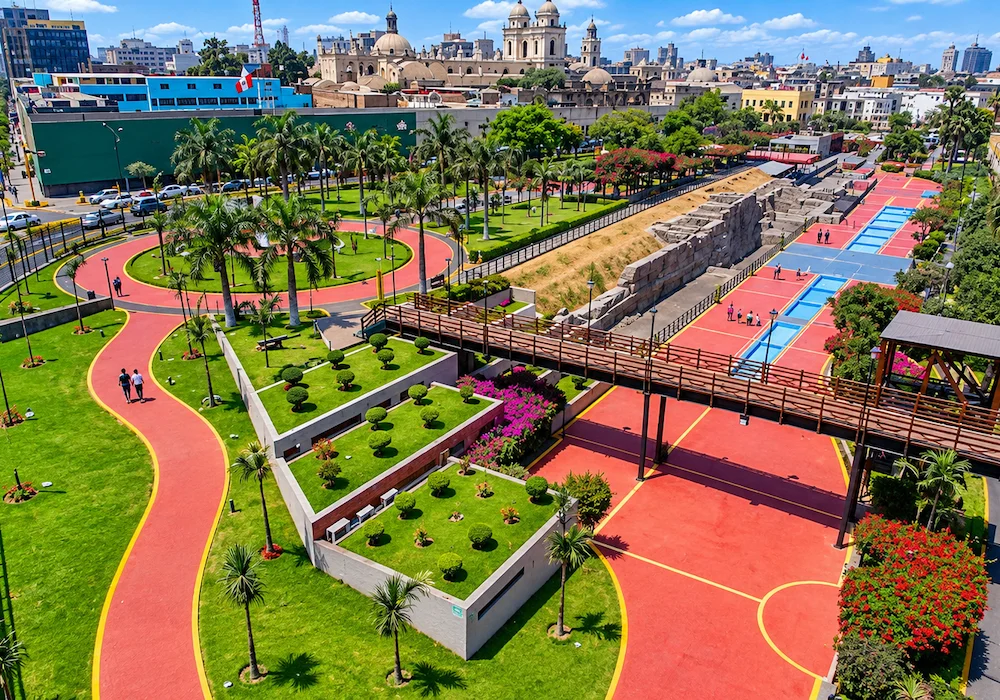
Perched along the southern bank of the Rimac River, directly behind the historic Saint Francis Convent and merely three blocks from Lima's Main Square, Parque de la Muralla preserves the most imposing archaeological vestige of the defensive fortification of the City of Kings. Constructed between 1684 and 1687 under the direction of Viceroy Melchor de Navarra y Rocafull, Duke of La Palata, to repel incursions by English and Dutch pirates, the viceregal city wall encircled Lima for nearly two centuries until its dismantling in 1871. Its monumental archaeological recovery and restoration in 2004 converted a forgotten riverfront sector into an inspiring public heritage park featuring an on-site archaeological museum, expansive viewpoints towards San Cristóbal Hill, and lush landscaped promenades connecting colonial history with modern civic life.
01 History of Lima's City Walls & the 17th-Century Pirate Threat
During the 17th century, the City of Kings reigned as the crown jewel and administrative heartbeat of the Spanish Empire in South America. Through its cobbled avenues flowed vast consignments of silver extracted from Potosi before being loaded at Callao port onto galleons bound for Panama and Cadiz. This legendary accumulation of wealth made Lima and its Pacific approaches prime targets for European privateers, corsairs, and buccaneers.
Following destructive Pacific raids led by English mariners Francis Drake and Thomas Cavendish, and culminating with the alarming 1684 expedition of pirate Edward Davis, Viceroy Melchor de Navarra y Rocafull, Duke of La Palata, mandated the immediate fortification of the viceregal capital. Constructed between 1684 and 1687 under the supervision of Flemish military engineer Jean Raymond Coninck, this massive defensive rampart stretched over 11 kilometers (6.8 miles), featuring 34 polygonal bastions and 10 monumental gateway portals that shielded Lima from foreign assault.
From Viceregal Defense to Urban Resurgence
As Lima expanded in the republican era, President José Balta ordered the demolition of the city walls in 1871 to make way for modern ring boulevards. For over 130 years, surviving foundations lay buried beneath river debris along the Rimac River until 2004, when municipal archaeologists unearthed, stabilized, and reopened the site as the beloved Parque de la Muralla.
02 The Rimac River Embankment & Stone Bastion Architecture
The segment preserved within Parque de la Muralla represents one of the most structurally complex sectors of the entire viceregal fortification: the riverfront curtain wall and the famous Tajamar de San Francisco embankment, engineered to accomplish a dual defensive purpose:
Hydraulic Flood Barrier
Deflecting the violent seasonal flash floods of the torrential Rimac River during Andean summer thaws, safeguarding churches, monasteries, and residential quarters from riverbank erosion.
Military Artillery Bastion
Serving as a raised gun platform and lookout post to repel potential infantry or riverborne amphibious advances from the northern banks of San Lázaro (today's Rímac district).
The walls were built utilizing the ancient colonial masonry technique known as calicanto: a heavy mortar blend of quicklime, coarse river sand, volcanic ash, and river boulders, reinforced in critical joints with kiln-fired bricks. This resilient composite withstood the violent earthquakes of 1687 and 1746 without catastrophic failure.
03 On-Site Archaeological Museum: Colonial & Ychsma Relics
At the park's center stands the Parque de la Muralla Site Museum, a modern cultural pavilion that showcases priceless artifacts uncovered during municipal archaeological rescue digs in 2004:
Pre-Hispanic Ychsma Culture
Ceremonial vessels, utilitarian pottery, and copper fishing hooks testifying to centuries of pre-Inca coastal settlement along the fertile Rimac banks long before Francisco Pizarro's arrival in 1535.
Colonial Daily Living
Terracotta amphoras for Spanish wine and Andalusian olive oil, tin-glazed Panamanian majolica dinnerware, and Dutch white-clay smoking pipes illustrating Lima's far-reaching trade ties.
Military Armament & Coins
Cast-iron cannonballs, sword hilts, viceregal cavalry horseshoes, and genuine silver coins minted at the Royal Mint of Lima (Casa de Moneda).
04 The Equestrian Statue of Pizarro & San Cristóbal Viewpoints
The park provides a home for one of the most iconic historical monuments in the capital: the colossal equestrian bronze statue of Francisco Pizarro, the Spanish founder of Lima in 1535.
Sculpted in 1935 by renowned American artist Charles Cary Rumsey, the multi-ton dynamic bronze masterpiece depicts the armored conqueror atop his charging steed. After standing for decades at the cathedral atrium and later on a public square flanking Government Palace, it was moved in 2003 to Parque de la Muralla. Displayed at ground level, it allows visitors to study the exquisite sculptor's craft up close and engage with Peru's complex, multi-layered historical heritage.
Panoramic Rimac & San Cristóbal Lookouts
The park's riverside promenades provide striking vistas of San Cristóbal Hill crowned by its glowing cross, the colorful hillside barrios of the Rímac district, the Baroque bell towers of Saint Francis Convent, and the iron Balta Bridge spanning the river.
05 Comparison Guide of Key Highlights at Parque de la Muralla
Overview of the principal historical attractions and amenities within the park grounds:
| Park Attraction / Sector | Historical Era | Admission & Access | What to See |
|---|---|---|---|
|
Unmissable 17th-Century City Wall & San Francisco Embankment |
17th Century (1684-1687) | Free / Public Access | Authentic calicanto defensive ramparts, river floodwalls & bastions |
| On-Site Archaeological Museum | Pre-Hispanic & Colonial Eras | Free / Public Access | Ychsma ceramics, weaponry, colonial tableware & silver coins |
| Francisco Pizarro Equestrian Statue | 20th Century (Cast in 1935) | Free / Public Access | Monumental bronze sculpture by Charles Cary Rumsey |
| Rimac River & San Cristóbal Lookout | Contemporary / Scenic Overlook | Free / Public Access | Panoramic sights of the river, Balta Bridge & surrounding hills |
06 Hours, Free Admission & Easy Walking Routes from Main Square
Parque de la Muralla is conveniently situated at Jirón Amazonas s/n (intersection with Jr. Lampa) along the northern edge of Lima's Historic Downtown:
Visiting Hours
The park is open Monday through Sunday from 8:00 a.m. to 6:00 p.m. The on-site museum typically operates Tuesday through Sunday from 9:00 a.m. to 5:00 p.m. Mid-morning to mid-afternoon (9:30 a.m. to 4:30 p.m.) provides ideal natural lighting.
Walking from Main Square
Merely 400 meters (a 5-minute stroll) from Lima's Main Square. Walk from Government Palace along Jr. Carabaya to the House of Literature, turn right on Jr. Ancash past Saint Francis Convent, and descend directly into the park grounds.
Park Amenities & Family Comfort
The facility offers clean municipal restrooms, ornamental fountains, shaded benches under palm trees, wide paved wheelchair-accessible paths, and full daytime security provided by Lima's municipal guard and Tourism Police.
07 How to Experience Parque de la Muralla with Lima Tour Peru
Parque de la Muralla provides the perfect scenic finale after visiting the majestic cathedral, Government Palace, and subterranean catacombs. At Lima Tour Perú, we weave this vital historic fortification into our premier guided circuits:
Colonial & Modern Lima City Tour
Explore the Main Square, Lima Cathedral, San Francisco Catacombs, Parque de la Muralla, and Miraflores clifftop parks with a licensed guide.
From US$ 35 per personColonial City Tour + Gourmet Lunch
Pair in-depth historical exploration with an oceanfront multi-course traditional Peruvian buffet in Miraflores.
From US$ 70 per personAll private excursions feature professional drivers, climate-controlled vehicles, and 24/7 dedicated assistance. Contact our travel specialists via our Contact Us page.
Recommended reading: Complete Guide to Lima Historic Center · Lima Cathedral & Pizarro's Crypt · Torre Tagle Palace: Viceregal Gem.
08 Frequently Asked Questions about Parque de la Muralla
Is there an admission fee for Parque de la Muralla and its on-site museum?
Admission to Parque de la Muralla's gardens, pedestrian walkways, and river viewpoints is completely free to the general public. The on-site archaeological museum operated by the Municipality of Lima also features free admission or a nominal community fee depending on temporary exhibitions.
How safe is it to walk from Lima's Main Square and Saint Francis Basilica to the park?
It is very safe and straightforward during daylight hours. The park is situated merely two blocks north of Saint Francis Basilica via Jr. Lampa or Jr. Amazonas, along pedestrian corridors monitored by Lima Tourism Police and municipal security patrols. Visiting during daytime hours (between 8:00 a.m. and 5:30 p.m.) is recommended.
Why was the equestrian statue of Francisco Pizarro relocated to this park?
The bronze statue cast in 1935 by American sculptor Charles Cary Rumsey originally stood in the cathedral atrium and later on a corner plaza of the Main Square. In 2003, as part of a civic initiative to recontextualize historic public spaces, the municipality relocated it to Parque de la Muralla, presenting it as an educational historical monument without an elevated domineering plinth.
What archaeological artifacts stand out in the park's on-site museum?
The museum showcases authentic structural segments of the 17th-century river stone tajamar, pre-Hispanic ceramics from the coastal Ychsma culture unearthed during excavation, colonial wine and olive oil amphoras, iron cannonballs, swords, and imported 17th- and 18th-century tin-glazed majolica tableware.
How much time is required to tour the park and what nearby landmarks should be combined?
A thorough visit takes between 45 minutes and 1.5 hours. It connects seamlessly on foot with the Catacombs of Saint Francis Convent, Government Palace on the Main Square, the House of Peruvian Literature (former Desamparados Station), and the historic Stone Bridge leading into traditional Rimac district.