


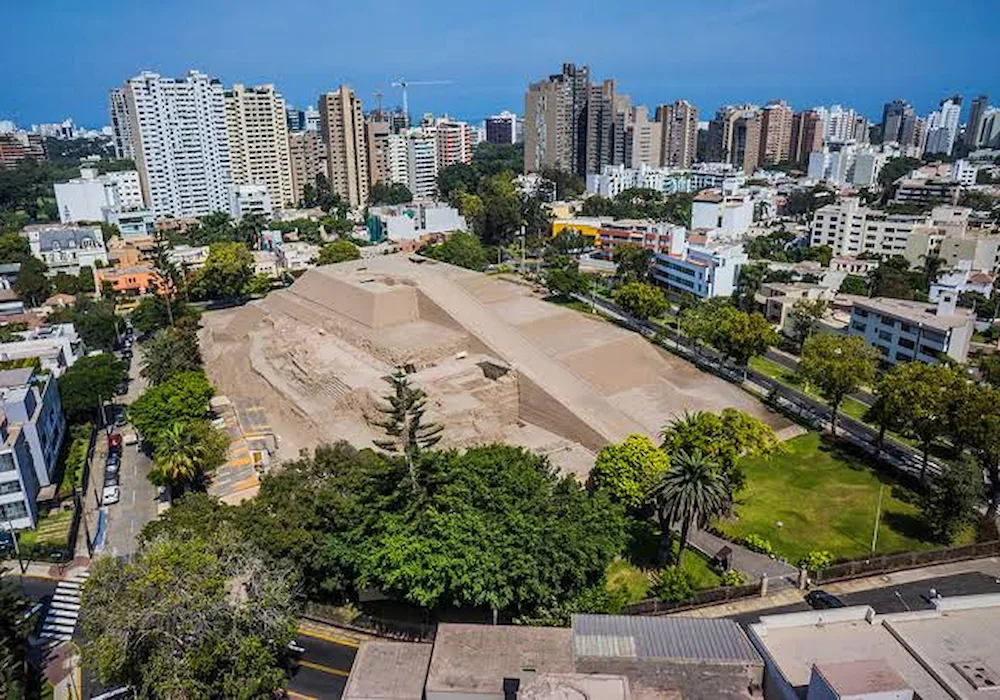
In the heart of Lima's premier corporate and diplomatic district, framed by sleek glass skyscrapers, upscale residences, and embassies in San Isidro, rises an imposing ochre-yellow earthen monument that dramatically defies modern metropolitan bustle: Huaca Huallamarca. Historically known as «Pan de Azúcar» (Sugarloaf), this stepped mud-brick pyramid featuring a signature central ramp dates to the 2nd century BC. Over centuries, it functioned as a ceremonial sanctuary for the Pinazo culture, an elite burial necropolis for Hualla and Ychsma lords, and a venerated shrine under Inca administration. Today, its restored monumental silhouette and on-site museum provide an extraordinary window into Lima's ancient civilizations. This comprehensive guide covers its history, museum treasures, 2026 visiting hours, and private guided excursions.
01 Millenary Origins: From Pinazo Sanctuary to Sacred Hualla Cemetery
For international visitors strolling through the refined residential avenues of San Isidro, flanked by gleaming banking towers and diplomatic embassies, encountering a colossal mud-brick pyramid is an unforgettable sight. Huaca Huallamarca stands as one of the oldest monuments in the Lima valley, with initial ceremonial foundations dating back to approximately the 2nd century BC during the Late Formative and Early Intermediate periods.
Across more than fifteen centuries of uninterrupted sacred usage, the pyramid served evolving functions under distinct pre-Columbian societies:
Pinazo Ceremonial Shrine (200 BC – 200 AD)
Initial construction of the truncated stepped pyramid as a communal temple and solar observation center by coastal communities of the Pinazo tradition.
Hualla Sacred Necropolis (600 – 1000 AD)
After being decommissioned as an active temple, the summit was converted into an elite burial ground by the Hualla lordship, interring noble ancestors in elaborate bundles.
Ychsma & Inca Hamlet (1100 – 1532 AD)
Late pre-Columbian farmers erected storage rooms and domestic quarters along the base, peacefully incorporating into the expanding Inca Empire.
The name Huallamarca derives from two indigenous roots: Hualla, the name of the local coastal chieftaincy that governed this fertile section of the Rímac valley, and marca, an ancient Quechua and Aymara term signifying a protected village, community, or homeland.
02 Monumental Architecture: The Great Access Ramp & Handcrafted Adobes
The most captivating architectural signature of Huaca Huallamarca is its sweeping central access ramp. Measuring nearly 10 meters wide and extending over 80 meters in length, the inclined ceremonial pathway gently ascends from the lower courtyard to the pyramid's upper sacred platform, soaring 18 meters above surrounding street level.
Unlike Huaca Pucllana, which used vertical bookcase masonry, Huallamarca reveals three distinct structural methods:
Odontiform Tooth-Shaped Adobes (Earliest Phase)
Hand-formed conical mud bricks placed vertically in tight clusters, forming durable retaining barriers for the earliest ceremonial platforms.
Box-Molded Rectangular Adobes (Middle Phase)
Sun-dried rectangular clay bricks laid horizontally in overlapping courses, bonded with fine sand-clay mortar.
Tapial Rammed Earth & Cobble Foundations (Late Phase)
Massive rammed-earth sections characteristic of Ychsma engineering, reinforcing the upper terraces against seismic shifts.
Huallamarca's monumental ramp faces due east, aligned with the sunrise during the Andean equinoxes. Standing atop the summit delivers an incomparable visual encounter: ancient 2,000-year-old mud architecture in the foreground framed by glass skyscrapers along San Isidro's financial corridor.
03 Site Museum: Intact Braided Mummies, Ancient Looms & Grave Goods
Nestled at the foot of the pyramid, the Huaca Huallamarca Site Museum exhibits one of the most remarkable bioarchaeological collections in Peru. Scientific excavations in 1958 unearthed over 70 undisturbed funerary bundles (fardos), exceptionally preserved by the hyper-arid coastal desert microclimate.
Key highlights of the museum include:
The Lady of the Long Braids
An exceptionally preserved elite Hualla noblewoman displayed flexed with her natural dark hair intricately styled in dozens of fine, waist-length braids.
Native Cotton Textiles
Ceremonial shrouds woven on backstrap looms from natural brown and white cotton, embroidered tunics (unkus), and sacred coca pouches (chuspas).
Ritual Musical Instruments
Cane panpipes, carved bone flutes, ceramic rattles, and pyro-engraved gourd vessels placed to accompany the deceased on their journey to the spirit realm.
04 The 1958 Rescue: Dr. Arturo Jiménez Borja's Vision Against Urban Sprawl
By the mid-20th century, rapid residential subdivision across San Isidro threatened to bulldoze the earthen mound into building plots. In 1958, distinguished Peruvian physician and archaeologist Dr. Arturo Jiménez Borja, backed by the municipality and archaeological patrons, spearheaded a historic preservation campaign.
Jiménez Borja not only systematically excavated the necropolis but painstakingly restored the grand access ramp and stepped terraces based on structural traces found in the mud foundations. His intervention rescued Huallamarca from destruction, making it the very first ancient monument successfully preserved and showcased within Lima's modern urban core.
Inscribed as National Cultural Heritage, Huaca Huallamarca is managed by Peru's Ministry of Culture. It serves as an active educational and research monument bridging ancient Andean roots with contemporary urban life.
05 Official 2026 Opening Hours, Admission Fees & San Isidro Transit
Here is the essential verified logistical data for planning your visit to Huaca Huallamarca in 2026:
| Tour Option / Category | Official Rate | Visiting Hours | Inclusions |
|---|---|---|---|
| General Adult Admission | S/ 5.00 PEN (~US$ 1.40) | Tuesday to Saturday (09:00 - 17:00) | Pyramid access & site museum entry |
| Student / Child Reduced Rate | S/ 1.00 to S/ 3.00 PEN | Tuesday to Saturday (09:00 - 17:00) | With valid student or youth ID |
|
Recommended Private Colonial & Modern City Tour |
From US$ 35 per person | Daily departures (morning or afternoon) | Private vehicle, driver, certified guide & hotel pickup |
Exact Address: Av. Nicolás de Rivera 201 (corner with Av. El Rosario), San Isidro. Located just 4 blocks from historic El Olivar Park and 10 minutes by taxi from Larcomar in Miraflores.
06 Practical Tips for Your Visit: Footwear, Photography & El Olivar Strolls
Make the most of your exploration with these proven recommendations from our team:
Ascending the 80-meter incline ramp requires steady footing on restored earthen slopes. Avoid high heels or open flip-flops.
Late afternoon (between 3:30 PM and 5:00 PM) bathes the adobe walls in warm golden light, accentuating ramp shadows against modern skyscrapers.
Just a 500-meter stroll away lies San Isidro's historic grove with century-old olive trees planted in the 17th century by Saint Martin de Porres.
The monument closes on Sundays and Mondays for conservation upkeep. Schedule your visit Tuesday through Saturday.
07 How to Experience Huaca Huallamarca with Lima Tour Peru
At Lima Tour Peru, part of the RAP Travel Peru group (RUC 20490005022, certified by MINCETUR and PROMPERU), we connect Lima's millenary past with modern comfort:
Colonial & Modern Lima City Tour
Scenic panoramic views of San Isidro and Miraflores huacas, coastal boardwalks, and guided exploration of the UNESCO Historic Center.
From US$ 35 per personPachacamac Sanctuary & Barranco
Discover ancient Peru's sacred oceanfront oracle and the romantic cliffside viewpoints of the Bridge of Sighs in Barranco.
From US$ 45 per personAll private excursions feature professional drivers, climate-controlled vehicles, and 24/7 dedicated assistance. Contact our travel specialists via our Contact Us page.
Recommended reading: Huaca Pucllana Miraflores Pyramid Guide · Archaeological Sites in Lima · Historic Center of Lima Travel Guide.
08 Frequently Asked Questions about Huaca Huallamarca
Why was Huaca Huallamarca historically called «Pan de Azúcar» (Sugarloaf)?
During the viceregal and early republican eras, the monument lay within the boundaries of the San Isidro estate, owned by the Counts of San Isidro. Because the weathered earthen mound resembled the traditional conical clay molds used to shape unrefined loaf sugar on coastal sugarcane plantations, local residents affectionately referred to it as «Pan de Azúcar» (Sugarloaf Hill).
What unique musical instruments and textiles were discovered alongside the Huallamarca mummies?
Excavations yielded delicate panpipes (antaras) fashioned from reed, carved bone flutes, miniature wooden drums, naturally dyed cotton yarn spools, cactus-spine needles, and pyro-engraved gourd vessels adorned with geometric and marine figures, reflecting the vibrant musical and artistic traditions of ancient Rímac Valley communities.
How does Huallamarca's adobe construction method differ from that of Huaca Pucllana?
While Huaca Pucllana in Miraflores was engineered using the «bookcase technique» (small rectangular bricks stacked vertically on end with flex spaces), Huallamarca's earliest architectural phases employed handmade odontiform (tooth-shaped or conical) adobes, later transitioning to solid rectangular clay bricks laid in horizontal tiers over gravel-filled stone foundations.
How did the ancient Huatica irrigation canal influence agriculture in San Isidro and Huallamarca?
The prehistoric Huatica irrigation canal, diverted from the Rímac River over fifteen centuries ago, traversed directly through San Isidro and Huallamarca, transforming arid coastal desert into highly productive fields of maize, cotton, beans, and squash. This ancient watercourse continued functioning throughout colonial times, later irrigating the historic olive grove of nearby El Olivar Park.
Can visitors take professional photographs or host cultural gatherings at Huaca Huallamarca?
Personal handheld photography without tripods is welcomed and free during standard tourist opening hours. However, commercial photoshoot sessions, professional tripod filming, and evening cultural events require advance formal permits and fees issued by the Ministry of Culture in coordination with the site museum's administrative staff.