


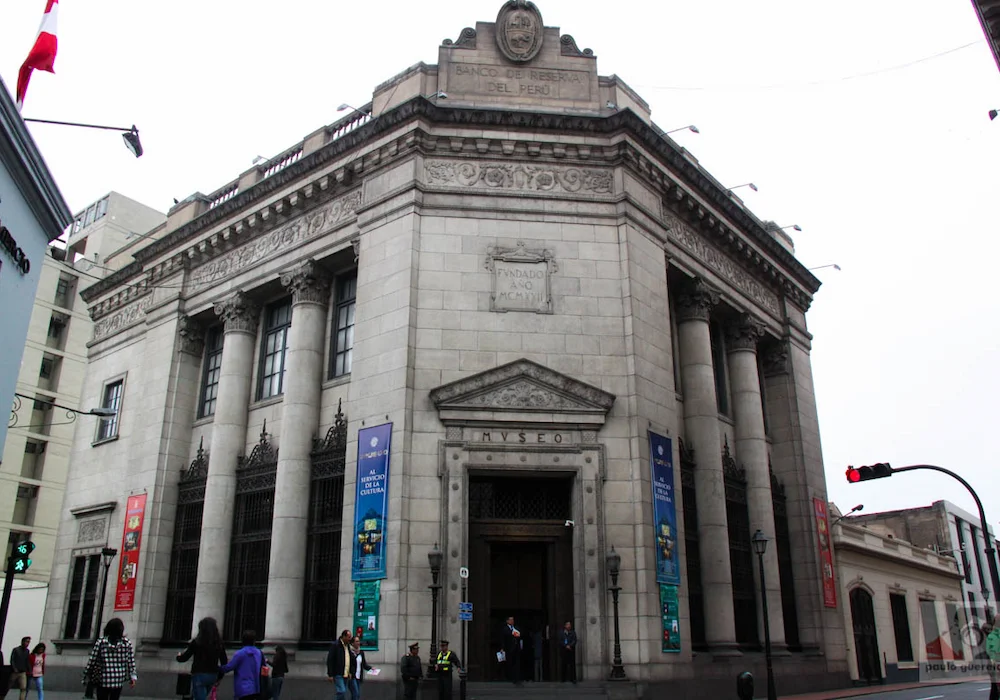
At the aristocratic intersection of Jr. Lampa and Jr. Ucayali, just a few short blocks from Lima's Main Square, stands one of the Historic Downtown's best-kept and most rewarding cultural sanctuaries: the Central Reserve Bank Museum (MUCEN). Housed within the majestic 1929 neoclassical and Art Deco banking palace, this premier institution offers completely free admission while safeguarding an astonishing heritage collection: an impenetrable subterranean Gold Vault brimming with pre-Columbian gold and silver treasures from the Vicus, Lambayeque, and Chimu civilizations; the nation's most comprehensive numismatic archive tracing coins struck since the 16th century; and a prestigious fine art gallery celebrating coastal, Andean, and Amazonian artistic masterworks.
01 The Historic Central Bank Headquarters: A 1929 Landmark
Strolling along Jiron Ucayali in Lima's Historic Downtown is an architectural journey through centuries of viceregal grandeur and early republican elegance. Facing the celebrated carved cedar Mudéjar balconies of the Torre Tagle Palace stands a majestic stone edifice: the former central headquarters of the Central Reserve Bank of Peru, celebrated today as the Central Museum (MUCEN).
Inaugurated in 1929 and designed by architects trained at the prestigious Ecole des Beaux-Arts in Paris, this monument blends the symmetry of neoclassical architecture with exquisite Art Deco ironwork and stained-glass ceilings. Its soaring Carrara marble tellers' rotunda and coffered ceilings were engineered to convey financial strength and institutional integrity. Today, that stately ambience provides a magnificent backdrop for one of Lima's most hospitable public cultural sanctuaries: admission is completely free for all visitors year-round.
National Historic Landmark
Constructed in 1929 as the sovereign mint and central bank headquarters, featuring marble banking counters and soaring entry atriums.
100% Free Public Admission
Fully sponsored by Peru's Central Bank as a civic gift to citizens and international travelers; simply present your ID or passport at entry.
Pedestrian Jiron Ucayali
Superbly positioned along one of Downtown Lima's most photogenic, safe, and pedestrianized thoroughfares, steps from San Pedro Basilica.
Visitor Security and Entry Protocol
As an active government financial institution building, visitors must pass through a walk-through metal detector and register large backpacks in the complimentary cloakroom, guaranteeing a secure, serene experience in the historic core.
02 The Gold Vault: Pre-Hispanic Treasures in the Bank's Deep Vault
MUCEN's star attraction lies deep below street level. Descending into the subterranean vaults through stairwells lined with reinforced concrete, visitors are greeted by the massive circular chrome steel door of the bank's historic high-security treasury vault. Crossing this armored threshold reveals not modern paper money, but an incomparably richer treasure: the renowned Hugo Cohen Pre-Columbian Gold & Silver Collection.
Subtly illuminated against deep black velvet, the vault showcases solid hammered gold crowns of the Sican / Lambayeque civilization, ceremonial ear ornaments inlaid with turquoise and lapis lazuli, biconical nose ornaments from the Vicus culture, and crimson-cinnabar-painted funerary masks that accompanied coastal lords into the afterlife.
Golden Sican Headdresses
Elaborate repousse crowns adorned with natural plumes and winged deities signifying the celestial authority of northern Peru's rulers.
Cinnabar Death Masks
Ceremonial funerary coverings fitted with winged eyes, turquoise bead pendants, and golden nose flares found in ancient coastal tombs.
Historic 15-Ton Steel Door
An engineering marvel manufactured by the Mosler Safe Company of New York in the early 20th century to safeguard sovereign national bullion.
03 Numismatics Gallery: Macuquinas, Viceregal Reales & the Modern Sol
As the nation's central monetary authority, the BCR curates Peru's definitive numismatic collection on the ground floor. The exhibit provides an engaging narrative of how Andean society transitioned from pre-Columbian reciprocity and redistribution (where cotton textiles and red Spondylus shells served as exchange media) to the globalized mercantile monetary system introduced by Spain.
The founding of the Lima Mint in 1565 —the first in South America— initiated the striking of irregularly hammered silver cobs known as macuquinas. The gallery showcases these early hand-clipped pieces, along with pristine 18th-century milled pillar dollars (reales columnarios), wartime emergency coins struck during the independence campaigns, early bank paper notes, and the 20th-century evolution through the Sol de Oro and Inti.
Global Currency of the 16th and 17th Centuries
Peruvian silver coins struck in Lima and Potosi served as the world's premiere global reserve currency during the early modern era, freely traded from Madrid and London to Canton, China, and Manila via the historic Manila Galleon trade fleets.
04 Fine Arts & Traditional Crafts: From Sarhua to Modern Masters
The upper level of MUCEN is dedicated to Peruvian folk crafts and visual arts. Rejecting rigid hierarchical divisions between 'high academic art' and 'popular craft', the museum presents a democratic dialogue that places traditional indigenous masters on an equal footing with contemporary easel painters.
Highlights include the renowned Painted Boards of Sarhua from Ayacucho (declared National Cultural Heritage), intricate multi-tiered portable altarpieces (retablos), glazed clay church roof ornaments from Quinua, geometric Kene textiles painted with natural river clays by Shipibo-Konibo Amazonian artists, and award-winning canvases from the annual Central Reserve Bank National Painting Competition.
Sarhua Painted Boards
Historic wooden beams painted with feather quills illustrating family genealogies, community work rituals, and Andean cultural memories.
Amazonian Kene Textiles
Intricate sacred geometric patterns created by Shipibo-Konibo artisans reflecting cosmic healing visions and deep rainforest spiritual ties.
National BCR Painting Prize
Annual grand prize canvases honoring innovative 21st-century visual artists pushing the boundaries of contemporary Peruvian identity.
05 Comparative Table: Top Free-Admission Museums in Downtown Lima
Historic Downtown Lima boasts exceptional museums offering 100% free or nominal admission. Review this handy comparative guide:
| Museum / Venue | Street Address | Primary Exhibit | Unmissable Highlight | Admission Fee |
|---|---|---|---|---|
| MUCEN (BCR Central Museum) | Jr. Ucayali 291 | Pre-Hispanic gold, coins & traditional art | Underground Bank Vault of Gold | 100% Free (Year-Round) |
| House of Peruvian Literature | Jr. Ancash 207 | Peruvian literature, Vallejo & Arguedas | Historic Desamparados Railway Station | 100% Free |
| Bodega y Quadra Museum | Jr. Ancash 213 | In-situ viceregal archaeological dig | 16th-century stone arches and water cistern | 4 PEN |
| Archbishop's Palace Museum | Plaza Mayor de Lima | Colonial religious art and bishops' chambers | Carved cedar balconies overlooking the square | 14 PEN |
06 Opening Hours, Free Admission Rules & 2026 Practical Tips
Make your visit to MUCEN smooth and enjoyable with these essential tips:
Official Operating Hours
Open Tuesday through Sunday from 9:00 a.m. to 5:00 p.m. Closed on Mondays for museum maintenance and technical conservation.
Mandatory Photo ID
All visitors must present original physical government photo identification (Peruvian DNI or foreign passport) at the entrance checkpoint.
Amenities & Accessibility
Full wheelchair ramps, elevators serving all gallery floors, complimentary safe storage lockers, and pristine modern restrooms.
Pedestrian Jiron Ucayali Exploration
Take time to wander Jiron Ucayali on foot: right beside MUCEN sits Goyeneche Palace, while Torre Tagle Palace is directly opposite. Walking two blocks east brings you straight into Lima's vibrant Chinatown (Calle Capon) for dim sum and authentic Peruvian-Chinese chifa dining.
07 Explore Historic Downtown Lima with Lima Tour Peru
Historic Downtown Lima boasts one of the highest concentrations of architectural treasures in Latin America. With guided excursions by Lima Tour Peru, you enjoy safety, private transfers, and rich cultural storytelling:
Colonial & Modern Lima City Tour
The definitive city tour connecting the Main Square, Lima Cathedral, San Francisco Catacombs, Jiron Ucayali, and upscale coastal Miraflores.
Half Day · Morning & Afternoon DeparturesGastronomic & Creole Tradition Tour
Pair architectural splendor with culinary discovery through historic taverns, fruit markets, and pisco tastings guided by a local culinary expert.
Culinary Experience · Expert Foodie Guide08 Frequently Asked Questions about MUCEN Central Bank Museum
Is admission to the Central Reserve Bank Museum (MUCEN) truly 100% free?
Yes, admission is completely free for all domestic and international visitors year-round. You only need to present an original physical photo ID (Peruvian DNI or foreign passport/government ID) at the security desk upon arrival.
Where is the museum located and what is the best way to get there?
It is located at Jr. Ucayali 291 (corner of Jr. Lampa) in Historic Downtown Lima, directly opposite the famous Torre Tagle Palace and two blocks from San Pedro Basilica. The surrounding pedestrian streets are safe and well-patrolled.
What is the Gold Vault and what pre-Columbian masterpieces does it hold?
It is the Central Bank's original underground fortified steel vault, transformed into a high-security gallery displaying the Hugo Cohen Pre-Columbian Gold Collection: hammered gold crowns from Sican/Lambayeque, funerary death masks inlaid with turquoise and chrysocolla, Vicus pectorals, and Chimu nose ornaments.
What are the operating hours of MUCEN in 2026?
MUCEN typically opens Tuesday through Sunday from 9:00 a.m. to 5:00 p.m. It is closed on Mondays. Weekends frequently feature free guided tours and cultural workshops.
How long does a visit to the museum take?
Exploring the three primary wings (Gold Vault in basement, Numismatics on the ground floor, and Fine Art Gallery on the second floor) takes between 1 and 1.5 hours, making it effortless to combine with a walking tour of the historic core.