


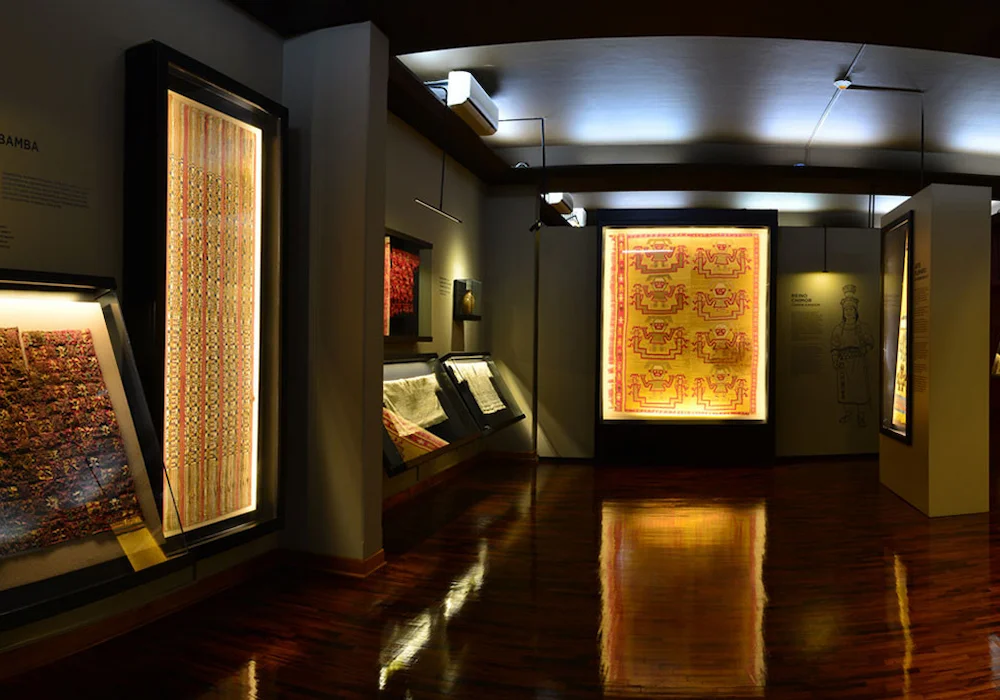
Tucked along a leafy residential avenue in the upscale district of Miraflores, just minutes from Óvalo Gutiérrez and the coastal boardwalks, lies one of the most exquisite and internationally celebrated cultural treasures in Peru: the Amano Pre-Columbian Textile Museum. Established in 1964 by the visionary Japanese industrialist, archaeologist, and philanthropist Yoshitaro Amano, this boutique museum was purpose-built to rescue, preserve, and illuminate the extraordinary heights of ancient Andean fiber arts. Across its climate-controlled galleries unfolds a breathtaking chronological journey spanning over two millennia of loom mastery: from vibrant Paracas embroidered necro-mantles and dense Wari geometric tapestries to ethereal openwork gauzes and funerary dolls of the Chancay culture, all anchored by its world-renowned Drawer Gallery (Sala de Gavetas), where travelers can pull open custom wooden drawers to inspect hundreds of original textile fragments at close range.
01 Yoshitaro Amano & the Foundation of Peru's First Textile Museum
In Lima's vibrant museum scene, where majestic collections of hammered gold and ceramic sculptures usually take center stage, the Amano Pre-Columbian Textile Museum occupies a rare, reverent niche among international textile scholars, fashion designers, and cultural travelers. Its origin story is rooted in the deep devotion of Yoshitaro Amano (1898–1982), a visionary Japanese industrialist and naval engineer who traveled the globe before falling profoundly in love with ancient Andean archaeology.
Settling in Peru following World War II, Amano explored the arid coastal deserts of Chancay, Ancón, and Supe. He was deeply troubled to witness clandestine grave-robbers (huaqueros) indiscriminately tearing open thousand-year-old mummy bundles and discarding delicate tapestries in the sand, seeking only gold or silver figurines to melt down. Recognizing that Andean textiles represented the apex of artistic, mathematical, and technological sophistication in pre-Columbian South America, Amano committed his personal fortune and decades of meticulous fieldwork to salvage, clean, conserve, and scientifically classify these masterworks, establishing Peru's first purpose-built textile research museum in 1964.
Heritage Rescue
Yoshitaro Amano saved thousands of delicate Chancay fabric fragments from destruction, returning them safely to the public domain of Peruvian cultural heritage.
Japanese Preservation Standards
He imported specialized cold-lighting systems, dehumidification technologies, and acid-free archival storage units from Japan to arrest organic fiber decay.
Peru-Japan Cultural Bond
The museum stands as an enduring monument of friendship between Peru and Japan, drawing textile historians, fashion designers, and scholars worldwide.
02 The Masterful Fiber Legacy of the Chancay Culture
While the museum encompasses fiber artifacts spanning twelve pre-Hispanic cultures, the crown jewel of the collection is unquestionably its works from the Chancay Culture (1000 – 1470 CE), an advanced coastal maritime society that flourished immediately north of modern Lima. Chancay weavers attained a degree of virtuosity and delicacy that contemporary textile scholars liken to European haute couture lace.
Among their most famous creations are openwork reticulated gauzes—gossamer-thin head veils spun from ultra-fine native coastal cotton, where warps and wefts interlock into airy geometric silhouettes of seabirds, fish, and deities. The museum also houses an extraordinary array of Chancay textile dolls: small anthropomorphic figures woven from colorful camelid yarns around reed cores, placed inside burial bundles as comforting spirit companions for the afterlife journey.
The Alchemy of Ancient Andean Dyes
The luminous colors shining across these textiles after eight centuries originate exclusively from natural botanicals and insects: intense scarlet from the cochineal cactus parasite, midnight blue from wild indigo, radiant golden yellows from molle berries and chilca leaves, and earthy chocolates from walnut bark, permanently fixed with mineral mordants.
03 The Legendary Open Drawer Gallery: A Unique Hands-On Museum Experience
The unforgettable climax of an Amano visit is entering the world-famous Open Drawer Gallery (Sala de Gavetas). Designed personally by Yoshitaro Amano as an active research sanctuary rather than a passive viewing hall, this space completely redefines museum engagement.
Under the gentle guidance of museum docents, visitors enter a room surrounded by over 460 custom-built mahogany pull-out drawers topped with crystal-clear tempered glass. Each drawer contains an expertly mounted collection of original textile swatches, brocades, woven belts, and polished bone needles. Sliding open a drawer brings you just inches away from the microscopic thread counts, intricate knotting structures, and dazzling dye work produced on pre-Columbian backstrap looms.
A Pilgrimage Site for Fashion Designers
Design teams from fashion powerhouses including Chanel, Hermès, and Issey Miyake regularly visit the Amano Drawer Gallery for creative inspiration, stunned to find that pre-Columbian coastal weavers pioneered complex three-dimensional weave patterns that modern textile looms can only replicate using specialized computer programming.
04 Andean Fiber Chronology: From Paracas and Wari to the Inca Empire
The museum's permanent galleries guide visitors through an illuminating chronological progression showcasing the evolution of fiber arts across the Central Andes:
Paracas Culture (700 BCE – 200 CE)
World-renowned for polychrome embroidered necropolis mantles sewn in camelid wool, depicting flying shamans, masked trance deities, and ceremonial ritual dancers.
Wari Empire (600 – 1000 CE)
Masters of interlocking tapestry with exceptionally high thread counts. Their imperial military tunics (unkus) showcase geometric abstractions that prefigured 20th-century Cubism.
Inca Empire (1438 – 1532 CE)
Imperial cumbi cloth woven from royal vicuña wool, adorned with heraldic tocapu geometric squares, and knotted string quipus for decimal census data.
05 Comparison Guide: Ancient Weaving Techniques & Civilizations
To deepen your appreciation of the textile treasures displayed throughout the Amano collection, this table synthesizes Peru's primary pre-Columbian weaving traditions:
| Civilization | Historic Period | Primary Fibers | Signature Weaving Technique | Cultural Significance |
|---|---|---|---|---|
|
Landmark Chancay Culture |
1000 – 1470 CE | Brown and white native coastal cotton | Openwork gauzes, tapestries & funerary dolls | Spiritual protection and passage into the afterlife |
| Paracas Culture | 700 BCE – 200 CE | Alpaca, vicuña & cotton base | Polychrome stem-stitch embroidery | Shamanic cosmological transformation |
| Wari Empire | 600 – 1000 CE | Cochineal & indigo-dyed alpaca | Ultra-dense slit and interlocked tapestry | Imperial military rank and administrative identity |
| Chimu Culture | 1100 – 1470 CE | Cotton, wool & Amazonian macaw feathers | Feather-mosaic cloaks & repoussé silver plaques | Aristocratic prestige and royal ocean regalia |
| Inca Empire | 1438 – 1532 CE | Royal vicuña (cumbi) & fine pima cotton | Double-faced tapestry with tocapus & quipus | Sacred state ideology and imperial governance |
06 Visitor Information: Miraflores Location, Hours & 2026 Ticket Prices
The Amano Museum is conveniently situated at Calle Retiro 160, in a quiet residential corner of Miraflores close to Av. Santa Cruz and Av. Angamos Oeste. Here are key visitor details for 2026:
2026 Opening Hours & Ticket Rates
- Opening Days: Tuesday through Sunday from 10:00 AM to 5:00 PM (closed on Mondays).
- International Adults: S/ 40.00.
- Peruvian Residents: S/ 35.00.
- Students & Seniors: S/ 20.00 (with valid ID).
- Children (under 12): Free admission.
- Specialized Guided Tours: Available upon advance reservation in Spanish, English, and Japanese.
The museum features a curated gift boutique offering certified artisan textile reproductions, baby alpaca wraps, and specialized academic publications on Andean archaeology.
07 Pairing Amano Museum with Your Lima Tour Peru Itinerary
Given its prime location in Miraflores, the Amano Museum combines effortlessly with a scenic stroll through Love Park (Parque del Amor), an archaeological visit to the pyramid of Huaca Pucllana, or an evening exploring art galleries in bohemian Barranco.
At Lima Tour Peru, we can incorporate a private guided visit to the Amano Museum into your Colonial & Modern Lima City Tour or build an exclusive design-focused craft circuit tailored to your personal artistic interests.
Miraflores & Amano Textile Museum Tour
Stroll Miraflores ocean parks, visit Huaca Pucllana, and explore Amano's open drawer gallery with private transport.
Half Day · Private DeparturesCustom Archaeology & Textile Circuit
Pair the Larco Museum and the Amano Museum in a seamless full-day exploration of Peru's greatest ancient civilizations.
Custom QuoteFor private bookings or tailored cultural itineraries across Lima, connect directly with our travel specialists through our Contact Us page or via WhatsApp.
Recommended reads: Huaca Pucllana Guide · Larco Museum Guide · Best Museums in Lima Guide.
08 Frequently Asked Questions
Who was Yoshitaro Amano and why did he establish the museum?
Yoshitaro Amano (1898–1982) was a Japanese industrialist and passionate amateur archaeologist who relocated to Peru after World War II. While exploring the Chancay desert coast, he witnessed grave-looters discarding delicate ancient fabrics to plunder gold. Horrified by this destruction, Amano invested his personal fortune to rescue, restore, and scientifically catalog ancient textiles, eventually founding the museum to preserve Peru's fiber heritage.
What is the "Open Drawer Gallery" (Sala de Gavetas) at the Amano Museum?
It is an internationally acclaimed hands-on gallery where textiles are not isolated behind distant glass vitrines, but carefully mounted inside more than 400 pull-out wooden drawers fitted with protective glass tops. Visitors can freely slide out drawers to inspect intricate weave patterns, embroideries, and weaving spindles just inches away.
Why did pre-Columbian textiles survive in such pristine condition in Peru?
The Peruvian Pacific coastal desert is one of the driest environments on Earth. The virtual absence of rainfall combined with the natural salinity of the desert sands created a dehydrated, airtight microclimate that halted bacterial decomposition and mold, preserving delicate cotton and camelid wool fibers with their vivid natural dyes intact for over 2,000 years.
What are the opening hours and admission fees for the Amano Museum in 2026?
The museum is open Tuesday through Sunday from 10:00 AM to 5:00 PM (closed on Mondays). General admission for international adults is S/ 40.00, Peruvian residents S/ 35.00, and students/seniors S/ 20.00.
How do I get to the Amano Museum from Larcomar or Kennedy Park?
The museum is located at Calle Retiro 160 (Miraflores) in a secure, pleasant residential neighborhood. From Kennedy Park, it is a 15-to-20-minute walk or a 5-minute taxi ride up Av. Comandante Espinar. From Larcomar, an app taxi takes approximately 8 to 10 minutes.