


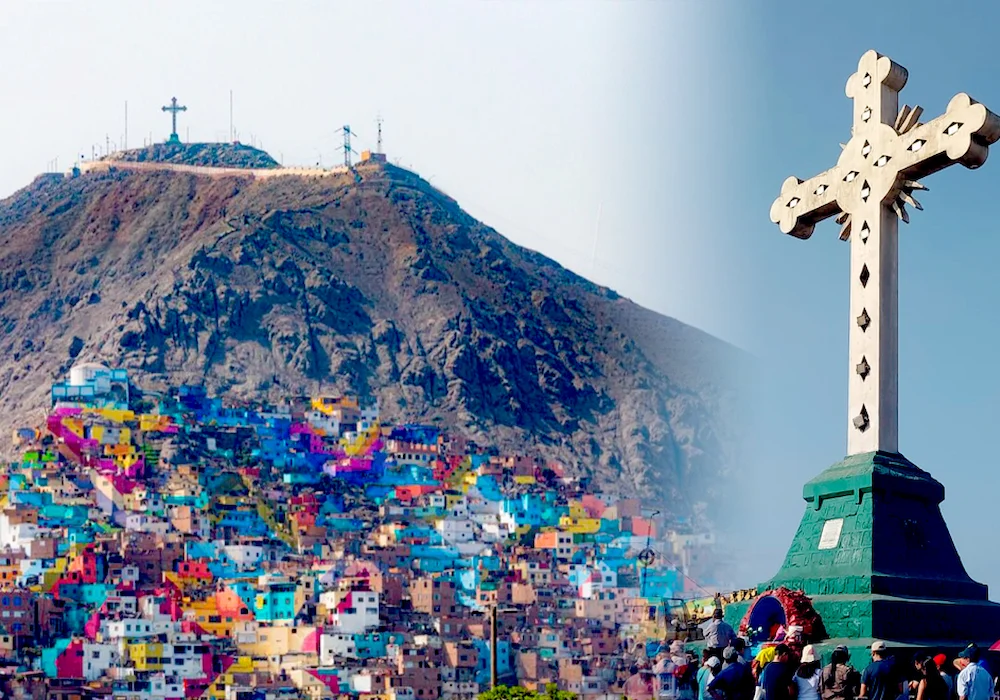
Towering more than 400 meters (1,300 feet) above sea level along the right bank of the Rímac River, Cerro San Cristóbal is the most legendary and commanding natural viewpoint in the Peruvian capital. Revered since pre-Hispanic times as an apu —a sacred guardian mountain protecting the valley— this historic summit bore witness in 1536 to the epic siege of Lima by the Inca armies of Manco Inca against the Spanish conquistadors. Crowned today by its celebrated Monumental Wrought-Iron Cross illuminated each evening, its summit affords an extraordinary 360-degree panoramic vista spanning the UNESCO Historic Center, modern oceanfront high-rises, the Pacific Ocean, and the port of Callao. This definitive travel guide delivers documented history, summit attractions, vital safety advice, and seamless private tour options.
01 History: From Sacred Pre-Hispanic Apu to the 1536 Inca Siege
Long before Spanish vessels appeared along Peru's central coastline, Cerro San Cristóbal was already a venerated sanctuary in the Andean sacred geography. For the ancient civilizations of the Rímac Valley —including the Ichma culture and the curacazgo of Taulichusco— this promontory was revered as an Apu, a guardian mountain deity protecting the surrounding agricultural fields and irrigation canals. From its summit, priests and lookouts monitored river flows, anticipated seasonal floods, and maintained line-of-sight communication with regional temples such as Pachacamac.
In August 1536, the hill became the epicenter of one of the most pivotal military confrontations in South American history: the Siege of Lima. Mobilized by the rebellious Manco Inca, thousands of imperial Inca warriors commanded by general Quizu Yupanqui established their strategic garrison on the slopes of the hill, laying siege to the newly founded Spanish capital. Over six intense days, Andean armies charged down toward the fortified grid defended by Francisco Pizarro and allied Huaylas indigenous contingents.
The Guardian Apu of Rímac
Sacred pre-Hispanic mountain deity presiding over the fertile valley, revered by local cultures as the patron of water and harvests prior to the 16th century.
The Epic 1536 Siege of Lima
Command outpost for Quizu Yupanqui's forces attempting to liberate the capital. His battlefield fall along the river bank determined Spanish viceregal control.
Pizarro's Christian Baptism
Attributing the survival of the city to Saint Christopher, Francisco Pizarro ordered a large wooden cross erected upon the peak and renamed the mountain.
Following the death of General Quizu Yupanqui near the riverbank and the subsequent retreat of the Inca forces, Pizarro attributed the miraculous survival of the city to Saint Christopher (patron saint of travelers), whose feast day coincided with the battle. The conquistador personally decreed that a massive wooden cross be planted on the peak, initiating a centuries-old tradition of pilgrimage.
02 The 1928 Monumental Cross & Its Beacon on Lima's Skyline
Across centuries of viceregal rule and early republic conflicts, the wooden crosses placed on the peak were repeatedly destroyed by lightning, severe tremors, and weathering. The enduring monument that crowns the mountain today is the Monumental Cross of Cerro San Cristóbal, built to serve as an enduring symbol of peace and devotion.
Spearheaded in the 1920s by Franciscan friar Francisco de Aramburú, the monumental project was funded through widespread civic contributions and enthusiastically backed by President Augusto B. Leguía, who officially dedicated the landmark on December 23, 1928.
Wrought-Iron Proportions
Crafted from industrial forged iron girders, the cross stands over 20 meters tall (reaching nearly 22 meters, or 72 feet, including its reinforced concrete and stone pedestal).
Nighttime Illumination
Equipped with 48 high-powered electric lamps that light up automatically at dusk, creating a luminous beacon visible from across metropolitan Lima up to 15 kilometers away.
National Historic Landmark
Recognized as a National Historic Monument of Peru, it ranks among Lima's most beloved urban cultural symbols, often compared to Rio de Janeiro's Christ the Redeemer.
03 The 360° Viewpoint: What You Can See & The Summit Museum
Standing on the summit observation deck at 409 meters above sea level offers one of the most breathtaking geographic vistas in South America. The view captures in a single sweep the dynamic interplay between viceregal colonial history, contemporary urban sprawl, and the open expanse of the Pacific Ocean.
From the safety railings, visitors can admire key architectural and geographical landmarks:
Historic Center & Plaza Mayor
The iconic colonial grid, the neoclassical twin towers of the Lima Cathedral, Government Palace, and San Francisco Monastery.
Historic Rímac District Below
Directly beneath the slopes lies the Plaza de Acho (America's oldest bullring, dating to 1766), the Alameda de los Descalzos, and the historic Barefoot Friars Monastery.
San Isidro & Miraflores Skylines
To the south rise the modern high-rise clusters of San Isidro financial center and the upscale cliffside towers of Miraflores bordering the Pacific shore.
Port of Callao & San Lorenzo Island
To the west unfolds the maritime bay of Callao, where container vessels anchor against the massive volcanic silhouette of San Lorenzo Island.
The summit also houses the Cerro San Cristóbal Site Museum, a charming historical archive displaying vintage 19th-century photography of Lima, colonial city maps, pre-Inca pottery artifacts excavated on the hillside, and architectural chronicles.
04 How to Reach the Summit: Transportation, Safety & Travel Advice
Visiting Cerro San Cristóbal requires realistic and informed travel planning. The lower hillsides comprise dense residential communities in Rímac with labyrinthine staircases that are not configured for standard unescorted pedestrian tourism.
Do not attempt to walk up the hill on foot independently, nor take unregistered street taxis. Walking alone or in small unguided groups through the lower stairway neighborhoods exposes travelers to opportunistic theft. The observation summit itself has round-the-clock tourist police presence, but the ascent should strictly be undertaken via authorized tourist transportation.
Traditional open-top or panoramic minibuses depart periodically from near the Main Square (Jr. Carabaya) and Alameda Chabuca Granda, providing a round-trip circuit with 20 to 30 minutes at the summit.
The safest, most relaxing and personalized choice for international travelers. Features door-to-door hotel pickup in Miraflores or San Isidro, air-conditioned van, licensed guide, and flexible pacing.
Midday to early afternoon (11:00 AM to 3:30 PM) delivers peak clarity. During coastal summer months (January through March), clear blue skies ensure sharp panoramas stretching all the way to the ocean.
Sunglasses, a wide-brim hat or cap, UV sunscreen, a fully charged camera, and a light windbreaker jacket, as breezes at the 400-meter peak can be brisk even on sunny afternoons.
05 Holy Week Pilgrimage Tradition & The 2026 Cable Car Project
Beyond its scenic vistas, Cerro San Cristóbal is the beating heart of Lima's most deeply rooted religious folklore. Every year during Holy Week (particularly Maundy Thursday and Good Friday), tens of thousands of devout pilgrims from across Peru ascend the winding hillside on foot, praying at the fourteen Stations of the Cross.
For decades, this massive devotion has been led by prominent folk actor Mario Valencia, affectionately celebrated as the «Cristo Cholo», who along with his theater company reenacts Christ's Passion, carrying a heavy timber cross up the mountain in a spectacle broadcast across international media.
To dramatically elevate visitor safety and accessibility, Peru's Ministry of Foreign Trade and Tourism (MINCETUR) together with ProInversión are advancing the landmark Lima Urban Cable Car (Teleférico) project. This state-of-the-art aerial gondola system will link the Alameda Chabuca Granda and Club Revólver in Rímac directly with the summit in an effortless 6-minute scenic ride, delivering sustainable, world-class tourism access.
06 How to Experience Cerro San Cristóbal with Lima Tour Peru
At Lima Tour Peru, part of the RAP Travel Peru group (RUC 20490005022, certified by MINCETUR and PROMPERU), we connect Lima's finest viewpoints with immersive cultural itineraries tailored to your schedule:
Colonial & Modern Lima City Tour
Guided exploration of the UNESCO Historic Center, Plaza Mayor, and San Francisco Catacombs, paired with Miraflores coastal boardwalks.
From US$ 35 per personColonial City Tour + Gourmet Lunch
Pair historical discovery with a complete multi-course Peruvian culinary feast at Casa Tambo, Mangos, or Café Museo Larco.
From US$ 65 per personMagic Water Circuit Night Tour
Experience Lima by night with the Guinness World Record 13 illuminated interactive fountains and laser mapping show.
From US$ 28 per personPachacamac Sanctuary & Barranco
Discover the pre-Inca seaside temple of the coastal earthquake deity paired with bohemian Barranco cliffside vistas.
From US$ 45 per personAll private tours include licensed drivers, comfortable climate-controlled vehicles, certified official bilingual guides, and 24/7 dedicated assistance. Contact our travel specialists through our Contact Us page.
Recommended reading from our guide series: Historic Center of Lima Travel Guide · Lima Cathedral & Pizarro's Crypt · Magic Water Circuit Complete Guide · Bridge of Sighs in Barranco: History & Legend.
07 Frequently Asked Questions about Cerro San Cristóbal
Where is Cerro San Cristóbal located and how high is it?
It is located in the historic Rímac district, immediately north of downtown Lima across the Rímac River. The summit rises 409 meters (1,342 feet) above sea level and stands approximately 280 meters above the valley floor, making it the highest natural observation point overlooking central Lima.
Is it safe for tourists to walk up Cerro San Cristóbal independently?
Walking up the hill independently is strictly not recommended for tourists. The lower slopes traverse densely populated neighborhoods with steep, maze-like stairways where solo visitors face serious safety risks. The only safe way to visit is by motorized tourist transportation, either via authorized scenic minibuses or a private guided tour with private driver.
What is the origin of the hill's name and the Monumental Cross?
The name dates to 1536, when Francisco Pizarro credited Saint Christopher with saving the nascent city during the Inca siege led by general Quizu Yupanqui, placing a wooden cross on the peak. The present 20-meter-tall wrought-iron Monumental Cross was initiated by Franciscan friar Francisco de Aramburú and inaugurated in 1928 by President Augusto B. Leguía, equipped with electric illumination visible across Lima.
What can you see from the Cerro San Cristóbal viewpoint?
On clear days (particularly during coastal summer months from December through April), the summit delivers an uninterrupted 360-degree vista: the colonial grid of the Historic Center, Plaza Mayor, Acho Bullring, the skyscrapers of San Isidro and Miraflores, the Pacific Ocean coastline, San Lorenzo Island, and Callao maritime harbor.
When will the Cerro San Cristóbal Cable Car project be completed?
The Historic Center - Cerro San Cristóbal Cable Car (Teleférico) is a major public infrastructure project promoted by MINCETUR and ProInversión. It is planned to link the Alameda Chabuca Granda and Club Revólver in Rímac with the summit in an effortless 6-minute scenic ride, providing modern, secure, and world-class aerial access for travelers.