

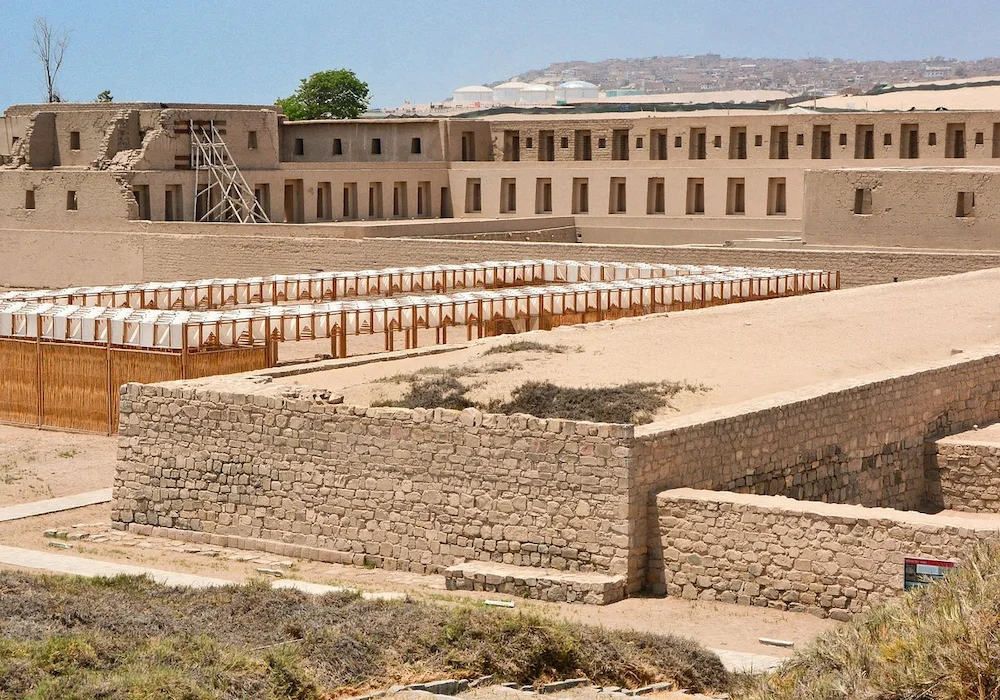
For more than fifteen centuries before the arrival of Spanish conquerors, lords and priests from across the Andes journeyed to the Lurín Valley to consult the revered oracle of Pachacamac, the creator divinity believed to control seismic tremors. This vast 460-hectare mud-brick complex preserves tiered pyramids, ceremonial sanctuaries, and an award-winning site museum.
01 The Great Oracle of the Andes: Millenary History of Pachacamac
Pachacamac Archaeological Sanctuary was the most influential ceremonial and spiritual center on the central Andean coast for over fifteen centuries. Unlike short-lived settlements, Pachacamac experienced continuous human occupation across four successive cultural horizons: the Lima Culture (200-650 CE), the Wari Empire (650-1000 CE), the Ychsma Lordship (1000-1470 CE), and the Inca Empire (1470-1533 CE).
The divinity Pachacamac ("he who animates the world" or "maker of the earth" in Quechua) was revered with awe due to his power over earthquakes. When the Incas incorporated the coast into their empire, they respected the sanctuary prestige and erected a monumental Temple of the Sun and an Acllahuasi convent for the Sun Virgins at its summit.
Pan-Andean Pilgrimage Hub & Qhapaq Ñan
The sanctuary constituted a crucial nexus on the Great Inca Road system (Qhapaq Ñan). Thousands of pilgrims journeyed from distant Andean valleys across modern Ecuador, Bolivia, and coastal valleys, observing strict fasting rituals to consult the oracle before undertaking agricultural cycles or political wars.
To experience this sacred heritage, the Pachacamac & Barranco Tour seamlessly connects coastal pre-Columbian archaeology with southern Lima bohemian and colonial quarters.
02 Main Monuments: Temple of the Sun, Painted Temple, and Pyramids
The sanctuary encompasses more than forty mud-brick pyramids and shrines. During the visit, three principal monumental sectors stand out for architectural and symbolic mastery:
Inca Temple of the Sun
Built atop a natural coastal promontory using millions of red-painted adobe bricks. Its upper terrace commands a panorama of the Pacific shoreline and the Cavillaca islands, forming the largest Inca temple on the Peruvian coast.
Painted Temple (Wari - Ychsma)
Tiered structure that preserved traces of polychrome fresco murals in yellow and red mineral pigments, depicting marine fish, coastal birds, and sacred maize ears.
Ramp Pyramids
Fifteen administrative and religious compounds erected by the Ychsma lordship, serving as residential embassies and collection hubs for tribute from surrounding coastal valleys.
03 The Acllahuasi and Pachacamac Site Museum
The lower sanctuary sector houses royal Inca residential architecture and modern museum facilities:
The Acllahuasi (Mamacona)
Sanctuary of the Chosen Women: Splendid Inca residential compound featuring wide open courtyards, trapezoidal niches, and underground irrigation canals. High-ranking women wove sacred textiles (cumbi) and prepared ceremonial maize chicha here.
Arturo Jiménez Borja Site Museum
Contemporary Museographic Center: Opened in 2016, the museum displays an exceptional archaeological collection featuring intact funerary bundles, carved idols, and detailed exhibits deciphering the complex architectural timeline.
Carved Wooden Idol of Pachacamac
The Oracular Deity: A sacred post carved from carob wood discovered in 1938 by Alberto Giesecke. Featuring double-faced anthropomorphic and zoomorphic relief carvings, it stands as the sole preserved coastal oracle idol in Peru.
For a traditional afternoon in the same valley, consult our guide on the Peruvian Paso Horse Show in Lurín.
04 Comparison of the Archaeological Circuit of Pachacamac
Review the historical timelines and religious functions among the three primary monumental complexes:
| Monumental Sector | Historical Period | Construction Material | Ceremonial Function |
|---|---|---|---|
|
Temple of the Sun Monumental Summit |
Late Horizon (Inca, 1470 CE) | Rectangular red adobe & carved stone | State solar worship & astronomical observation |
| Acllahuasi (Mamacona) | Late Horizon (Inca) | Adobe with trapezoidal niches | Residence of the Sun Virgins & textile workshop |
| Painted Temple | Middle Horizon (Wari - Ychsma) | Polychrome plastered adobe | Oracular shrine & chamber of the wooden idol |
05 Opening Hours, Fares, and Practical Visiting Tips
To enjoy an enriching tour under coastal desert conditions, follow these practical field recommendations:
The sanctuary and museum welcome visitors Tuesday through Sunday from 9:00 AM to 4:00 PM. The first Sunday of each month experiences higher attendance due to national citizen free-entry policies.
Set across an open desert plain with minimal shade, wide-brim hats, UV-blocking sunglasses, SPF 50+ sunscreen, and refillable water bottles are essential gear.
Given the site vast scale and subtle mud-brick contours, touring with a licensed expert brings the millennia-old ritual history vividly to life.
06 Frequently Asked Questions about Pachacamac Sanctuary
How long does a complete visit to Pachacamac Sanctuary take?
A standard guided tour through the vehicle and pedestrian circuit takes between two and two-and-a-half hours, plus an additional 45 minutes to explore the Site Museum galleries.
Can visitors hike to the top of the Temple of the Sun?
Yes, the designated path permits ascending a protected ramp up to the upper platform of the Temple of the Sun, which reveals sweeping views of the Pacific Ocean and Pachacamac Islands.
Is Pachacamac Sanctuary accessible for travelers with reduced mobility?
The Site Museum features universal ramp accessibility. The vast outdoor circuit is navigated primarily by tour vehicle with drop-offs at accessible observation decks.
Is the entire Pachacamac Sanctuary tour done on foot?
No. Because the site encompasses over 460 hectares, travel between distant sectors (such as the Temple of the Sun and the Acllahuasi) is done by tour vehicle, followed by short walks along designated pedestrian trails.
Can exclusive private tours be booked for families or couples?
Yes, Lima Tour Peru provides private tour departures with dedicated bilingual official guides and exclusive vehicles, allowing flexible pickup times and a customized walking pace suited to your party.