

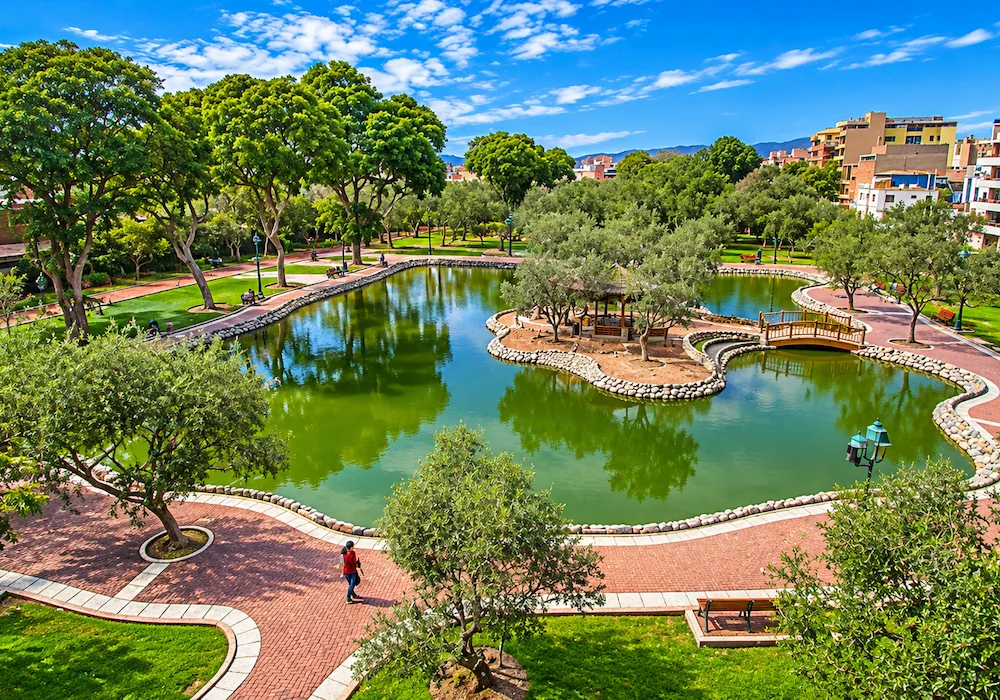
Amidst Lima's most exclusive financial and residential district lies a verdant oasis of extraordinary botanical and historical heritage: El Olivar Park in San Isidro. Declared a National Monument in 1959, this enchanting urban forest houses over 1,600 olive trees, with its earliest specimens planted during the mid-17th century. Strolling beneath gnarled, twisting trunks, spotting diverse coastal bird species along stone walkways, and admiring republican-style manors offer one of the most serene and culturally rewarding escapes in Peru's bustling capital.
01 Origin and History: The 17th-Century Colonial Olive Trees
El Olivar Park is far from an ordinary municipal garden; it stands as a living botanical monument of Lima's colonial era. Its origins date back to 1637, when General Attorney and Cavalry Captain Antonio de Rivera brought twenty olive saplings (Olea europaea) from Seville, Spain, with the goal of acclimating them to the fertile valley of the Rimac River. Although the perilous transoceanic journey claimed almost all the cargo, only three saplings survived and were lovingly planted in what was then the Conde de San Isidro agricultural estate.
Limeño oral tradition attributes to Saint Martin de Porres, the beloved Dominican friar, having personally blessed and tended the initial shoots, miraculously multiplying the trees across the surrounding fields. By the end of the 18th century, the olive grove boasted more than 3,000 thriving trees, supplying olive oil and table olives throughout the Viceroyalty of Peru and exporting to neighboring colonies.
National Monument & Protected Heritage
During the Wars of Independence and subsequent 19th-century conflicts, many trees were felled. However, in 1959 the Peruvian Government officially proclaimed El Olivar of San Isidro a National Historic Monument under Supreme Resolution No. 577, safeguarding each tree and solidifying its status as an untouchable ecological haven against modern real estate expansion.
Today, the park shelters over 1,600 mature olive trees across nearly ten hectares, framed by elegant diplomatic residences, ancestral mansions, and foreign embassies that recall Lima's stately 20th-century character.
02 Heritage Trees and Biodiversity: Urban Birdwatching Species
El Olivar serves as a protected biological island within Lima's metropolitan core. Thanks to its lush foliage and cooler microclimate, over 30 species of resident and migratory wild birds find nourishment, refuge, and safe nesting grounds here:
Creole Olive Tree (Olea europaea)
Living Antiquity: Ancient specimens over 300 to 350 years old distinguished by thick, knotty, sculptural trunks with hollow crevices housing pollinating insects and birds.
Vermilion Flycatcher (Pyrocephalus obscurus)
Emblematic Songbird: Instantly recognizable by the brilliant scarlet plumage of the males. Commonly seen perching on lower boughs and darting swiftly to catch insects mid-air.
House Wren & Harris's Hawk
Acoustic Fauna: Small, spirited wrens with melodious calls that forage along the bark, while magnificent Harris's hawks soar above the canopy as natural ecosystem regulators.
Amazilia Hummingbird (Amazilis amazilia)
Native Pollinators: Frequent visitors to the flowerbeds surrounding the park, noted for their iridescent emerald and bronze flashes as they hover gracefully in the morning sun.
For birdwatching and photography enthusiasts, early mornings (between 07:00 and 09:30 AM) present the highest avian activity and sweetest bird songs across the park.
03 Cultural Highlights: Cultural Center, Museum, and Pond
Beyond its botanical wealth, El Olivar hosts key cultural and artistic venues managed by the San Isidro Municipality, accessible to the public:
Casa de la Cultura & Municipal Library
Set within a restored colonial estate facing the park, offering comfortable reading halls, seasonal art galleries, and historic literature about Lima and San Isidro.
Scenic Pond & Wooden Pergola
A peaceful central water feature home to colorful carp, framed by shaded wooden pergolas where travelers and families unwind in a picturesque setting.
Marina Núñez del Prado Museum
The former home and studio of celebrated sculptress Marina Núñez del Prado, showcasing masterpieces crafted from native Andean stone, bronze, and hardwood.
Just a ten-minute walk or brief drive from the park lies Huaca Huallamarca, a restored pre-Inca adobe pyramid that perfectly complements this cultural circuit.
04 Photography, Relaxation, and Urban Walks in San Isidro
The gentle tempo of El Olivar contrasts sharply with busy urban arteries like Javier Prado or Camino Real. Along its safe and spotless walkways, visitors wander among twisted trunks that resemble natural sculptures molded by centuries.
Tips for Photography Sessions
Filtered sunlight streaming through silvery olive foliage provides ideal illumination for portraits, street photography, and macro nature shots. Peak light occurs during early morning and late afternoon (between 15:30 and 17:30 PM). Commercial or film crews require municipal permits; personal and recreational mobile photography is completely free.
05 Dining and Specialty Coffee Shops Around the Park
The perimeter of San Isidro encircling El Olivar boasts a refined dining scene where specialty coffee roasters featuring beans from Cusco and Cajamarca meet cozy European-style bistros and acclaimed Peruvian dining spots:
- Specialty Cafes: Charming leafy sidewalk terraces serving artisan brew methods (V60, Chemex, Aeropress) paired with traditional pastries and Andean fruit cakes.
- Gourmet Bistros & Light Fare: Along Conquistadores and Emilio Cavenecia avenues, popular bistros serve organic salads dressed with extra-virgin olive oil, handmade pasta, and artisan Peruvian cheeses.
- Fine Peruvian Dining: Award-winning establishments serving fresh coastal ceviche, tender wok-seared lomo saltado, and delicate causa limeña in restored residential homes.
06 Practical Guide 2026: How to Get There, Hours, and Rules
Plan your visit to El Olivar Park with these up-to-date practical logistics for 2026:
San Isidro district, bordered by Camino Real, Paz Soldán, and Santa Cruz Avenues. Easily reached by taxi or a 15-minute scenic walk from Miraflores' Ovalo Gutiérrez.
Open 24/7 as a public municipal park with free admission year-round. We recommend visiting between 07:00 AM and 18:30 PM to enjoy daylight and blooming gardens.
One of Lima's safest and most thoroughly patrolled sectors, with continuous municipal Serenazgo presence and high-definition security cameras.
Climbing historical trees, breaking branches, or picking olives from the canopy is strictly prohibited. Please remain on paved pedestrian stone pathways at all times.
07 Discover San Isidro and Lima with Lima Tour Peru
Pairing the serene beauty of El Olivar with viceregal architecture in Downtown Lima and the clifftop parks of Miraflores offers the ultimate overview of Peru's vibrant capital. Our Colonial & Modern Lima City Tour features private air-conditioned transit, certified professional guides, and tailored stops at all major sights.
08 Frequently Asked Questions about El Olivar Park
How much does admission to El Olivar Park cost?
Admission to El Olivar Park is completely free of charge all year round, as it is a public green space maintained by the Municipality of San Isidro.
How old are the oldest olive trees in the park?
The oldest preserved olive trees were planted in the mid-17th century (circa 1637), making them over 380 years old.
Is it safe to visit El Olivar with family or in the evening?
Yes, it is one of the safest and quietest neighborhoods in metropolitan Lima, backed by around-the-clock district security patrol and proper night illumination.
Can I walk to El Olivar Park from Miraflores?
Yes, from Ovalo Gutierrez in northern Miraflores, you can reach El Olivar in about 12 to 15 minutes along pleasant, safe residential sidewalks.
What bird species can be observed in the park?
Over 30 urban bird species have been recorded, including vermilion flycatchers, Amazilia hummingbirds, Harris's hawks, house wrens, and saffron finches.